Xiaotian Sun (2022). The smell of the scene - Mapping the digital smell of scenes around Beijing. In: Affective and Pleasurable Design. AHFE Open Access, vol. 41, pp. 30–36. https://doi.org/10.54941/ahfe1001777
Smell is an sensation underrated in our life.In the culture dominated by vision, it is common to try to hide and deny the true smell of things.But smell may be the strongest and most interesting sensations humans possess: it is primitive, instinctive, sensual, and uncontrollable. We are surrounded by smells, they process through the air, and we cannot avoid perceiving them.We perceive the quality of things through smell, and we get thousands of messages from a large number of small particles that reach our nostrils . It communicates with people directly and exchanges information.Smell can reach the marginal regions of the brain before we feel any other sensory stimuli, because this is the most primitive part of human experience related to the strongest emotions.In order to explore digital smell,I designed a “scentgraphy” in my previous work, and establishing the relationship between color and smell is my main job.In this paper,I'll started to establish the relationship between the smell and scene to make the digital smell more accurate.and it is expected in the next research that the relationship between smell and scene will be applied the scentgraphy4.0 based on computer vision recognition .Therefore, my research aim in this article is to use common scene in our everyday life or the nature to map with their corresponding smell. However, due to the different geographical and cultural gap, the smell of the same scene may appear different, because this study will be studied that be selected in different scene of a city.In this paper, my research aims to use the common scene in our everyday life or the nature to map with their corresponding smell in order to establish the relationship between scene and smell. In the research process, take Beijing as an example, and record the smell of 6 kinds of outdoor scenes through on-site perception and photography. The research result will be applied in digital olfactory project related with computer vision recognition.In order to explore the digitization of smell, this paper will explore representative smell from the same kind of scene.By drawing on DrKate McLean's Smell Map method, which was used to study and design urban smell scenes, the participants were able to discover the unique odor from the urban environment. The common scenes in daily life or nature are mapped to their corresponding scents, while this paper focuses on finding the most common scents in the same type of scenes.Participants selected a scene to take pictures feel and analyze the smell of the scene(the smell was divided into different experience values of 1-5),and finally record the time, place and noise value(the noise was also divided into experience values of different values of 1-5).When collecting the questionnaire ,we will Qualitative analysis and quantitative analysis these subjective data to get the unique smell scene in each scene of Beijing. The result are used as the basis for the subsequent smell calculation model and smell database.Due to the differences between regions and cultures, different smell may appear in the same scene, because I chose different scenes(and representative scenes)in Beijing for this study. Finally, the data collected during the experiment were used to explore the connection between scene and smell.The whole experiment was divided into four parts.The experiment started on the internet. Volunteers collect data, recover and process data, analyze and summarize data.
Smell is an sensation underrated in our life. In the culture dominated by vision, it is common to try to hide and deny the true smell of things. But smell may be the strongest and most interesting sensations humans possess: it is primitive, instinctive, sensual, and uncontrollable. We are surrounded by smells, they process through the air, and we cannot avoid perceiving them. We perceive the quality of things through smell, and we get thousands of messages from a large number of small particles that reach our nostrils. It communicates with people directly and exchanges information. Smell can reach the marginal regions of the brain before we feel any other sensory sti- muli, because this is the most primitive part of human experience related to the strongest emotions (LeDoux, 1998).
In order to explore digital smell, I designed a “scentgraphy” (Sun and Tomimatsu, 2018) in my previous work, and establishing the relationship between color and smell is my main job. In this paper, I’ll started to establish the relationship between the smell and scene to make the digital smell more accurate. and it is expected in the next research that the relationship betw- een smell and scene will be applied the scentgraphy 4.0 based on computer vision recognition. Therefore, my research aim in this article is to use com- mon scene in our everyday life or the nature to map with their corresponding smell. However, due to the different geographical and cultural gap, the smell of the same scene may appear different, because this study will be studied that be selected in different scene of a city.
The Smell of the Scene – Mapping the Digital Smell of Scene Around Beijing 31
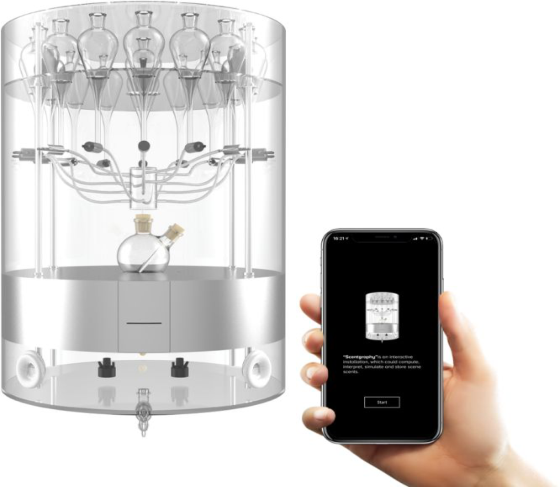
Figure 1: Scentgraphy.
SCENTGRAPHY “Scentgraphy” is an interactive installation, which could compute, interpret, simulate and store smell behind scenes. It acts like an original camera or gramophone to capture and save pictorial memories. Not only does it enrich the interactive experiences, but also it establishes a closer relationship with the combination of smell, vision and emotion. Meanwhile, Scentgraphy also provide an interesting interaction conducive for immersive experience of bre- athing aromatherapy. New experiences are explored in this project, including the senses, sensory boundaries, storing and reproducing of the sense of smell. Based on ancient perfumery techniques, a closer bond is developed between memory and sense of smell. A way for computing, simulation, and tele- communication of smell is explored by Scentgraphy project by visual and olfactory conversion. This is a preliminary exploration on olfactory infor- mationization, and this research ensures that the feasibility of converting visual, olfactory and digital odors can be spread and applied in media and information technology.
Related Work
Drobnick, a historian of sensory art and curator of olfactory art, put forw- ard the “Toposmia (location+smell)” method to study the spatial location of smell and its relationship with the concept of a specific place (Drobnick, nd). He believed that through the combination of vision and smell, the smell in vision is temporarily transformed into vision, thus repositioning the senses and perception of the city. In the eye-centered Western world, attentioning
32 Sun
to everyday smell can be both refreshing and uplifting, which can eventu- ally lead to relationships among our individuals. Kate McLean has come up with a method for studying and designing urban smell scene—Smell map, which can be recorded, presented and visualized by urban designers, archi- tects, archaeologists, designers and art event organizers. It is a multi-sensual and participatory experience for the audience to present the urban landscape of smell through the olfactory journey (Smellmap, nd). Urban smell landscape provides the basis for people’s sensory experience of urban environment. This project studies the perceptual role of smell in British towns and cities, empha- sizes the connection between urban smell landscape and place perception, and describes the contribution of smell to the overall sense of places. Through the studies of factories, breweries, urban parks and experimental smell environ- ments in Manchester and Glasgow, the process of managing and controlling the urban odor environment is determined, and tools are provided for desi- gners and urban planners (Urban Smellscapes,nd). Amy Radcliffe, a graduate of the Central St Martin in London, designed a bell-jar-like “smell camera”to record the smell of objects placed in a glass dome by using head space capture technology (developed in the 1970s by The Swisschemist Roman Kaiser). It gives us a way to record the chemical information of an smell, so we’re able to synthesize it without damaging the original smell,” said AmyRadcliffe. The scent to be captured is exposed to an smell trap that absorbs all the volatile smell molecules (Chen, 2016).
Methods
Cities can be seen and heard, but the most important thing is that we smell the city. Smell has a unique quality: it is ubiquitous, lasting and has an unpa- ralleled connection with memory, but it has been ignored in the discussion of sensory design-what smell shaped the city? (Urban Smellscapes, nd). In order to explore the digitization of smell, this paper will explore represen- tative smell from the same kind of scene. By drawing on Dr Kate McLean’s Smell Map method, which was used to study and design urban smell sce- nes, the participants were able to discover the unique odor from the urban environment. The common scenes in daily life or nature are mapped to their corresponding scents, while this paper focuses on finding the most common scents in the same type of scenes. Due to the differences between regions and cultures, different smell may appear in the same scene, because I chose dif- ferent scenes (and representative scenes) in Beijing for this study. Finally, the data collected during the experiment were used to explore the connection between scene and smell. The whole experiment was divided into four parts. The experiment started on the internet. Volunteers collect data, recover and process data, analyze and summarize data.
Participants selected a scene to take pictures feel and analyze the smell of the scene (the smell was divided into different experience values of 1–5), and finally record the time, place and noise value (the noise was also divided into experience values of different values of 1–5). When collecting the question- naire, we will Qualitative analysis and quantitative analysis these subjective data to get the unique smell scene in each scene of Beijing. The result are used
The Smell of the Scene – Mapping the Digital Smell of Scene Around Beijing 33
as the basis for the subsequent smell calculation model and smell database. In December 2019, I made the first smell record, and from January to December 2020, the remaining 42 people collected more than 60 smell reports. Volunte- ers aged 20–40 participated in the experiment, and they spontaneously went to certain types of outdoor scenes, including different times(different tempe- ratures),different types of locations, and so on. Data collection was carried out in three steps:
1. Take photos; 2. Sniff; 3. Fill in the scene and smell scale from the given base smell selection and submit.
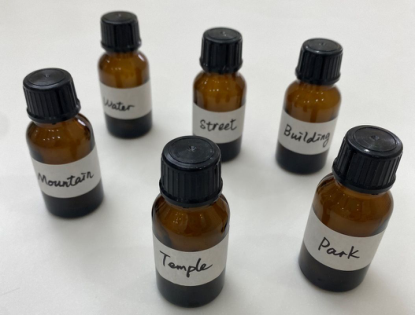
To narrow and refine the research, we provided participants with 6 scenes (building street, park, mountain, temple, water) and 27 common and easily recognizable smells in daily life for quick selection. Participants recorded their smell of the scene they had chosen in the form of on-site perception and pho- tography. Participants used three stages of sniffing (McLean, 2012): initial sniffing, auxiliary sniffing, pause, and third sniffing to collect smell data and confirm.
In the process of scene perception, in addition to the option of olfactory, the quantified olfactory information and other sensual information are also provided as auxiliary judgments, for example, smell experience value is quan- tified (1. Close to experience, it is almost tasteless, you need to recognize it. 2. Close to smell carefully, you will smell lightly 3. Close to smell you will have relatively strong smell 4. You can smell and recognize closely 5. Smell and recognize it from a distance); As well as the numerical intensity of noise sounds (1 is silent 2 is simple communication sound in the ear; 3 is normal indoor or outdoor speech; 4 is that you can listen relatively correctly from a distance; 5 is noisy. At the same time, participants also need to mark the shooting time and specific location. This paper will analyze these subjective data and select a group of scents to map each scene.
Finding The whole experiment was difficult. At first, the perception of the faint smell was very weak, but gradually, we took pictures and sniffed out every part of the scene carefully. Therefore, in a series of scenes, participants found the unique oder from the related scenes in the city. In the process of sniffing smell selection, we provide participants with the smell of data base reference, the smell of the data base is built on scentgraphy with color based on the smell of more options, including: cream, vanilla, powder, soap, mint, seawater, cold air, smoke, ink, medicine, soil, bread, wood, sandalwood, leather, choco- late, coffee, grass, moss, lavender, flowers, leaves, pepper, chilli, fruit, lemon, orange and so on.
Through the collected data, we can find that: the scene near the park, we will experience the faint smell of soil, trees and grass; You can feel as light mossy smell near the water; Scenes of streets and buildings are usually taste- less, but they are associated with noise. The more noise there is, the more
34 Sun
Figure 2: Process of experiment.
smoke there is. But in some of the architectural scenes, occasionally there will be a small amount of food smell, such as stir-fry, bread or coffee; the scene associated with the temple is usually accompanied by unique sandalwood, but it is also associated with noise. The louder the noisy, the stronger the sense of smoke, there will be different cold air feeling affected by the season or sunshine in the same scene in different times. We averaged the smell expe- rience values corresponding to each scene (The images shot by volunteer) to reach the following conclusions: Building: Smoke1.3, Tree1.8, Bread 1.5 Street: Smoke1.4, Tree 1.75 Temple: Smoke 3, Tree 1.8, Sandalwood 3, Soil 1.5 Park: Tree 2, Grass 1.7, Soil 2, Moss 2, Floral 3.6 Mountain: Tree 1.6, Grass 1.5, Soil 2.2 Water:Tree 1, Soil 1, Moss 1.6
User Study Through the “scent of the scene” data of the smell walk result, we produ- ced the corresponding scent through Scentgraphy, and selected volunteers to perform the matching test between the scent and the scene. The entire experimental procedure has been recorded by video, and we also organize interviews after the test. During the interview, we asked them about their impressions of this research and the value of scent informatization. In addi- tion test data and interview content will be used in the experiment. Finally we will organize and evaluate the collected questionnaires.
The main content of the experiment is volunteers choose 6 kinds of odors on the odor test paper corresponding scenes, to test the feasibility of the pre- vious step data. 20 volunteers aged 22 - 35 participated in the experiment. After each volunteer received a brief introduction, for a 10 minutes test, we instruct each Volunteers to fill out a questionnaire and experience the scent. After identifying the odor on the test paper, the volunteers were asked to number the odors in the questionnaire corresponding to the scene. In between experiencing each scent, volunteers are required to smell the coffee beans to
The Smell of the Scene – Mapping the Digital Smell of Scene Around Beijing 35
remove the previous smell. After the test, each volunteer was interviewed for five minutes and videotaped. Based on the accuracy of volunteer judgments, we can demonstrate the feasibility of scents in the scene.
The test results show that among the 120 answers provided by 20 people, 67 answers can correctly identify the smell of the scene, accounting for 55%. The accuracy of the Building scene is 40%, The accuracy of the Street scene is 25%, The accuracy of the Temple scene is 95%, The accuracy of the Park scene is 80%, The accuracy of the Mountain scene is 55%, and The accuracy of Water scene is 40%. During interviews, volunteers said they found the test very interesting and agreed with the significance of our research. However, we also had some conclusions through interviews. The smells of street and building are similar in composition, so it is more difficult to identify them. And temple and park scene have their signature sandalwood and floral scents to make volunteers more recognizable. The difference between mountain and street, building is that there is no smell of smoke. And the smell of water is relatively light, which is not particularly conducive to identification. But in general, more than half of the volunteers can recognize different scenes by feeling the smell, it can even generate associations to the scene. Therefore, it is feasible to pass our conclusions. Volunteers can identify the smell of different scenes. Volunteers said they had not been addicted to smell before, but through experiments they found that smell is indeed the missing part of our information age.
CONCLUSION
In the past few years, there are great development in the study of the rela- tionship between human senses and social space. Traditionally, smell has been considered one of the weaker human senses and is often overlooked. Victoria Henshaw points out in Her book Urban Smell Land scapes that the relationship between smell and society has changed: in the past, cities and landscapes were largely perceived and shaped by modern vision. The audio-visual advantage determines the practice of architects in urban design and planning. But in the post-modern era, smell is becoming more and more important (Henshaw, 2013).
In this paper, in order to establish the relationship between scene and smell, participants were selected in Beijing to record their smell to 6 kinds of out- door scenes through on-site perception and photography. During the study, we analyzed the average value of the most representative mixture of smell in each scene. In the conclusion, the relationship between scene and smell is preliminarily established through the link between vision and smell, which is a preliminary preparation for the next step of computer recognition of smell and a further exploration of digital smell. In the future, not only will digi- tal smell provide a more convenient way for business marketing, but also provide more immersive interaction with multi-dimensional experience.
REFERENCES
Chen, A. (2016) “Perfume and vinegar: Olfactory knowledge, remembrance, and recordkeeping.” The American Archivist 79.1: 103–120.
36 Sun
Drobnick J. (nd), ‘Toposmia: Art, Scent, and Interrogations of Spatiality’, Angelaki, 7.1. Henshaw, V. (2013). Urban smellscapes: Understanding and designing city smell
environments. Routledge. LeDoux, J. (1998), The emotional brain: The mysterious underpinnings of emotional life. Simon and Schuster. McLean, K. (2012) “Emotion, location and the senses: A virtual dérive smell map of
Paris.” Proceedings of the 8th International Conference on Design and Emotion: Out of Control. Smellmap (nd). Amsterdam –Olfactory Art and Smell Visualization Kate McLean Sun X., Tomimatsu K. (2018) Scentgraphy-Interactive Installation of Scent Communication[M]//Interactivity, Game Creation, Design, Learning, and Innovation. Springer, Cham: 188–199. Urban Smellscapes (nd). Understanding and Designing City Smell Environments
Bodo Kubartz
LISTED IN THE AHFE DIGITAL BOOKSTORE CATALOGUE
Explore the complete digital volume
Affective and Pleasurable Design
Read this individual research paper free through the original publisher, or explore the full digital proceedings book.
ISBN 978-1-958651-17-9
Explore this ISBN in the AHFE Bookstore ↗Listed in the July 2026 bookstore catalogue; search by ISBN to confirm current availability · Digital book purchase optional