Xiaoyun Jing, Junyao Fan, Yufei Liu (2022). Dynamic privacy hierarchical design to optimize the user experience of financial management. In: Ergonomics In Design. AHFE Open Access, vol. 47, pp. 282–287. https://doi.org/10.54941/ahfe1001947
As the social attributes of fund financial products for young people have increased, users have begun to share financial management information in social circles, which has become a new way of privacy disclosure. Generally, users have a lower willingness to disclose financial information, but the social emotion gains become the benefit points of privacy fluctuations in this scenario. We looked forward to improving the user experience of financial income information sharing services from the perspective of privacy protection. Dynamic privacy classification control could help users reduce the hidden dangers of privacy disclosure, which helped to overcome the above problem. We conducted semi-structured interviews and behavioral observations with young users (18-35 years old) who purchased financial products online to explore users' attitudes towards sharing financial information. We asked participants to rank the privacy sensitivity of their information shared online to establish a privacy classification standard for financial information sharing. According to the research, user roles, users' financial management capabilities, and the sharing scenarios of financial information would all affect users’ privacy sensitivity. Therefore, we established a dynamic model. Finally, we showed the participants a design prototype of dynamic privacy classification control. Almost every participant found it perceivable and useful, improving their user experience of using financial income information sharing services. Privacy classification protection research usually discussed user privacy rights and social ethics, but thought less of user's own experience. The study introduced dynamic privacy classification control to provide a reference for the optimization of user experience design.
With the popularization of mobile internet, most users tend to use mobile financial apps to manage their finances. The younger generation is more likely to use mobile funds for financial management and to gain social approval, they are used to sharing daily life. In general, users have little incentive to disclose financial information, however, the social-emotional gain becomes the benefit point of privacy fluctuation in this scenario (Hu P.P., 2019). Face- to-face social communication has shifted to media-based network communi- cation, where people need to take the initiative to disclose their information to enhance familiarity and maintain intimate relationships (Yiannis K., 2016).
Dynamic Privacy Hierarchical Design to Optimize the User Experience 283
For example, people obtain social-emotional value through sharing financial information, such as taking screenshots in financial apps and sending them to friends or sharing them on social platforms.
In the process of sharing financial information, Inevitably, there is a risk of privacy disclosure. For example, there may be a demonstration of the family’s economic situation, exposure of personal financial situation in the screenshot, etc. The risks are obvious. A wealth of data shows that self-presented infor- mation and privacy in cyberspace can become a tool for criminals to profit, which directly affects users’ experience of using mobile financial products. At the same time, it becomes the focus of the user’s attention (Sun C.Q., 2021). So far, mobile finance platforms have not been optimized for complex social scenarios, and users’ financial information is still exposed in an insecure social space.
In the view of the phenomenon that people are increasingly concerned about financial information privacy and the lack of corresponding privacy protection behaviors, One possible solution is to create a privacy hierarchy that dynamically changes according to the scenario. Privacy classification is ranked by the degree of privacy, covering all important aspects of privacy. Therefore, unnecessary disclosure of privacy can be reduced (Santi P., 2018, Ann C. and Michelle C., 2009,). To give full play to the role of privacy classifi- cation, It is necessary to study and formulate the ranking of financial privacy degree of financial privacy information in the social sharing scenario, under- stand the role of privacy classification in reducing users’ perception of privacy risks, and enhance the user experience by improving privacy protection in the field of mobile finance.
Up to now, we’ve found that privacy classification is still in the prelimi- nary research stage and implemented in user experience design. The existing privacy classification mostly focuses on users’ social and personally identifi- able information, and rarely considers financial information. However, the privacy of financial information is gradually becoming the focus of users’ attention, which also affects users’ social sharing and user experience of financial information.
THE RESEARCH METHODS To study the privacy classification design in the mobile financial sharing sce- nario, three sets of methods are adopted: participatory observation and group interview, ranking scale, path analysis, and prototype test. In participatory observation, four observers completed eight sharing tasks, at the same time, we invited 5 young users (18-35 years old) with online financial management experience to conduct a focus group discussion to determine the problems of privacy disclosure in financial sharing scenarios. For semi-structured inte- rviews, we designed the interview guide, and the interviewees were required to have the behavior of buying financial products online and the experience of sharing financial products online. Finally, young users (18-35 years old) (n = 12) were recruited to participate voluntarily, in the interview, they com- pleted the ranking of private information in the financial sharing scenario (Pardis E.N. et al., 2019, Judith S.O., et al., 2005). In addition, we studied
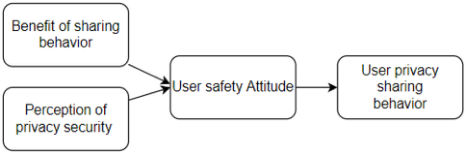
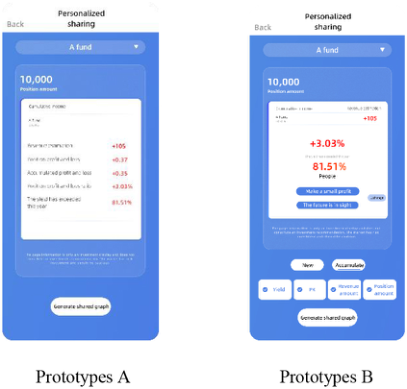
Figure 1: Path of privacy disclosure in financial social networking scenarios.Figure 2: The Interaction prototypes.
the usability and ergonomics issues in the privacy grading design evaluation, based on which we constructed a theoretical path of privacy disclosure in the financial sharing scenario, and verified the path with a scale. At the same time, we proposed two dimensions to test the effectiveness of the privacy gra- ding design. Then we created a prototype APP interface. Each participant uses the prototype to perform a different sharing task on a pre-set scenario. Ano- ther 12 participants (18-35 years old) participated in our prototype testing experiment.
In the participatory observation and focus group discussion of financial management sharing scenarios, we found significant differences between the social scene of acquaintances and the social scene of strangers. This is con- sistent with research suggesting that social environments create differences in privacy sharing (Santi P., 2018). We mainly studied these two scenes in the semi-structured interview. The psychological causes of privacy disclosure are complicated. Therefore, it is necessary to explore human factors for the effectiveness of the design.
A recent study established the influencing factors model of privacy para- dox behavior (Sun C.Q., 2021). The interaction and feedback of the platform will affect users’ perception of privacy security (Zhang J.X., 2016). If the theoretical framework of mobile banking security perception is constructed,
Dynamic Privacy Hierarchical Design to Optimize the User Experience 285
Table 1. Privacy classification of stranger and acquaintances social scene.
Table available in the original PDF paper.
Stranger Social Scene
Frequency Privacy information Privacy level in strangers’ social scenes
Fund name Quite high 85% Exceeding the ratio of fund buyer earnings Quite high 83% PK results Quite high 79% Essay case Quite high 77% Platform QR code Quite high 72% Platform logo Quite high 68% Time Quite high 67% Cumulative / yesterday’s earnings High 79% Cumulative / yesterday yield High 77% Position amount Moderate 92% User Avatar Moderate 89% User nickname Moderate 89% Acquaintances Social Scene
Frequency
Privacy information
Privacy level in strangers’ social scenes Exceeding the ratio of fund buyer earnings Quite high 78% PK results Quite high 77% Essay case Quite high 73% Platform logo Quite high 71% Fund name High 84% User Avatar Moderate 91% User nickname Moderate 90% Platform QR code Moderate 86% Time Moderate 82% Cumulative / yesterday yield Moderate 73% Cumulative / yesterday’s earnings Low 88% Fund name Low 87%
it is determined that interface design elements and feedback design are the two internal factors affecting mobile banking security perception, and users’ security perception levels can be changed by changing these two factors.
In the study of the path of privacy disclosure in the financial sharing sce- nario, we design a perceived behavior model of privacy disclosure in the financial sharing scenario by combining the behavioral influencing factor model and the perceptual theoretical framework. In scale making, the Likert 7-point scale was used to decompose each variable into several measures and the user could choose the degree of agreement or disagreement according to the expression of the question (Geoff N., 2010). All the measures are directly or indirectly derived from the previous studies, thus, the reliability and accu- racy of measure items are guaranteed. We will use these two dimensions in the following prototype test to evaluate the usability of the privacy classifica- tion design. We collected a scale of 327 people, and the data analysis shows
that perception of private security and the benefit of sharing behavior were two necessary conditional variables affecting user privacy sharing behavior (Figure 1). We will use these two dimensions in the following prototype test to evaluate the usability of the privacy classification design.
We created two interaction prototypes, their size is the usual screen display size (iPhone12, 2532x1170 px). Prototype A is similar to the current mobile financial APP display information interface, similar to screenshot sharing. Prototype B is a piece of mobile financial information sharing interface with privacy classification (Figure 2). Each participant had to complete two tasks, the sharing task in the social scene of acquaintances and the sharing task in the social scene of strangers. After completing the task, each participant was asked to rate the two prototypes (Using another seven-point Likert scale).
In the semi-structured interview, we can see the difference between the privacy degree of users’ mobile financial information in the social networking scenarios of acquaintances and strangers (Table 1). In the social networking scenarios of acquaintances, the privacy degree of information involving the total amount is higher, while in the social networking scenarios of strangers, the privacy degree of information involving personal identity is higher.
In conclusion, through the ranking mean analysis of private information, there are significant differences between the social scene of acquaintances and the social scene of strangers. Privacy security perception and privacy display benefit affect the privacy degree of users’ privacy information in different situations.
In the path study, we confirm that users’ privacy sharing behavior is influe- nced by the two variables of perceived privacy security and benefit of sharing behavior, and verify that the design of privacy classification can improve users’ perceived privacy security in the prototype test.
CONCLUSION
The evaluation and analysis of the concept of privacy classification in the privacy sharing scenario show positive results. All users interviewed agreed that the concept of privacy gradation was a useful one. The privacy classifica- tion under the user evaluation system can make up for the matching between online privacy operations and different scenarios, and provide users with an information display and reference according to the specific situation. In addi- tion, the respondents also agree that it is effective to improve the classification of privacy for the division of situations: to distinguish strangers from acqu- aintances in social situations. The privacy classification design can meet the needs of people’s privacy-sharing behavior. However, the users interviewed also reported drawbacks and barriers to use the privacy grading design. A notable problem is that there are differences in the level of privacy informa- tion among users with different identities. To satisfy more people, privacy information should be divided with the maximum level of privacy.
For interaction prototype testing, the software should divide the scene effe- ctively, and the reasonable division of the scene determines the satisfaction of users in the operation of privacy sharing. Therefore, a feature of the system
Dynamic Privacy Hierarchical Design to Optimize the User Experience 287
should be to adjust the privacy classification design in time according to the situation.
In this study, we establish a design prototype of privacy classification control so that each participant can find it perceptual and useful, and the use of financial revenue information sharing services can also improve their user experience. This study introduces dynamic privacy classification control, which provides a scientific reference for optimizing user experience design.
ACKNOWLEDGMENT
We sincerely thank Professor Hu Ying for providing us with the opportunity to carry out research, and Professor Liu Fang for providing theoretical sup- port for our research on mobile financial privacy information. I would also like to thank Qiaoru Xu for her participation in helping us to complete this study. At the same time, I would like to thank the students from Hunan Uni- versity and the recruited friends who actively participated in this study as the subjects and provided us with valuable experimental data.
REFERENCES
Ann C., Michelle C.(2009), “Advancing privacy and security in computing, networking, and systems innovations through privacy by design”. In: 2009 Conference of the Center for Advanced Studies on Collaborative Research (CASCON ‘09). IBM Corp., USA, 358–360. Geoff N.(2010), Likert scales, “levels of measurement and the “laws” of statistics”.
Advances in health sciences education, 15(5),625-632. Hu P.P.(2019), “The impact of new media technology on privacy concept in the Internet Era”. (Master’s thesis), Changsha: Hunan University. Judith S. O., Jonathan G., Eric H.(2005), “A study of preferences for sharing and
privacy”. In: CHI ‘05 Extended Abstracts on Human Factors in Computing Systems (CHI EA ‘05). Association for Computing Machinery, New York: NY, USA, 1985–1988. Pardis E.N., Henry D., Yuvraj A., Lorrie F. C.(2019), “Exploring How Privacy and Security Factor into IoT Device Purchase Behavior”. In: 2019 CHI Conference on Human Factors in Computing Systems (CHI ‘19). Association for Computing Machinery, New York: NY, USA, 534, 1–12. Santi P.(2018), “Towards Privacy-Preserving Content Sharing for Online Social
Networks”. In: 2018 ACM International Joint Conference and 2018 International Symposium on Pervasive and Ubiquitous Computing and Wearable Computers (UbiComp ‘18). Association for Computing Machinery, New York: NY, USA, 1088–1095. Sun C.Q.(2021), “Research on the influencing factors of privacy paradox on Weibo platform”. (Master’s thesis, Dalian: Dalian University of Technology. Yiannis K.(2016), “Personalized Privacy-aware Image Classification”. In: 2016
ACM on International Conference on Multimedia Retrieval (ICMR ‘16). Asso- ciation for Computing Machinery, New York: NY, USA, 71–78. Zhang J.X.(2016), “Research on mobile banking Design based on security Awareness”. (Master’s thesis), Guangzhou: South China University of Technology.
LISTED IN THE AHFE DIGITAL BOOKSTORE CATALOGUE
Explore the complete digital volume
Ergonomics In Design
Read this individual research paper free through the original publisher, or explore the full digital proceedings book.
ISBN 978-1-958651-23-0
Explore this ISBN in the AHFE Bookstore ↗Listed in the July 2026 bookstore catalogue; search by ISBN to confirm current availability · Digital book purchase optional