Taiyang Wang, Xianqi Zeng, Peng Luo (2022). Spatial Elements of Middle School Gymnasium Based on Youth Visual Perception. In: Human Factors in Architecture, Sustainable Urban Planning and Infrastructure. AHFE Open Access, vol. 58, pp. 379–388. https://doi.org/10.54941/ahfe1002375
Middle school students are physically and psychologically different from adults. They are in a relatively special and rapidly changing phase. As the most penetrating level of environmental perception, visual perception directly affects the use of the space in middle school gymnasiums. Based on the human factors engineering problem of teenagers using campus gymnasiums to carry out sports activities, this study takes visual perception as the starting point and adopts the method of combining research and experiment. Through semi-structured interviews and grading questionnaires, the strong factors related to middle school students’ willingness to exercise and architectural space design were refined. A seven-differentiation evaluation scale was constructed by SD method, and a questionnaire survey was conducted on 1150 middle school students. Multiple linear regression analysis was performed on the statistical data, and multiple groups were compared by age group and gender, and thus corresponding design strategies were proposed. The paper aims at promoting the enthusiasm of youth sports development, and providing theoretical support for the construction and development of middle school gymnasiums.
Generally speaking, when children encounter differentiation problems, they will receive more extensive help and attention from adults, but in the transi- tion period of “adolescence”, teenagers often no longer receive such attention (S.P. Chaube et al. 1985). Middle school students are generally between 13 and 18 years old. They are in a period of dramatic physical and psychological changes. Their physical development and psychological needs are different from adults and children. They are in the puberty period of individual deve- lopment. During this period, the sensitivity of adolescents to external factors, especially those related to school education, increases sharply (Dubrovin- skaya et al. 2000). The campus gymnasium is the most common activity carrier for teenagers. Whether the architectural environment design has an impact on the willingness of young people to exercise, and the degree of influence of different factors on different age groups are the main points
of this study.In the use of the method of semantic differential, the subjects were asked to evaluate different visual elements in the campus gymnasium on a nine-item seven-point semantic scale, so as to understand the meaning and intensity of each element in the different dimensions being evaluated. SPSS data analysis software was used to conduct multiple linear regression analysis on the strong correlation factors between middle school students’ willingness to exercise and architectural space design, and the significant cor- relation factors affecting middle school students’ willingness to exercise and the degree of influence of different factors were summarized. Through the analysis and comparison of middle school students aged from 13 to 18 in dif- ferent grades and genders, it is found that teenagers have different perception of the sports environment in the gymnasiums in different stages of growth and development, and there is a significant difference compared with adults.
LITERATURE REVIEW ON TEENAGERS’ VISUAL PERCEPTION OF CAMPUS GYMS The Influence of Visual Perception on Exercise Intention
In 1951, Graham CH reviewed the visual perception literature (Graham CH et al. 1951). In 1973, The psychology of visual perception (Haber RN et al. 1973) introduced the three main areas of visual perception: sensory organi- zation, information processing, and spatial organization. Key topics included theoretical and empirical evidence on the mechanisms by which color, form, and motion were perceived. In 1995, Jane L. Harte, Georg H. Eifert tested the psychoneuroendocrine effects of exercise-induced emotional experiences and the mediating effects of environmental setting and subjects’ attentional focus (Jane L. Harte et al. 1995). In 2002, Kahn Jr et al. proposed the dif- ferences between children and adults in cognitive science, and there is also evidence that people of different ages have different sensitivity to the environ- ment (Kahn Jr et al. 2002). In 2009, D Araujo et al. proposed the influence of sports environment on sports cognition and sports attitude in International Journal of Sport Psychology (D Araujo et al. 2009). In 2015, White MP et al. conducted a study on the influence of the environment on the willingness to exercise in postmenopausal women, and a small-scale experiment poin- ted out that different environments had different effects on the willingness to exercise (White M P et al. 2015).
The above research has largely summarized the effects of visual perception on people’s willingness to exercise, from the initial research on the objective causes and changes of vision based on the entry point of human physiology degree to the impact of visual perception on people in different objective states.
The earliest research on the effect of age on visual perception came from the medical field, explaining the link between age and the level of brain response in terms of physiological feedback. In the summary of the deve- lopment process of the research, the visual perception of different age groups and genders is gradually refined, and visual perception is also subdivided into distance perception, time perception, etc. The subjects of this study are young
Spatial Elements of Middle School Gymnasiums Based on Youth Visual Perception 381
adults between the ages of 13 and 18, who still have a big gap with adults in psychology and physiology.
METHODOLOGY
Research and Interviews The objectives are as follows: 1. Select typical objectives of scientific rese- arch across the country; 2. Discover the similarities and differences betw- een middle school gymnasiums and other gymnasiums; 3. Determine the main influencing factors of visual perception of middle school students’ gymnasiums.
1. Research object
In the preliminary investigation, the focus of in-depth research was mainly to classify the visual elements as follows: volume, form, interface, equipment (lighting), and the volume includes the length-width ratio and height of the space; the interface includes the virtual and real interface (permeability), ligh- ting conditions, interface materials and interface colors; the equipment is mainly based on the selection of lighting equipment. Finally, 9 expected influ- encing factors were extracted: space height, aspect ratio, space form, space brightness, light source mode, lighting equipment, space color, space material, space permeability.
2. Questionnaire Design Based on SD Method
The questionnaire consists of four parts: basic information of respondents, usage of campus gymnasium, willingness to exercise and influencing factors, and SD evaluation of spatial visual perception. Considering the age of the subjects, all the special terms in the questionnaire were explained. At the same time, all the questionnaires were distributed and collected on site and questions of the respondents about the questionnaire were answered on site.
A) Basic information of respondents. It includes respondents’ gender, age, grade, height, and weight. B) Campus gym usage. It includes collecting weekly frequency of exercise and time ranking of exercise types.
C) Exercise willingness and categories of influencing factors. The exercise willingness was scored on a 5-division scale, and the ranking of the factor categories that affected the exercise willingness was collected.
D) SD evaluation of visual perception of motion space. The semantic scale is set according to the “bi-Polar” principle, with 0 as the midpoint, and is divided into 7 levels. For the nine neutral factors of adolescent spatial visual perception, nine groups of adjectives corresponding to advance were collected (as shown in Figure 1). According to the require- ments for setting the difference table, the level of this survey was divided into 7 levels, from left to right: extremely poor, very poor, generally poor, neutral, generally good, very good and extremely good, corresponding to seven scores of −3, −2, −1, 0, 1, 2 and 3.
Spatial Elements of Middle School Gymnasiums Based on Youth Visual Perception 383
Figure 1: Seven differentiation scale.
Figure available in the original PDF paper.
3. Participants
Two junior high schools and five senior high schools in China were sele- cted, including four grades in junior high schools and three grades in senior high schools. 50 students from each grade were randomly selected from a class, a total of 1050 students (M = 610, F = 440, Age = 12~18, Mean Age = 15.8). Through preliminary screening of the data, the effective sample size was 879 (sample effective rate was 83.7%). Another 200 adults were selected for comparison (M = 114, F = 86, Mean age = 24.7).
4. Statistical Analysis
SPSS software was used for statistical analysis to carry out descriptive sta- tistics and multiple linear regression analysis on the data. Due to the large number of predicting influencing factors, step-back regression was used, and the variables were screened one by one and put into the regression equation to effectively eliminate the statistical impact of the non-conforming factors in the prediction variables on other factors.
RESULTS AND DISCUSSION
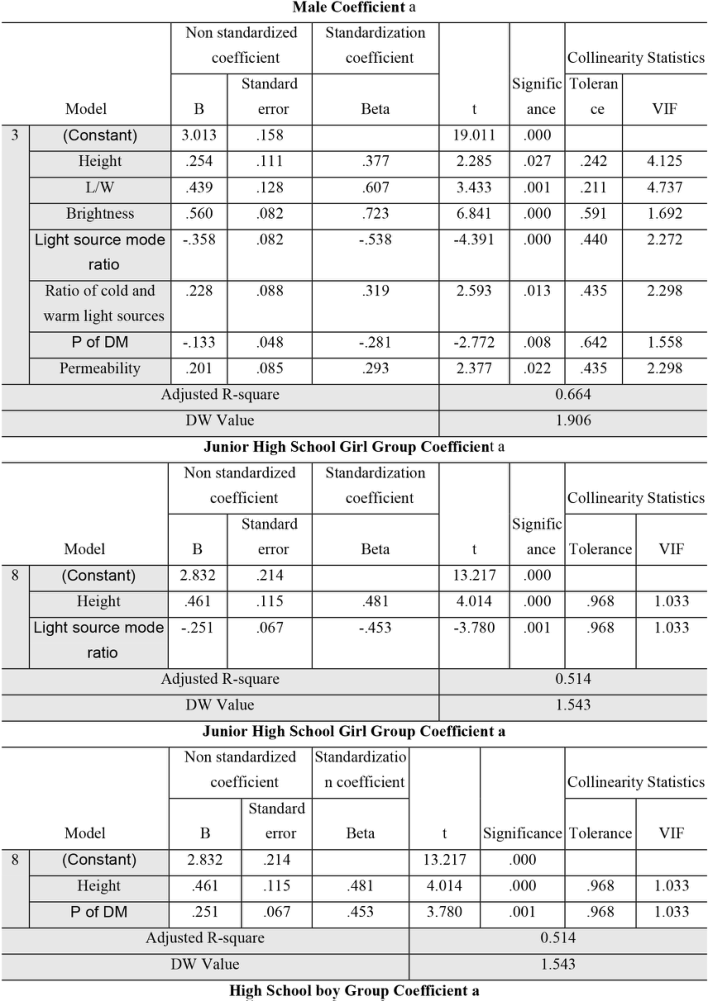
Multiple Linear Regression The nine target variables (height, aspect ratio, shape regularity, brigh- tness, light source mode ratio (natural light/artificial light), cold and warm light source ratio, color softness, interface permeability, decorative mate- rial ratio (natural material)/artificial materials)) and the dependent vari- able (willingness to exercise) were analyzed by multiple linear regression to establish a causal relationship between multiple variables. In statistics, it is required that all independent variables be independent of each other and there is no multicollinearity. The collinearity test and Debin Watson (DW) test (VIF < 5, 1.5 < DW < 2.5) were carried out for all the follo- wing regression models, and the regression method was used for stepwise regression. Through the observation of significance in the model (P < 0.05 was significantly correlated), the visual perception factors under different conditions were judged, and the degree of correlation among the signifi- cant correlation factors was discussed combined with the unstandardized coefficient (β).
In Figure 2, the results show that the spatial height, brightness, color and material characteristics of campus gymnasium have significant influence on teenagers’ willingness to exercise.
The above four independent variables were observed as non-standardized coefficients (β), and it was found that there was a small difference in the influ- ence degree of the four independent variables on the willingness to exercise, which were brightness (β = 0.060) < color softness (β = 0.073) < space hei- ght (β = 0.076) < the ratio of decorative materials (natural materials/artificial
Figure 2: Three groups of correlation comparison distinguished by gender.
materials) (β = −0.095). Brightness, color softness and height were positively correlated with motion intention, while the ratio of decorative materials (natural materials/artificial materials) was negatively correlated with motion intention.
Spatial Elements of Middle School Gymnasiums Based on Youth Visual Perception 385
Figure 2: Continued.
Multiple Linear Regression for Different Ages According to the relationship between visual perception and age in the previ- ous article, the second stage mainly studies the relationship between spatial
Table 2.
Table available in the original PDF paper.
High school
Adult group
Group/Significant Correlation
Teen group
Junior high school group
group
H M F Hole M F Hole M F
✓
Height ✓ ✓ ✓ ✓ L/W ✓ ✓ Morphological Brightness ✓ ✓ ✓ ✓ ✓ ✓ ✓ Light source mode ✓ Ratio of cold and warm light sources Color softness ✓ ✓ Proportion of DM ✓ ✓ ✓ ✓ Interface Permeability ✓ ✓ ✓ ✓
visual perception and motor willingness of different age groups. The subje- cts were divided into two groups: junior high school group and senior high school group. The junior high school group includes school A and school C, each with 400 students in 4 grades, and the senior high school group includes school BDEFGH, with 650 students in 3 grades. Multiple linear regression was performed on the two groups separately, and the adult group was added for comparison.
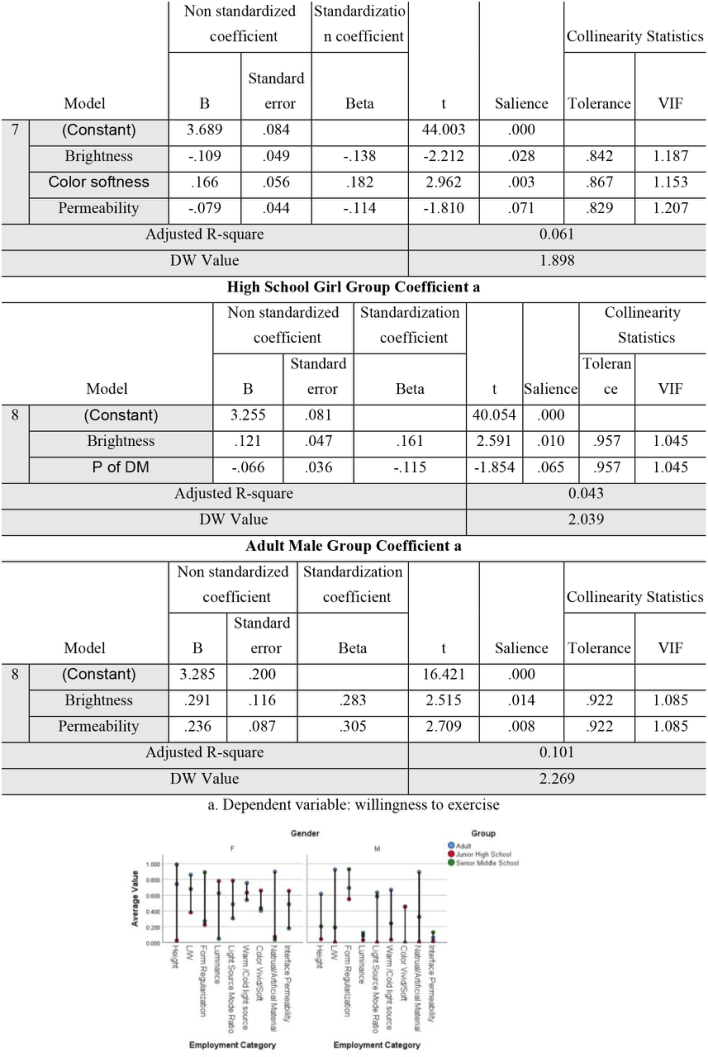
From the comparison between the two groups, each age group has diffe- rent feedbacks on the factors strongly related to visual perception that affect the willingness to exercise, but the relationship between the willingness to exercise and the visual perception factors in the junior high school group is significantly stronger than that in the senior high school group. Through the significance line chart of nine independent variables, it can be found that the junior high school group is better than the senior high school group in the number of significant related factors and the average value of P value. When comparing the data of the adult group, it is found that the visual influence factors (permeability) of the adult group are different from those of teena- gers, and the significance of the adult group is close to and slightly worse than that of the senior high school group. It can be seen that the p value of junior high school group is less than that of senior high school group and less than that of adult group, and the degree of change shows a decreasing trend.
Multiple Linear Regression by Gender The third phase investigates the effect of gender on the correlation between visual perception and motor intention. All data were divided into six groups, namely: junior high school boys/girls group, senior high school boys/girls group, and the comparison group adult male/female group.
Comparing the significance of the above six groups of data and drawing a line graph, it is found that in the age group of 12 to 30 years old, women’s willingness to exercise is less affected by visual perception than men, and
Spatial Elements of Middle School Gymnasiums Based on Youth Visual Perception 387
the impact of visual perception on exercise willingness increases with age. The increase shows a decreasing trend. Among the 6 groups of data, the willingness to exercise of the junior high school boys group is most affected by spatial visual perception, and seven spatial visual perception elements show a significant impact on willingness to exercise, while the adult female group shows no independent variable related to willingness to exercise.
CONCLUSION
From the horizontal observation in Table 2, the visual element of brightness has the highest frequency among all groups. Ensuring natural lighting in sta- dium design and timely enabling of lighting equipment in use will have a positive impact on teenagers’ willingness to exercise. The two factors of hei- ght and the ratio of decorative materials mainly appear in the adolescent group, and there is no obvious correlation in the adult group. This indica- tes that the space height and material selection in the gym will be related to the willingness to exercise in the adolescent stage. The integration of natural language, the selection of materials and colors, and the increase of the height of the main space are conducive to the voluntary participation of teenagers in sports design methods; Interface permeability has a significant correlation with exercise intention in both adolescent group and adult group, and both have a positive correlation with dependent variables.
Campus gymnasiums are different from social gymnasiums. Social gymna- siums often need to undertake social functions such as city symbols in addition to their use functions, while the design of campus gymnasiums needs to be centered on the healthy development of students. Through subdivided research on teenagers’ exercise intention, a design method for middle school campus gymnasiums is proposed to promote the enthusiasm of youth to exe- rcise actively, which will play an important role in the healthy development of youth physique.
ACKNOWLEDGMENT
This study was supported by National Natural Science Foundation of China (52078156).
REFERENCES
A study on the effect of exercise on emotional stability Yang Xueqin Qiu Ruilan 1996 Journal of PLA Institute of Physical Education. Adolescent Psychology India Translated by S.P. Chaube, Jiang Wenbin, 1985. Biddle S J H, Mutrie N, Gorely T, et al. Psychology of physical activity: Determinants,
well-being and interventions[M]. Routledge, 2021. Bradley M M, Lang P J. Measuring emotion: the self-assessment manikin and the semantic differential[J]. Journal of behavior therapy and experimental psychiatry, 1994, 25(1): 49–59. Comalli Jr, Peter E. “Life-span changes in visual perception.” Life-span developmen-
tal psychology. Academic Press, 1970. 211–226.
Dubrovinskaya, N.V., Farber, D.A., and Bezrukikh,M.M., Psikhofiziologiya rebenka.
Uchebnoe posobie (Child Psychophysiology: A Handbook), Moscow:VLADOS, 2000. Gill D L, Williams L, Reifsteck E J. Psychological dynamics of sport and exercise [M].
Human Kinetics, 2017. Graham C H. Visual perception[J]. 1951. Haber R N, Hershenson M. The psychology of visual perception[M]. Holt, Rinehart & Winston, 1973. HANACHI, PIROOZ, and ARMAKI MARZIYEH AZAD. “Visual Perception of
Chizar District by Chizarian Young Adults.” (2012): 87–97. Levine B K, Beason–Held L L, Purpura K P, et al. Age-related differences in visual perception: a PET study[J]. Neurobiology of aging, 2000, 21(4): 577–584. Liu Fuwu. Social Survey Theory and Practice. Nanjing: Nanjing University Press,
1992: 121–122. Meng, Qianli, et al. “Age-related changes in local and global visual perception.”Journal of vision 19.1 (2019): 10–10. Norman J F, Dowell C J, Higginbotham A J, et al. Sex and age modulate the visual
perception of distance[J]. Attention, Perception, & Psychophysics, 2018, 80(8): 2022–2032. White M P, Pahl S, Ashbullby K J, et al. The effects of exercising in different natural environments on psycho-physiological outcomes in post-menopausal women: A simulation study[J]. International journal of environmental research and public health, 2015, 12(9): 11929–11953. Yeh H P, Stone J A, Churchill S M, et al. Physical and emotional benefits of different
exercise environments designed for treadmill running[J]. International journal of environmental research and public health, 2017, 14(7): 752.
LISTED IN THE AHFE DIGITAL BOOKSTORE CATALOGUE
Explore the complete digital volume
Human Factors in Architecture, Sustainable Urban Planning and Infrastructure
Read this individual research paper free through the original publisher, or explore the full digital proceedings book.
ISBN 978-1-958651-34-6
Explore this ISBN in the AHFE Bookstore ↗Listed in the July 2026 bookstore catalogue; search by ISBN to confirm current availability · Digital book purchase optional