Fabian Walocha, Hoai Phuong Nguyen, Uwe Drewitz, Klas Arne Ihme (2022). Evaluation of a User-adaptive Light-based Interior Concept for Supporting Mobile Office Work during Highly Automated Driving. In: Human Factors in Transportation. AHFE Open Access, vol. 60, pp. 526–532. https://doi.org/10.54941/ahfe1002486
Automated driving promises that users can devote their travel time to activities like relaxing or mobile office (MO) work. We present an interior light concept for supporting MO work and evaluate it in a driving simulator study with participants. A vehicle mock-up was equipped as MO including light elements for focus and ambient illumination. Based on these, an adaptive (i.e. adapting to user activities) and an adaptable (i.e. could be changed by user according to preference) light set-up were created and compared to a baseline version. Regarding user experience, the adaptive variant was rated best on hedonic aspects, while the adaptable variant scored highest on pragmatic facets. In addition, the adaptable set-up was ranked best on preference before adaptive and baseline. This suggest that adaption of the interior light to non-driving related activities improves user experience. Future studies should evaluate combinations of the adaptive and the adaptive variants tested here.
Evaluation of a User-adaptive Light-based Interior Concept 527
depending on activity and state of the users. The question remains how to best realize adaptions of the vehicle and communicate these to the user. For example, one current topic in this field is whether and under what conditions HAV users prefer user adaptive configurations, i.e. automated systems which enact changes whenever they are deemed appropriate depending on the user state and activity, or adaptable configurations, i.e. an option for full manual control by the user over changes in their surroundings. Therefore, the follo- wing work aims to analyze user’s preference towards user adaptive systems in HAVs for a mobile office (MO) use case. For this purpose, we conducted a simulator study with a demonstrator vehicle mockup with integrated custom light setup that allows MO activities during simulated travel. While working on a MO task, the light setup could either be changed manually (adaptable) or was changed automatically depending on the task during MO (adaptive) using a wizard-of-Oz approach. We evaluated the two set-ups and compared them with a standard, baseline light setup in terms of user experience (UX), usability, experienced stress during MO as well as user preference.
TECHNICAL SET-UP OF THE DEMONSTRATOR The demonstrator is located in driving simulator with a 360° projected virtual environment and a modular vehicle mock-up. The interior of the mock-up was specifically configured with notable features being the driver space, a revolving driver seat, a collapsible keyboard-trackpad-combination mounted to the right armrest of the seat, a center console with a screen and additio- nal light interior elements. In automated driving mode, the steering wheel is retracted into the dashboard to free up space, which allowed the driver to revolve the seat away from the traditional driving position. Hence, the inte- rior enables the use of MO on the center console during automated driving. The center console can be comfortably accessed by turning the revolving seat with more legroom available for the user.
For illumination of the interior, a ceiling mounted dome light and an ambi- ent light were integrated into vehicle cockpit. The dome light (matrix LED reading light) serves as focus light to illuminate the MO area and could be controlled directly (switched on/off by touching) or via a computer interface. In contrast, the ambient light indirectly illuminates the vehicle interior and is adjustable in intensity and color temperature. Two pre-set light modes were defined: a stimulating mode with high correlated color temperature (cold) and a relaxing mode with low correlated color temperature (warm). The ambient light could be controlled (switching on/off and changing light mode) via a computer interface. Moreover, the mock-up was equipped with a tablet PC with touchscreen (Microsoft Surface with 12.3 inches) that could display an interface with buttons to control the abovementioned interior light (focus light: on/off; ambient light: on/warm/cold).
EVALUATION STUDY A driving simulator study with a within-subjects design was conducted in the demonstrator to evaluate three different light adaptations (baseline,
adaptable and adaptive) with respect to UX, usability, experienced stress and preference.
Methods
Participants: Thirteen volunteers (2 females, 11 males, age between 20 and 70 years, M= 33.7 years, SD= 15.7 years) participated in the study. Participants received 5 € per commenced half hour as financial reimbursement.
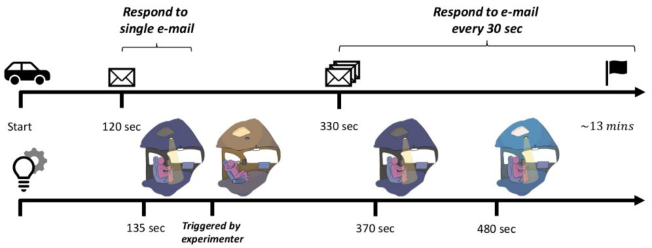
Mobile office task and driving scenario: In order to create an authentic MO task, a mock-up e-mail client was created that could be filled with inco- ming e-mails at pre-defined times from a specific set of e-mails and allows replying to the e-mails as well as adding appointments to the calendar (see Ihme et al. 2021). Participants were instructed to imagine to be on the way to their last meeting of a workday and want to utilize their time in their automa- ted vehicle efficiently to empty their inbox, but also to relax when possible. Further, they were requested to write a brief reply to each e-mail in the inbox and to enter any appointment request into the calendar. Participants could relax whenever they had replied to all e-mails in their inbox. For this they could rotate and tilt the seat to a comfortable position. Simulated automated driving took place on a highway with randomly generated moderate traffic (German Autobahn, speed limit 130 km/h). Each scenario began with a run- ning start and ended when the vehicle left the highway at an exit after roughly 13 minutes driving time. All scenarios started and ended at the same location. We created two training scenarios. In the first one, participants just experie- nced the automated drive without the MO task to accustom to the simulated driving situation. In the second training scenario, the drive started with an empty inbox and after 270 s every 30 seconds a new e-mail arrived in the inbox, which had to be processed by the participant to practice the MO task. Both training scenarios were simulated with day time and clear weather. In addition, three experimental scenarios that served to let participants experie- nce the three different light-based interior concepts with varying loads of the MO task were created. For this, the e-mail client was programmed, such that the inbox was empty in the beginning and one e-mail was received after 120 s. Then, there was a pause and after another 210 s (= 330s after beginning) new e-mails came in with a frequency of about 1/30s. The design of the sce- nario had the intention that participants should switch between relaxing and MO several times to trigger the need for adapting the interior light (for the time course of events, see upper part of Figure 1). The three scenarios had the same structure with respect to start and end location on the highway as well as the timing of the incoming e-mails. However, to avoid habituation effects, random traffic was generated around the ego vehicle for the simulated dri- ving and three different e-mail sets were used for the mobile office task. The scenarios took place during dusk with cloudy weather to provoke the need to switch on the interior light.
Light adaptations in the experimental scenarios: Three different light concepts were experienced by participants with the experimental scenario described above. In the baseline (BL), the light set-up was designed to mimic the standard set-up in a current vehicle. This means that participants could
Evaluation of a User-adaptive Light-based Interior Concept 529
Figure 1: Events for an experimental scenario. The upper timeline depicts the events for the MO task (same in all three experimental scenarios). The lower timeline shows related changes in the interior lighting during the adaptive (AD) condition.
only switch the dome light on or off whenever they wanted to. In the ada- ptable version (AB), an interface was presented on the tablet PC that allowed participants to switch the dome light on or off and to change the mode of the ambient light between off, warm, and cold whenever they wanted to. Finally, for the adaptive variant (AD), participants were told that the interior light concept automatically adapted to their activity. Indeed, the light adaptation, was realized in a Wizard-of-Oz fashion. This meant that in the beginning of the scenario, both lights were switched off. The dome light was switched on 15 s after the first e-mail was received to support the participant with a focus light. When the participant completed the response of this e-mail, the expe- rimenter switched off the dome light and set the ambient light to warm to create a relaxing interior. Then, 40 s after several the beginning of the intense MO phase (when a new e-mail came every 30 s), the focus was switched on and another 110 s later, the ambient light was set to cold to stimulate the working atmosphere (Figure 1).
Self-report questionnaires: To evaluate the three design alternatives, we administered the User Experience Questionnaire short (UEQ-S,Schrepp, Hin- derks & Thomaschewski 2017), the System Usability Scale (SUS, Lewis & Sauro 2009) and the Short Stress State Questionnaire (SSSQ, Helton 2004). In addition, participants were asked to rank the three design alternatives regar- ding their preference to use them. For data analysis, the subscale Worry of the SSQ had to be excluded, because its reliability was low for AB and AD (Cronbach’s α < .6). A series of non-parametric Friedman’s rank ANOVAs was used to compare the three system variants on the assessed scales. In case of a significant test, post hoc comparisons were conducted against an α-level of p = .05 (uncorrected).
Procedure: Upon arrival, participants were welcomed and requested to read and sign the consent forms for simulator driving (according to the institute’s simulator security concept) as well as the consent form regarding the processing of personal data (in line with the European General Data Protection Regulation). Thereafter participants filled a short demographic questionnaire. Then the experimenter showed the simulator and the vehi- cle mock-up to the participants, instructed them how to use all the elements
Table 1. Descriptive statistics (median, mean and SD) for the Short Stress State Questionnaire (SSSQ), the System Usability Scale (SUS) and the short version of the User Experience Questionnaire (UEQ-S) for the three light-based interior concepts baseline (BL), adaptable (AB) and adaptive (AD).
Table available in the original PDF paper.
Baseline Adaptable Adaptive Median Mean SD Median Mean SD Median Mean SD
in the interior and briefly explained the mobile office task. Subsequently, participants experienced the two training scenarios and afterwards filled the SSSQ for the first time. Then, the three experimental scenarios were driven in sequence. The order of scenarios was balanced based on a Latin square. After each of the experimental scenarios, participants filled in the UEQ-S, the SUS and the SSSQ. In the end, participants stated their preference ran- king of the three interior light concept and filled out the template for wire transfer of the financial reimbursement. Due to the pandemic situation, it was mandatory to wear a FFP2 face mask for experimenter and participants. However, participants could remove their mask when they were alone in the vehicle mock-up. The procedure was approved by the ethics committee of the German Aerospace Center (no. 12/21).
Results
The descriptive statistics (median, mean and standard deviation) of the que- stionnaires in the three conditions are presented in Table 1. From the UEQ-S, both pragmatic (χ2(2) = 7.61, p < .05) and hedonic qualities (χ2(2) = 6.04, p < .05) differed significantly between the system variants. Post-hoc compa- risons showed that system variant AB was rated to have higher pragmatic qualities than BL and AD (ps < .05). Regarding the hedonic qualities, AD was rated higher than BL (p < .05) as revealed by post-hoc comparisons. For the SUS, no differences in the overall score (χ2(2) = 4.04, p = .13) as well as for learnability (χ2(2) =.73, p = .70) and usability (χ2(2) = 5.64, p = .06) were found. Similarly, for the SSSQ, no significant differences were revealed for the scales distress (χ2(2) = 4.17, p = .12) and engagement (χ2(2) = 1.70, p = .43). Finally, there was a significant difference in the subjective prefere- nce ratings (χ2(2) = 10.71, p < .01). AB was preferred compared to BL as shown by post-hoc comparisons (p < .05).
Evaluation of a User-adaptive Light-based Interior Concept 531
DISCUSSION
In this work, we set up a demonstrator realizing a flexible vehicle interior light concept to support different non-driving related activities during auto- mated driving. With this demonstrator, we compared an adaptive and an adaptable version of the light concept with a standard light set-up in an MO scenario in a user evaluation study. Results suggest that participants valued the light setup in the vehicle mock-up over the standard equipment for MO use. In terms of user experience, participants appreciated the pragmatic qua- lities of the adaptable light concept and the hedonic aspects of the adaptive version. No significant effects in terms of usability and experienced stress during the MO were revealed, which may be due to the relatively low sample size. When participants evaluated the three light scenarios according to their preference, the adaptable version was ranked best, the adaptive second and the baseline lowest, with significant differences between the adaptable and the baseline light concept.
One explanation for the better evaluation of the adaptable over the ada- ptive concept (in terms of pragmatic qualities of UX and, descriptively, in terms of preference) could be that the pre-selected light configurations in the adaptive scenario were not perfectly adjusted for all users. For insta- nce, if individual users prefer the warm light mode while responding to e-mails, they might perceive the preset cold ambient light during MO as annoying or distracting. Furthermore, it is possible that the total effect of the changing lighting setup was overvalued. While additional light to illuminate the keyboard or cockpit as a whole might be seen as pleasant, automated changes in the lighting throughout the journey might not have. In addition, it may be that participants experienced the adaptive version as non-transparent because they could not anticipate why a certain light mode was chosen. Interestingly, the adaptive variant received the best evaluation in terms of hedonic qualities suggesting that participants associated rather positive feelings with this light concept. This could be related to the fact that the adaptation to their current activity was positively experienced as kind of “empathic” behavior of the system (Stephan 2015; Drewitz et al. 2020). Together, these results suggest that both the adaptive and the adaptable light concept are worth further developing. Combinations of both variants may lead to even more positive user evaluations that should be evalua- ted in future studies. One such combination could be to allow users to identify and set their preferred light mode in the beginning which is then triggered adaptively to their current activity. In this way, the chance of pre- senting disliked light modes could be minimized. A second variation worth considering could be a scenario where the automated system only provi- des recommendations to the participants for changes to the interior light rather than enacting these changes on its own. This may prevent that users experience a loss of control. Further, providing explanations of why the par- ticular adaptations were chosen may improve the evaluation of the adaptive version.
REFERENCES
Drewitz, U., Ihme, K., Bahnmüller, C., Fleischer, T., La, H. & Pape, A.-A. et al.
(2020) Towards User-Focused Vehicle Automation: The Architectural Approach of the AutoAkzept Project. In: Krömker, H. (Ed.) HCI in Mobility, Transport, and Automotive Systems. Automated Driving and In-Vehicle Experience Design. Springer: Cham, pp. 15–30. Helton, W.S. (2004) Validation of a Short Stress State Questionnaire. Proceedings of the Human Factors and Ergonomics Society Annual Meeting, 48(11), 1238–1242. Available from: https://doi.org/10.1177/154193120404801107. Ihme, K., Walocha, F., Wegener, J., Rehm, J., Grolms, G. & Nguyen, H.P. et al. (2021)
Towards User-Focused Automated Vehicles Supporting Mobile Office Work. In: Proceedings of the 7th Humanist Conference, 7th Humanist Conference, 26-27 Oct, Rhodes Island, Greece. Lewis, J.R. & Sauro, J. (2009) The Factor Structure of the System Usability Scale.
In: Kurosu, M. (Ed.) Human Centered Design. Springer Berlin Heidelberg: Berlin, Heidelberg, pp. 94–103. Oehl, M., Ihme, K., Pape, A.-A., Vukeli´c, M. & Braun, M. (2020) Affective Use Cases for Empathic Vehicles in Highly Automated Driving: Results of an Expert Workshop. In: Krömker, H. (Ed.) HCI in Mobility, Transport, and Automotive Systems. Automated Driving and In-Vehicle Experience Design. Springer: Cham, pp. 89–100. Pfleging, B., Kun, A.L. & Shaer, O. (2020) Future Cars as a Space for Work & Play. In:
Bernhaupt, R., Mueller, F.’., Verweij, D., Andres, J., McGrenere, J. & Cockburn, A. et al. (Eds.) Extended Abstracts of the 2020 CHI Conference on Human Factors in Computing Systems, CHI ’20: CHI Conference on Human Factors in Computing Systems, 25 04 2020 30 04 2020, Honolulu HI USA. ACM: New York, NY, USA, pp. 1–4. Schrepp, M., Hinderks, A. & Thomaschewski, J. (2017) Design and Evaluation of a Short Version of the User Experience Questionnaire (UEQ-S). International Jour- nal of Interactive Multimedia and Artificial Intelligence, 4(6), 103. Available from: https://doi.org/10.9781/ijimai.2017.09.001. Stephan, A. (2015) Empathy for Artificial Agents. International Journal of Social
Robotics, 7(1), 111–116. Available from: https://doi.org/10.1007/s12369-014- 0260-0. Weirich, C., Lin, Y. & Khanh, T.Q. (2022) Evidence for Human-Centric In-Vehicle Lighting: Part 1. Applied Sciences, 12(2), 552. Available from: https://doi.org/10. 3390/app12020552. Wilson, C., Gyi, D., Morris, A., Bateman, R. & Tanaka, H. (2022) Non-Driving
Related tasks and journey types for future autonomous vehicle owners. Transpor- tation Research Part F: Traffic Psychology and Behaviour, 85, 150–160. Available from: https://doi.org/10.1016/j.trf.2022.01.004.
LISTED IN THE AHFE DIGITAL BOOKSTORE CATALOGUE
Explore the complete digital volume
Human Factors in Transportation
Read this individual research paper free through the original publisher, or explore the full digital proceedings book.
ISBN 978-1-958651-36-0
Explore this ISBN in the AHFE Bookstore ↗Listed in the July 2026 bookstore catalogue; search by ISBN to confirm current availability · Digital book purchase optional