Carlos Marcelo Borja-Galeas, Hugo Arias-Flores (2022). How does the participatory design in the brand construction helps?. In: Human Interaction & Emerging Technologies (IHIET 2022): Artificial Intelligence & Future Applications. AHFE Open Access, vol. 68, pp. 737–741. https://doi.org/10.54941/ahfe1002800
1 Facultad de Administración de Empresas, Universidad Tecnológica Indoamérica, Av. Machala y Sabanilla, Quito, Ecuador ↗
2 Centro de investigación en Mecatrónica y Sistemas Interactivos (MIST), Universidad Tecnológica Indoamérica, Av. Machala y Sabanilla, Quito, Ecuador ↗
The brand is not just a logo, goes further, it is like the consumer internalizes the product or service. It is to look from coherence, consistency, perseverance, trust, content and reach the customer, these elements are the way for the construction of a brand. The corporate image is created from a cultural internalization of the company and becomes the identity that will be reflected towards the whole world, this design is born of the participation of the designer and the senior executives, who transform the ideas through the use of tools Innovative administration. The objective of this investigation is to generate the corporate identity manual through the use of Canvas, identifying the value proposition of the company. Through the use of a heuristic matrix, the value proposition and differentiators that the company have, added the iconic elements that represent them, together with the colors and typographies that together build the brand with its components: (1) , (2) Color and (3) typography. The participatory design of the actors at each stage, accelerates the brand construction and the results are integrated into the best corporate identity and resistance is avoided in their adoption.
Building a strong brand with significant capital provides a lot of benefits for companies (Keller & Brexendorf, 2019). Having a strong brand, which impa- cts, is recognized, increases and improves experience, where culture plays an essential role when considering it, which at the management level helps to understand the positive results of brands in the satisfaction of their clients and this leads to increasing investments that allow improving every day in brand experience (de Oliveira Santini et al., 2018).
Studies on cultural differences and their influence on the purchase deci- sion of different brands of products or services lead to scientifically defining that in the western world and in East there are different interests and ways to specify a purchase. Brand manuals for example of appliances differ in con- tent, structure and use of images. These studies show that the content of Chinese manuals is less strictly limited to the user support function than that of Western manuals. Compared to western manuals, the structure of Chinese
manuals seems to be more confusing and less rigid. With respect to images, Chinese manuals contain more entertaining and non -instrumental illustrati- ons than western manuals. Behind these differences there is a more general distinction between the highly instrumental western manuals and the most flexible Chinese manuals. These differences seem to point to two cultural dimensions (Li et al., 2020), which at the time of deciding plays an important role.
Several authors of Branding topics studies confirm that customer experie- nces with brands will make them more solid. Managing the brand with all the strategies of branding literature and customer experience by introducing the concept of the brand experience manual can lead to a much more intimate and deep contact with customers (Motta-Filho, 2021).
The consumption of products or services is related to the confidence offered by brands, their projection, their shape, the typography used, the colors that are used, the type of substrate in which it is presented (Keller & Brexendorf, 2019). The emotion and trust generated by the bran- ded packaging of a product can lead to building loyalty to a brand and accepting it as the best market option (Fernandes & Moreira, 2019).
Talking about internal marketing in companies, involves a multifunctio- nal process that involves both marketing and human resources departments. Research on internal branding is still open because there are several issues to investigate in this field: brand commitment, brand loyalty, brand citizenship behaviors so that they can build brand value against interests external parties (Barros-Arrieta & García-Cali, 2021).
Companies make branding consciously or unconsciously, where the con- scious work it through strategies that will avoid going to fail. The branding on off connects a brand with the consumer within physical and virtual sce- narios in which alliances and commitments that can be temporary or durable are generated. The 5 Cs raised by Andy Stalman: Coherence, Consistency, Confidence, Trust and Content will deepen the results sought for the good of the Sixth C: Client (Stalman, 2014).
The present study presents the methodology that will be used in the con- struction of brand manuals in which the Canvas model, tools and graphic design theories are used to create or refresh business brands.
The structure of this article is as follows: in section 2 the methodology used is presented, which is the theoretical basis of the proposal. In section 3 it is exposed as the investigation was developed to generate the brand. The results of the proposal are presented in section 4. Section 5 presents the conclusions obtained from the results and future lines of research.
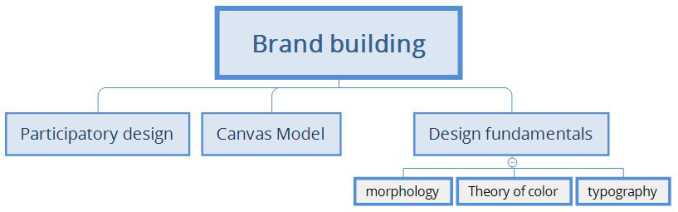
METHODS AND MATERIALES To develop this research manuals, the Lean Startup method was used, fun- damentals of design based on morphology, typography and chromatic. And these two elements were worked from participatory design, as can be seen in Figure 1.
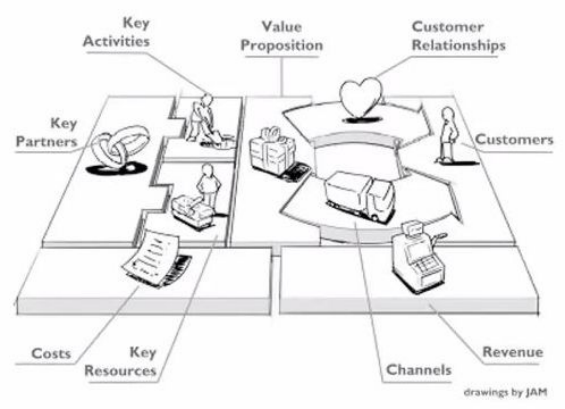
The Lean Startup method with the Osterwalder business model. It allows to understand the companies that generate products and services. It consists
How Does the Participatory Design in the Brand Construction Helps? 739
of nine pictures that expose the business model and make it understandable so that who must design the logo, as can be seen in Figure 2. In this canvas it is essential to understand what is the differentiator that the company has to expose it to its users or customers (Osterwalder, 2010).
Design Fundamentals Theories for the design and conceptualization of brands are based on 3 fundamental ideas: the morphology of the brand, the chromatic and the typography to be used. These 3 concepts must be merged and plasma an image that expresses in a clear and precise way the essence of the company, product or service. With great creativity and applying principles of composi- tion, the different prototypes that the company owner will observe and after an argumented exhibition will define which is the best proposal that will mean. It is usually used in this conceptualization of double entry matrices that allow to expose on one of its sides the value proposals of the company, product or service and on the other side the possible graphic elements that can conceptualize them.
740 Borja-Galeas and Arias-Flores
Participatory Design Allow members of companies together with designers, marketing people and users and customers to understand the essence of the brand and obtain in collective meetings a logo according to the context in which the product or service develops. This method allows to accelerate the process of construction of the logos, since the proposals were obtained collectively and then the final model of the brand (Bødker & Kyng, 2018). The culture and understanding of what is being built makes the results obtained be better accepted by the company and the community a proposal development.
This research is carried out with the participation of the owners and col- laborators of the companies or ventures, together with graphic designers, marketing experts and the community in general. Distributed in teams and with a dynamic and participatory methodology, the company is conceptua- lized with the Canvas canvas, the value proposition that the company has and under its characteristics is generated, sketches that symbolize the above with words are generated. The teams must be motivated to generate results and expose them, which will cause less strong proposals to be declined and those that conceptualize them best are maintained. The work of designers and experts in marketing guide and express the results until designs with the consensus of the majority. Forms, colors, typefaces must express in the best way the essence of what is built. In the end it will be the designers who per- fections and will geometry the approved final logo, and then construe their use manual.
CONCLUSION
This participatory work methodology allows results that allow the accepta- nce of the community, but it needs the team to be motivated to work and obtain a viable result. The coordinators of the different teams must keep the participants connected and committed to obtaining results and not diver- ting their efforts. Working with exact times, with defined activities will allow favorable results.
Having enthusiastic and committed participants willing to listen and pro- pose in the different stages of collective work will make positive results and in an agile way. Therefore, the construction of the work team will be essential to obtain a coherent final product.
REFERENCES
Barros-Arrieta, D., & García-Cali, E. (2021). Internal branding: conceptualization from a literature review and opportunities for future research. Journal of Brand Management, 28(2), 133–151. https://doi.org/10.1057/s41262-020-00219-1 Bødker, S., & Kyng, M. (2018). Participatory Design that Matters—Facing the Big
Issues. ACM Transactions on Computer-Human Interaction, 25(1), 1–31. https: //doi.org/10.1145/3152421 de Oliveira Santini, F., Ladeira, W. J., Sampaio, C. H., & Pinto, D. C. (2018). The brand experience extended model: a meta-analysis. Journal of Brand Management, 25(6), 519–535. https://doi.org/10.1057/s41262-018-0104-6
How Does the Participatory Design in the Brand Construction Helps? 741
Fernandes, T., & Moreira, M. (2019). Consumer brand engagement, satisfaction and brand loyalty: a comparative study between functional and emotional brand relationships. Journal of Product & Brand Management, 28(2), 274–286. https: //doi.org/10.1108/JPBM-08-2017-1545 Keller, K. L., & Brexendorf, T. O. (2019). Measuring Brand Equity (pp. 1409–1439).
https://doi.org/10.1007/978-3-658-13342-9_72 Li, Q., de Jong, M. D. T., & Karreman, J. (2020). Cultural Differences Between Chinese and Western User Instructions: A Content Analysis of User Manuals for Household Appliances. IEEE Transactions on Professional Communication, 63(1), 3–20. https://doi.org/10.1109/TPC.2019.2961010 Motta-Filho, M. A. (2021). Brand experience manual: bridging the gap between
brand strategy and customer experience. Review of Managerial Science, 15(5), 1173–1204. https://doi.org/10.1007/s11846-020-00399-9 Osterwalder, A., & Pigneur, Y. (2010). Business model generation: a handbook for visionaries, game changers, and challengers. (J. W. & Sons. (ed.)). Osterwalder, A. . & P. Y. (2010). Business model generation: a handbook for
visionaries, game changers, and challengers (Vol. 1). John Wiley & Sons. Stalman, A. (2014). BRANDOFFON: EL BRANDING DEL FUTURO (E. G. 2000 (ed.)).
Read this individual research paper free through the original publisher, or explore the full digital proceedings book.
ISBN 978-1-958651-44-5
Explore this ISBN in the AHFE Bookstore ↗Listed in the July 2026 bookstore catalogue; search by ISBN to confirm current availability · Digital book purchase optional