Anabela Becho (2023). Sculpting the fabric: Madame Grès’ emotional and innovative Pleating Technique. In: Intelligent Human Systems Integration (IHSI 2023): Integrating People and Intelligent Systems. AHFE Open Access, vol. 69, pp. 533–540. https://doi.org/10.54941/ahfe1002874
Madame Grès (1903-1993) worked for six decades in the exclusive world of Parisian haute couture, creating clothes as if they were living sculptures, always in search of the ideal dress.Her legacy was designs marked by a ceaseless quest for absolute beauty. Her long,draped dresses crafted with obsession and technical mastery are a profound reflection on fashion, time and memory. In its undying association with sculpture, her oeuvre encloses an inherent affirmative, solid, timeless perpetuity. Respect for the principles of design lies in Grès’s discourse with textiles; because it is a discourse, a thought that is transformed into matter, that grows pleat by pleat in a game of alternating light and shade. The couturier's folds enclose successive pain and mystery, melancholy and persistence, obsession and conviction. There can be no doubt that Grès’s gowns were designed for the female form, in the cutting and manipulation of the fabric, in a prodigious, precise technique in which nothing could be left to chance. This is why they are perfect examples of the highest calling of design.Nonetheless, it is precisely in the relationship between body and gown, the harmony and tension between the organic and inorganic, that Grès’s work goes beyond mere design. It moves naturally into the real world of creation, as the couturier’s gowns do not just dress the body; they become the body itself, in which fabric and flesh turn into a single, indivisible, absolute entity. Even though her oeuvre was much wider than the so-called “goddess dresses”, the long draped gowns, reminiscent of eternal time, became her archetype. Incontrast with the ephemeral nature of fashion, it is my goal to show in the course of this paper that precisely the opposite can be true, through the observation of the French couturier’s meticulous, emotional and innovative pleating technique, in which the role of avant-garde materials is crucial. The expressive use of pleating and drapery in all its limitless variation and fluidity along the outside is rightly considered to be Grès’ hallmark. Grès had a profound respect for the textile material, honouring its integrity, preferring not to cut it, and reducing its size through successive pleats — the amplitude of her dresses’ skirts could occasionally reach twenty metres in diameter. Grès’s work was unmistakably modern, though it did not seem to belong to a particular age. At the same time, it takes us back to a distant past and forward into the future. The evocative power of her gowns is absolutely breathtaking. It is ingrained in their materiality, the details of their construction, and the quest for perfection and for beauty. Although a woman of her time, bound by a cultural context specific to her epoch, there is a deliberate quest for timelessness at the very heart of Grès’ work, which, I argue, can be perceived in her technique. In a manual process, wrapped in an emotional dimension, each draping, rib, or pleat is worked minutely, actively taking part in the construction of the garment’s final shape. The initial width of the fabric could be reduced to a few centimetres by an exquisite pleating technique: to be kept in place the folds were sewn at the back, a sartorial innovation in the universe of Parisian haute-couture. Time seems to be suspended by this technical detail. In the light of the French philosopher Henri Bergson's theory, this suspension can be seen as durée, a moment of simultaneity, an experience of temporality based on a constant interaction between the past (the classical approach), the present (the moment of the making of the dress) and the future (the preview of the following repetitive gesture of making). In the draping of the fabric, we become conscious of the physical dimension of the hand that created the sculptural object, that carved the cloth as if it was stone, involving the body in a game of hide and seek, concealing and revealing its contours, emphasising its movements. It is this tension between the body and the fabric that brings the dresses alive, as the result of an emotional relationship between the humanity of the making process and the technical innovation of the textile material.
Born Germaine Emilie Krebs in Paris, Madame Grès (1903–1993) worked for six decades in the exclusive world of Parisian haute couture, initially going by the name of Alix, creating clothes as if they were living sculptures, always in search of the ideal dress. Her legacy was designs marked by a ceaseless quest for absolute beauty. Her long draped dresses crafted with obsession and technical mastery are a profound reflection on fashion, time and memory (Becho, 2021). In its undying association with sculpture, her oeuvre encloses an inherent affirmative, solid, timeless perpetuity. Respect for the principles of design lies in Grès’ discourse with textiles; because it is a discourse, a thought that is transformed into matter, that grows pleat by pleat in a game of alternating light and shade. The couturier’s folds enclose successive pain and mystery, melancholy and persistence, obsession and conviction. There can be no doubt that Grès’ gowns were designed for the female form, in the cutting and manipulation of the fabric, in a prodigious, precise technique in which nothing could be left to chance. This is why they are perfect examples of the highest calling of design. Nonetheless, it is precisely in the relationship
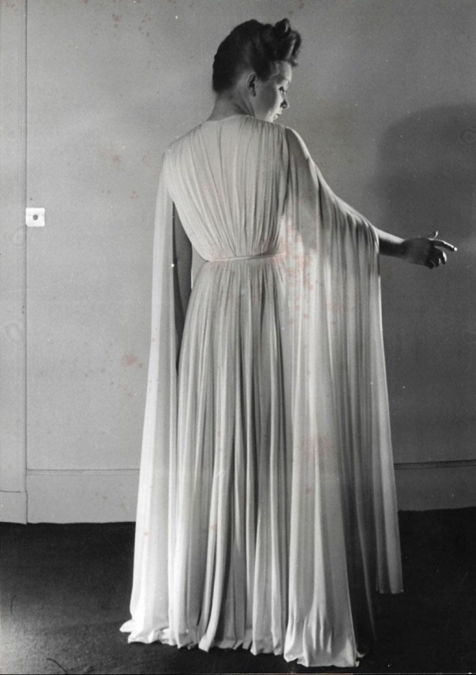
Figure 1: Photograph of the maison Grès. Inscription on the back: “With an admirable simplicity of line, this evening dress in white rayon jersey falls with great fluidity. The fine pleating starts from the shoulder and shapes the bust; the waist is tight with a jersey cord. Two wide wing-shaped sleeves float freely to the ground. The second photograph of the same dress shows the breadth and movement of the wings on the back”. Ca. 1942. Gelatin silver print, 13 × 18 cm. Anabela Becho Collection.
between body and gown, the harmony and tension between the organic and inorganic (Benjamin, 1999), that Grès’ work goes beyond mere design. It moves naturally into the real world of creation, as the couturier’s gowns do not just dress the body; they become the body itself, in which fabric and flesh turn into a single, indivisible, absolute entity (Becho, 2021). Even though her oeuvre is much wider than the so-called “goddess dresses”, the long draped gowns, reminiscent of eternal time, became her archetype (Fig. 1).
The expressive use of pleating and drapery in all its limitless variation and fluidity along the outside is rightly considered to be Grès’ hallmark. Grès had a profound respect for the textile material, honouring its integrity, pre- ferring not to cut it, and reducing its size through successive pleats — the amplitude of her dresses’ skirts could occasionally reach twenty metres in dia- meter. In contrast with the ephemeral nature of fashion, it is my goal to show in the course of this paper that precisely the opposite can be true through
Sculpting the Fabric: Madame Grès’ Emotional and Innovative Pleating Technique 535
the observation of the French couturier’s meticulous, timeless, emotional and innovative pleating technique, in which the role of avant-garde materials is crucial.
SCULPTING THE FABRIC Some fabrics were made exclusively for her; modern materials like the silk jer- sey became her favourite textile, given its malleability and lightness. Madame Grès claimed: “You can know the soul and nature of a fabric, of silk, from its touch. When I drape a mannequin in silk, it reacts between my hands and I try to understand and judge its reactions. Thus, I give the dress that I’m creating a line and a form that the fabric itself would like to have” (Hata, 1980). It was the lack of deep formal knowledge in cutting and sewing that led Madame Grès to a sculptural approach to fabric, a more intuitive pro- cess than the methods used by her contemporaries of the 1930s. Using her hands, the couturier carved the cloth as if it was stone. From the begin- ning, Grès’ fashion and sculpture were linked; the fruit of her vocation, the designer intuitively sculpted the fabric, working it, shaping the silh- ouette with the warmth of her skilled hands. Because of their perfection, her models evoked classical statues. “Draping and cutting the fabric on the bodies of her models, Miss Alix [Grès] understands couture as a sculptor” (Jardin des Modes, 1938).
The initial width of the fabric could be reduced to a few centimetres by an exquisite pleating technique: a succession of folds created in the grain, following a depth of three centimetres and a relief of no more than two mil- limetres; they were sewn at the back, two by two, after being patiently fixed by a myriad of pins on a dressmaker’s dummy covered with kraft paper. The first step of the process took place in the solitude of her workspace: she claimed to use only pins to sculpt the toile in a wooden mannequin, never sewing and employing only scissors. Once the toile was ready, she transmit- ted her idea to the première d’ atelier, providing them with the pattern, the croquis and the elected fabric. After receiving the directives, the première interpreted her indications, translating them into the required measurements and replacing the provisional pins with permanent stitches. The patterns were thus ready to be replicated on the final fabric, where the border, the grain, and the bias were marked. Finally, the network of folds was plea- ted directly on the bust at the top of the corset, fixed with pins and later sewed.
The jersey, inseparable from most sculptural Grès’ creations, represents, like the couturier’s work, the exciting bond between history and modernity, past and present, tradition and innovation. In particular, the emblematic dra- ped dresses were prodigious in conception and rich in evocative power as much as the taste of the time. Her models were praised “as a miracle of inge- niosity and accomplishment”not forgetting their modernity: “This admirable creator possesses the gift, by subtleties all of her own, of evoking the oriental passiveness or the all-powerful grace of the purest of antique Art statues in her models which, as paradoxical as this may appear, are absolutely adapted to the modern life of our western cities” (L’Officiel, 1935).
536 Becho
The importance attributed to fabrics, the raw material, is the dominant note throughout the couturier’s long career; in the press releases of the mai- son Grès, the textile manufacturers were mentioned at the head of each of the models. Djerdafyn, Djersyl, and Djersatimmix, among many others, were the names of the materials purposely created for her, showing the close relation- ship that Madame Grès’ maintained from the beginning with the cutting-edge of the French textile industry: “It is difficult to imagine today how remarkable the materials were that France produced then; France was the first in the field. The silk manufa- cturers of Lyon and St. Etienne and the woolen manufacturers of the North employed first class artisans and created first-class materials, real masterpie- ces. Marvelous materials were created for me at that time. They don’t exist anymore; they would be too expensive and nobody would take the trouble. The firm of Bianchini [-Férier] did a gold-and-silver silk lamé for me in 1938 with Persian miniatures at the rate of six centimeters a day! Rodier, Petillault, Colcombet, Ducharne, and Cordurier made sumptuous materials for me, too. Because natural materials were rare during the war, synthetic ones were craf- ted, and the first results were sensational. The feel was light, incomparable!” (Villiers le Moy, 1982).
At maison Grès existed a large room to store the textiles. A series of ceiling- height shelves contained countless rolls and lengths of fabric. In a counter, it was possible to assess the characteristics and texture of the cloth, thus facilita- ting the choice. The faithful Micheline, a rustic woman and close collaborator of the designer, was in charge of the storage. In a photograph ca.1943, the couturier is in storage. She is on top of a ladder holding a piece of fabric. With her hands, she feels the texture of the cloth. With an absorbed gaze, she shows concentration and is focused on her task – choosing the ideal fabric to embody her ideas; or looking for inspiration in textiles to design a particu- lar model. Throughout her career, Madame Grès never tired of emphasizing fabric selection as a crucial moment in creation, emphasizing the role of texti- les in the development of a collection: “When I choose a fabric, I immediately know what I want to do with it, not in detail, but instinctively. I love all beau- tiful fabrics, be it wool or silk, even some blends. Taffeta, which stands on its own, has character. Then I drape the fabric and let it take its place”(Lepicard, 1980). The fabrics she chose were described in detail on the pages of maga- zine, almost like textile poetry in which the indecipherable names contained mystery and inspiring phonetics. “Fabrics: coarse canvas, hand-woven wool- lens (exclusive); Djersalap by Rodier, Cyngalya by Meyer, Tramireine by Chatillon, Mouly, Roussel, gold and black lamé by Coudurier, Fructus; rib- bed wool jerseys, used horizontally, pale blue piqué.” In October 1937, Vogue highlighted an Alix [Grès] day-draped dress in “Djersafyn dark green from Rodier” (Vogue, 1937). Madame Grès combined a passion for sophisticated textiles, technical perfectionism and an audacious sense of the combination of fabrics. All these qualities gave her work an exceptional modern aura. “Her rigour went hand in hand with an unbridled imagination, an innate sense of luxury and extraordinary modernity. No haute couture great has had as much audacity as her” (Charles-Roux, 1994). The couturier’s draping relied
Sculpting the Fabric: Madame Grès’ Emotional and Innovative Pleating Technique 537
upon materials, and her technique evolved due to the technological evolution of fabrics. It was, therefore, something focused on the future and not the past.
If her fabric choice lay in the most innovative production and technology, the way she worked with it was purely manual. The designer claimed that the draping that made her famous was due entirely to the fabric with which her work is most associated and her achievement in sculpting it. “When I started to make draped dresses, I drew inspiration from nowhere…I disco- vered silk jersey by chance. It interested me right from the moment when I was able to handle it” (Vogue, 1974). Madame Grès’ vocation as a sculptor was decisive for the technical mastery of the material she managed to achieve, an excellent manual skill in which emotion was present. The suppleness of silk jersey, combined with her physical virtuosity, offered her infinite sculptu- ral possibilities. “The fabric that allows the variety to renew itself endlessly is almost always jersey, this clay, docile without sentimentality, of the dress sculptor” (Vogue, 1937). An ethereal quality and lightness emanate through the couturier’s creations since day one. These characteristics were the fruit of the couturier’s manual skill, which allowed her to sculpt the fabric subtly, never in a forced way. “Alix [Grès] handles gradient jerseys with marvellous flexibility” (Vogue, 1937). The couturier’s skilled hands sculpted prodigious draperies to the rhythm of her emotional technique. “We don’t know, in Alix [Grès], which should be admired more, her talent for combining fabrics and colours or her skill in the art of draping and distributing the unheard-of wid- ths, which, directed by her fairy hands, never give the slightest impression of heaviness or ‘mass’ “(L’Officiel, 1938). L’Officiel magazine widely praised the couturier’s unique work and personality, writing that her technique was close to sculpture. Her emotional way of moulding the textile material, they referred to, imbued the fabric of heart and soul. Her in-depth knowledge of tissues gave her mastery of movement while flattering the female silhouette: “We will never be able to express our admiration enough for the magnifi- cent creations of Alix, these creations full of such a personal character, which impose themselves by a technique, a harmony which holds of the prodigy! We can not speak of cutting but of sculpture with Alix [Grès], who seems to carve and chisel in the middle of the material, who kneads and shapes the fabrics until giving them the shape of her dream” (L’Officiel, 1938).
SUSPENDING TIME “You have to want to do something with something. They say that these draped gowns come from antiquity. But I’ve never been inspired by antiquity. Back before this fabric existed (a delicate silk jersey), I didn’t even think about draping. But as soon as I got the fabric, it fell into place on its own. Greek sculptors made their sculptures from the materials that were best suited to them” (Alix Grès L’Enigme d’un style, 1992).
The material power of cloth is evident since the beginning of civilisation, and in its sartorial expression lies its metaphorical nature. Anne Hollander points out: “Clothes, then, are objects made of fabric that convey messages beyond the power of the cloth itself to convey”(Hollander, 1978). The associ- ation of drapery with a more elevated form of perfection came to us through
the stone folds arrested by time in classical sculpture. Although there is no such thing as a clear and absolute thread that links drapery and nobility, “the association of the idea of drapery with the idea of a better and more beautiful life flourished, fed by the accumulated art of the past with its thousands of persuasive and compelling folds” (Hollander, 1978).
History repeats itself, reinventing the past in a new light, and fashion takes this to a higher level. The plurality of meanings of the word pattern shows it clearly, simultaneously signifying an example to copy, a repetition of motifs, a particular technique, or a drawing or shape used as a scheme to make some- thing. The pattern, an ideal of the past to be copied as a model, is reinvented through new insights and techniques — new patterns — that will, in turn, generate another pattern that will be copied in the future. And so the cycle of fashion continues (Becho, 2017).
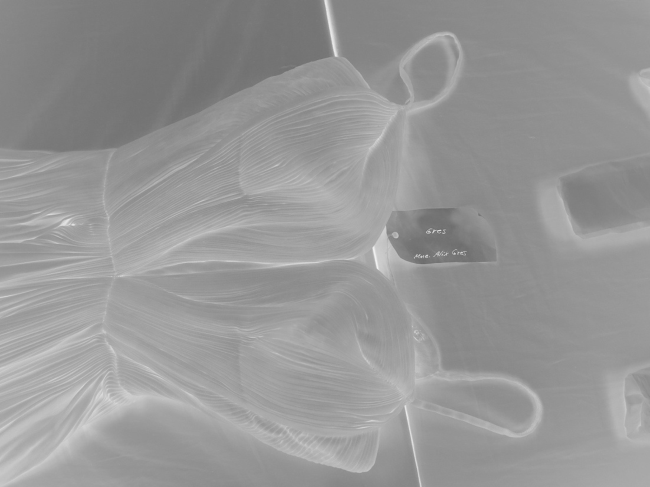
At the turn of the twentieth century, when western civilization was looking back to the past while moving forward, the notion of time and temporality, became a major trend in various disciplines. Like the literature by Marcel Proust and his À la Recherche du Temps Perdue, very influenced by Henri Bergson’s philosophy, in which the past leads an active role in the interpreta- tion of the present, conducting the way to the future. Bergson’s conception of memory implies a qualitative multiplicity, a continuity of experiences with- out a juxtaposition, and an active prolongation of the past into the present (Bergson, 1896). Far from being extraneous abstract concepts that we can apply to the sartorial object, time and memory are weaved into a dress toge- ther with the warp and the weft. Dresses can be seen as temporal conveyors, in which different ‘times’ – past, present and future – coexist without line- arity (Fig. 2). In the article L’Orientation Neuve de la Technique Éternelle
Sculpting the Fabric: Madame Grès’ Emotional and Innovative Pleating Technique 539
du Drapage, Lucien François reflects on how fashion’s history affects its pre- sent - its novelty - namely in the classically oriented draping techniques. The author emphasized Grès as a leading figure and innovator, being the first to sew the pleats to hold them in place, like arrested in time (François, 1944). The obsessive pleating, fold after fold, as a manually repetitive yet medita- tive process, which would last “up to 300 hours of work” (Benaïm, 2004), arrests minutes and hours in a dimension that seems to suspend time. In light of Bergson’s duration, this suspension is far from being immobile: it is pure mobility, containing the continuity of experiences implicit in the memory of the gesture, in the act of pleating each fold. Madame Grès’ dresses interwe- ave their physical evidence with the qualitative multiplicity that defines the notion of memory within Bergson’s thought. From their tangible immane- nce, we can perceive different times - past, present and future - weaved into material memory.
CONCLUSION
Grès’ work is unmistakably modern, especially when it came to her choice of the most innovative fabrics, although it did not seem to belong to a particular age. At the same time, it takes us back to a distant past and forwards into the future. The evocative power of her gowns is breathtaking. It is ingrained in their materiality, the details of their construction, and the quest for perfection and beauty. Although a woman of her time, bound by a cultural context spe- cific to her epoch, there is a deliberate quest for timelessness at the very heart of Grès’ work, which, I argue, can be perceived in her technique. In a manual process, wrapped in an emotional dimension, each pleat is worked minutely, actively taking part in the construction of the garment’s final shape. The ini- tial width of the fabric could be reduced to a few centimetres by an exquisite pleating technique: to be kept in place the folds were sewn at the back, a sartorial innovation in the universe of Parisian haute-couture. Time seems to be suspended by this technical detail. In the light of the French philosopher Henri Bergson’s theory, this suspension can be seen as duration, a moment of simultaneity, an experience of temporality based on a constant interaction between the past (the classical approach), the present (the moment of the making of the dress) and the future (the preview of the following repetitive gesture of making). In the draping of the fabric, we become conscious of the physical dimension of the hand that created the sculptural object, that carved the cloth as if it was stone, involving the body in a game of hide and seek, concealing and revealing its contours, emphasising its movements. It is this tension between the body and the fabric that brings the dresses alive as the result of an emotional relationship between the humanity of the making process and the technical innovation of the textile material.
ACKNOWLEDGMENT
The author would like to acknowledge: CIAUD, Professor Fernando Moreira da Silva, Professor Ulrich Lehmann, Professor Rita Almendra, Pedro Rosário Nunes.
540 Becho
REFERENCES
Alix Grès L’Enigme d’un style (1992), p.16. Hyères : Editions L’Or des Iles. Becho, Anabela (2021). “Grès: (Self)Portrait as a Dress”, in: Electra Summer 2021, pp 176-191, Lisboa: Fundação EDP. Becho, Anabela (2017). “Contemplating a Madame Grès Dress to Reflect on Time
and Fashion”, in: The Journal of Dress History, Volume I, Issue 2, Autumn 2017, pp. 2–13. Benaïm, Laurence (2004). Grès, p.13. New York : Assouline Publishing. Benjamin, Walter (ed. 2002). The Arcades Project (1927–1940), pp. 62–81.
Cambridge: Harvard University Press. Bergson, Henri (1896). Matter and Memory. London: George Allen and Unwin (1911). Charles-Roux, Edmonde (1994). “A Dictator Disguised as a Mouse”, Paris Match,
January 1994, p.57. François, Lucian (1944). “L’orientation neuve de la technique éternelle du drapage”, Silhouettes, n
182, pp. 8–9. Hata, Sahoko (1980). L’Art de Madame Grès, p.256. Tokyo: Bunka Publishing
Bureau, p.256. Hollander, Anne (1978). Seeing Through Clothes, pp. 2–3. New York: The Viking Press. Lepicard, Marie-José (1980). Le Portrait de Madame Grès, 00 :29 :00. Aujourd’hui
Madame, Antenne 2. Villiers le Moy, Pascale (1982). “The Timeless Fashions of Madame Grès”, Connoisseur, August, pp. 94–99. Jardin des modes (1938). April. L’Officiel de la Couture et de la Mode de Paris (1938). Collections report, September. L’Officiel de la Couture et de la Mode de Paris (1935). December, p. 113. L’Officiel de la Couture et de la Mode de Paris (1933). Collections report, June, p. 80. Vogue (1974). September, p.171. Vogue (1937). October, p.37. Vogue (1937). January, p.14. Vogue (1937). April, p. 46.
LISTED IN THE AHFE DIGITAL BOOKSTORE CATALOGUE
Explore the complete digital volume
Intelligent Human Systems Integration (IHSI 2023): Integrating People and Intelligent Systems
Read this individual research paper free through the original publisher, or explore the full digital proceedings book.
ISBN 978-1-958651-45-2
Explore this ISBN in the AHFE Bookstore ↗Listed in the July 2026 bookstore catalogue; search by ISBN to confirm current availability · Digital book purchase optional