Cheng Peng, Siyun Teng (2023). Beyond Problem-solving: Exploring Design Modes for Children’s Medical Care Service and Experience. In: Human Factors in Communication of Design. AHFE Open Access, vol. 90, pp. 146–154. https://doi.org/10.54941/ahfe1003706
Driven by great passion of designing for the real world, College of Design and Innovation , Tongji University, reached out to Shanghai Children’s Medical Center in 2014 and established collaboration regarding this plan. We attempts to understand the cause for the children’s ‘crying’ and thus identify what could be done to solve the problems. By introducing and analysing this eight-year exploration, We found that following the traditional problem-solving was not a good solution to the communication problem between children patients and doctors. this paper attempts to understand and reframe the design modes in the context of designing for children’s medical care service and experience, We established a new design model of an IP-based communication system for children patients, the parents and the doctors, providing space for further discussion and practice.
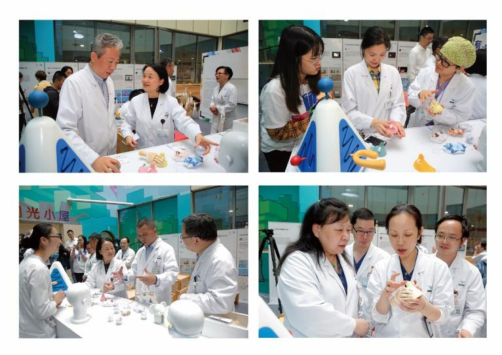
As one of the best hospitals in Shanghai dedicated to children’s medical care, Shanghai Children’s Medical Center (SCMC) was the first to propose the goal of establishing a ‘children’s hospital without crying’, with the purpose of improving children’s healthcare, especially their experience at the hospital (see Figure 1).
Research shows that health care providers tell patients the information of diseases and relevant treatment can help patients to participate in treatment actively (Eysenbach, G., 2001), which enables doctors, patients and their families to establish a partnership. So they can work together to solve the problem of information transmission in medical services to ensure the accu- racy of it and take care of the needs and preferences of the patients. Such forms of service usually require constant design iterations, involving pati- ents and healthcare professionals throughout the process. They will act as information providers, design partners, testers and users at the same time. But, patients are vulnerable, especially children patients has limited cogni- tive abilities and poor resistance (Imelda, & Coyne, 2006), which leaves a lot of uncertainties in the design mode. The patients and doctors selected
Figure 1: “No-cry” hospital exhibition received high compliment and welcome by the doctors. (Photo by the SCMC, non-commercial) during the design mode are clearly targeted and specific to the concrete situation and the resulting product or service can only be designed to solve a specific and concrete problem. Whereas medical service system is sup- posed to innovate constantly to satisfy the needs of patients and health care providers, the original design principles can no longer cope with the complexity of medical service. Against this background, it’s necessary to rethink new ways to satisfy the needs of doctors, patients and their families today (Altman, M., et al., 2018).
The design thinking method recognizes that no one discipline can syste- matically solve complex health issues alone. Hospitals need to imple- ment a patient-centered design model while also paying more attention to communication during the caregiver and patient meetings (Roberts J P., et al., 2016). In addition to providing medical care, hospitals also need to consider exploring patients’ reasons for visiting the physician, under- stand medical issues and emotional needs, increase prevention and health initiatives, and enhance the relationship between patients and providers (Steinmair D., et al., 2022).
Driven by great passion of designing for the real world, College of Design and Innovation (D&I), Tongji University, reached out to SCMC in 2014 and established collaboration regarding this plan, the D&I team attempts to understand the cause for the ‘crying’ and thus identify what could be done to solve the problems. We conducted both online and offline research, mainly in the form of questionnaires, targeting both parents and doctors, to provide direction for the subsequent product design.it was found that pre- school children aged 2–6 are the most susceptible to infected bacteria and the most likely not to cooperate with doctors and parents during the medical treatment.
148 Peng and Teng
REFLECTION The Mode of Design Applied
The reflection starts from reviewing the mode of design applied in the colla- boration. The D&I team began to think about why the design skills acquired in college, such as creativity, sketching and visual sophistication, were not being applied well in design practice (Norman D A., 2011). In particular, the D&I team found in their field research: The team visited the entire hospi- tal including waiting rooms, injection rooms, surgery rooms and wards, and students tended to focus only on existing hospital conditions and system defi- ciencies to view the “unsatisfied need” of parents and children patients, so that they can develop items which can ease the children’s anxiety and release patients’ pressure psychologically or physically.
On the other hand, during these projects, the hospital is to a certain extent treated as a system of parts, and the students seemed to believe that if these individual parts could be improved, it’s more possible to elevate the pati- ents’ experience. Therefore, they usually started the design process by looking for problems of the parts and delivered the outcome as resolutions of the problematic situation. The mode of design applied here is problem-solving.
Analysis of Problem-Solving Design Mode The authors believe the problem-solving approach needs to be better under- stood before exploring alternative design modes. Design thinking is so widely used and even taken as the default approach among the industrial design stu- dents. One possible explanation of this is the influence of the wide-spreading Design Thinking promotion to larger audience by powerful design promoters (Brown, T., 2008).
It has not only been widely discussed in different communities, and has also casted influence among design schools. Design Thinking provides to the public a workable set of design procedure, according to which design begins with ‘empathy’ and then ‘define’ the problem, and develops to the stage of ‘prototype’ and finally ‘test’. In such design thinking framework, design more or less has become a way of resolution (Roberts, J. P., et al., 2016).
Design thinking theorises the thinking and applies the results in practice. The practice of design is not just a matter of copying and applying theoretical model.
It somehow makes design students believe these are the inevitable steps to accomplish a design. But it has been more than ten years since the current design thinking was introduced by tim brown in 2008, and the current design problems and social issues have changed a lot, even more complex.
EXPLORATION OF AITERNATION DESIGN MODES With the analyzed mode of design applied in those previous projects, which is problem-solving, how could we explore and understand other potential design modes?
With such understanding, the D&I team starts to realize that besides star- ting with a particular problematic approach, there may also be other options
of design modes, which would be starting with a universal dialectical appro- ach. In the Modes of Design, there are also Discrimination and Assimilation. The method of these modes is operational and dialectical, which are more from the perspective of concepts rather than situations. In other words, those approaches stand for sense-making of concepts rather than problem-solving of situations.
From the perspective of condition, a system is under a harmonious, orderly interaction. On Condition is the core property of the whole. The system repre- sents a pattern of assimilation. Assimilation is a process of approaching the truth or principle of organizational phenomenon. There are no small parts in the system, but rather the harmonious unity of every part (Richard, B., 2019). We summarize the problem of communicating information in medical care as a systemic problem. How the complexity of problems in information commu- nication can be solved orderly and harmoniously so that a better experience can be served for children patients will be the subject of this paper.
This is inspiring for the D&I team to further the design practice at the hospital. The issue of design for children’s hospital was revisited from the perspective of sense-making. It is noticed that at the hospital communica- tion is a key element to make the system work, and communication at the children’s hospital is more complex than that of other hospitals because it usually involves three parties, the patients, the doctors, and also the parents, who plays the role of information translator between the patients and the doctors. Confusion and misunderstanding are quite common in a commu- nication with translators, and in the case of children’s treatment, these will cause the children patients’ fear and anxiety. Upon further study and field research, the D&I team decides to develop a communication system, with the center as the children patients since they the key “user” to comprehend the concept of well-being. All the treatment and communication about it is carried out with the center as the children patients (Wanzer, MB, et al., 2004). And because of the uniqueness of children cognition, an effective communi- cation system should be established with the design mode of sense-making, to enable the sense-making in the hospital system.
So, how can we make the experience better for our children patients? What design mode can do this? Research has shown that treating children as active participants in healthcare situations can reduce their anxiety. For children, they want more attentions from doctors and parents, and they want to be involved and be able to express their feelings and ideas (Carlsson, I. M., et al., 2020). In the design mode, the relationship between design and healthcare will be rethought, from the monolithic traditional design model to a coherent and universal design, from the original approach of solving specific problems to a universal view of design.
The designer will no longer be confined to the hospital and the medical process, but to think how to combine well-being with design mode in both the medical and non-medical environments. This mode based on the narra- tive tone of storytelling with IP intervened, it can focus on children’s feelings and ideas and effectively connect the conveyance of information across space and time (the role of IP). We look at the role and work of designers from a universal perspective, and IP serves as an ecological tool, so the issue of
150 Peng and Teng
communicating health information is no longer confines to time and space, or confines to hospitals and medical processes.
In the next chapter, we will introduce our detailed practice and explain how we use IP-based characters to help children establish a positive perception of health care.
IP-BASED COMMUNICATION SYSTEM The Existing Communication at the Hospital and Its Consequences
The various components of a hospital are not really a system, and when a child needs to be hospitalized across departments, including waiting rooms, injection rooms, wards, etc., we usually assume that the child is surroun- ded by such a complex and unfamiliar environment, especially for pre-school children, which can be frightening for the child the children patients, who are the problem-owner, are usually ignored in the communication (Carlsson, I. M., et al., 2020). On one hand, the doctors usually deliver information dire- ctly to the parents without much attention to the children’s emotions and demands because they believe the adults are more capable of understanding the medical information, and this is more effective for the treatment. On the other hand, the parents assume their children are not capable or willing to follow the doctors’ instructions so they tend to force the children to obey the doctors’ words or receive medical treatment (Imelda, & Coyne., 2006). These will lead to the children’s resistance to hospital since they are not tre- ated with care and respect, and this will imprint the children with a negative image of the hospital.
For children to have a better experience in medical visits, the previous relationship between children, parents and hospitals must be changed. From the parents’ perspective, children are pushed to obey the doctors’ treatments and to cooperate with the doctors in a coercive manner. From the doctors’ perspective, children’s especially preschool children’s requests and feelings are completely ignored as the doctors rarely talk or listen to them. The doctors talks to the child’s parents directly, leaving the child with no decision-making power in the medical process. This treating method directly leads to poor experiences and treatment outcomes for children and has an adverse impact on their self-esteem and healthy growth(Imelda, & Coyne., 2006).
This was also proved by the field research at the hospital. When research- ing at SCMC, we noticed that children’s fear and anxiety at the hospital is not caused by physical pain, but more often is caused by limited understan- ding of the intimating surroundings, especially during injections and inhaled pharmaceutical aerosols treatment.
Not only are children patients not provided with a good experience during their medical visits, but also the pre- or post-visit part is missing. We need to shift the role and perspective of the designer and use an empathetic design thinking mode (Brown, T., 2008). We need to see the children’s health care process as a system, to pay attention to the whole experience. We need to realize that the medical visit is also a part of children’s life and part of the children’s growing awareness of well-being issues.
As mentioned by a nurse: “Actually, the injection process is finished instan- taneously and children will not feel any pain. The problem is that children are not willing to put out their hands before the injection. The same is true for the inhaled pharmaceutical aerosols treatment. Children will not feel any pain, but they need to wear a mask. In many cases, the masks are frightening and make children uncomfortable. As a result, children are naturally resi- stant to the treatment. “ Therefore, a better and positive understanding of the treatment and the hospital will help to ease the children’s psychological difficulties.
From the discussion above, it can be seen that the children’s capability of comprehending the medical information or surrounding is the crucial point in the communication system at the hospital. Therefore, out study and design is carried out based on the cogitative uniqueness of the children.
IP-Based Communication System and Its Potentials To develop a communication system which helps the children to have better understanding of the medical procedure and a positive sense of the medical care, we need to understand the ways children sees the world.
According to research in the field of children cognition, storytelling is one of the most effective ways for the children to understand the world, especially in communicating obscure medical terms and basic knowledge, which are usually far beyond the cognitive capability of children.
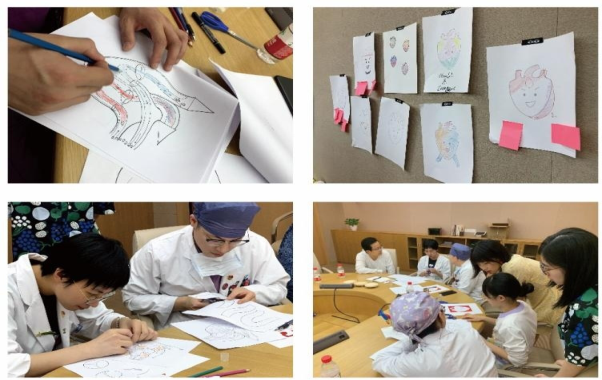
How could we make to big story to include all the medical information? The D&I team decides to develop a design which enables the story-telling, not only at the hospital, but also at home. A story usually includes a plot, major characters, and an ending (Walter, S et al., 2015). Usually, the characters are the starting point of the story, and other elements of the story are brought by them or carried out around them. Without characters, there will be no story, and no “sense”. So we believe designing characters will be the basis for story-telling of medical care (see Figure 2).
Figure 2: Workshops with SCMC team to create IP characters. (Photo by the SCMC, non-commercial).
152 Peng and Teng
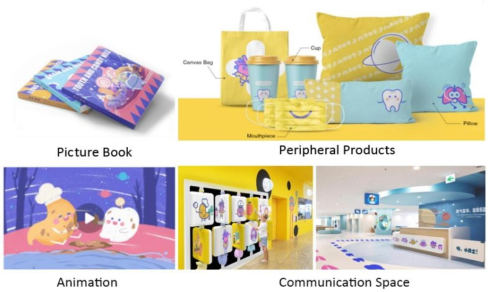
The D&I team has tried to involve the IP in the whole process of medi- cal treatment for the child. Before the treatment, the child can learn about simple pathology through medical science animations/illustrated books, and integrate some hospital plots into illustrated books so that preschoolers can familiarize the hospital environment in advance; and the anthropomorphic, friendly characters can be designed to compiled into cartoon images that are more easily understood by children. During the hospitalization, the hospital departments are linked as a whole, using the same visual symbols, simi- lar color schemes and anthropomorphic cartoons to enhance the children’s enjoyment of the environment, thus making them less afraid of the unfamiliar environment (see Figure 3). After the treatment, anthropomorphic IP images are designed around them and enable children to see their familiar cartoon characters at home and in hospital.
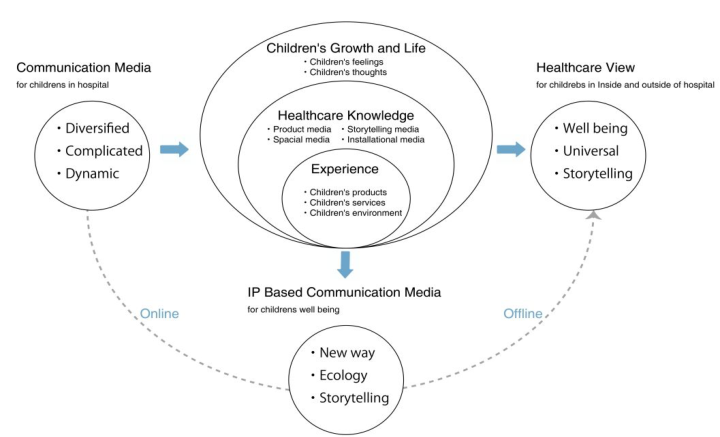
Therefore, the D&I team designs the character of IP, and further builds IP into an ecosystem (see Figure 4). The ecosystem is mainly divided into two
Figure 3: Designs in the IP-based communication system. (Photo by the author).Figure 4: IP is ecology (system diagram).
parts, online and offline, and children can get access to the system through online and offline. The online part is mainly presented in the form of website, and the offline part operates based on the platform of hospital. In general, the ecosystem can provide good service through IP, whether it is an online way or an offline way.
CONCLUSION
From the perspective of Condition, we found that the use of IP to build vir- tual characters is easier for children to accept and is beneficial to the healthy growth of children. IP steps into the real world and resonates with children, which makes it easier for children to accept medical devices and hospitals by story-telling, and reconstructs the relationship between children patients and doctors; As a medium, IP creates a space for communication in the process of children’s medical treatment, which can convey medical and health know- ledge through different ways; IP is an ecology and a design mode. Further, IP can cross the media to narrate and spread through multiple channels, which strengthens children’s cognition of the real world, and is characterized by the narrative and story-telling.
From the perspective of children, IP is no longer a virtual character but a growth partner. Bringing IP into reality makes it easier for children to accept medical devices and hospitals, learn medical knowledge, reduce their fear during the medical process, and finally have better medical experience.
This paper reports on the series of practice by College of Design and Innovation, Tongji University, during the design-driven collaboration with Shanghai Children’s Medical Center for improving children’s medical care service and experience. The design mode applied during this process is refle- cted, discussed and elaborated, providing a framework for repositioning it. While problem-solving still plays important role in the ongoing collaboration between D&I and SCMC.
REFERENCES
Amaral, I., Simes, R. B., & Santos, S. C.. (2020). Transmedia Storytelling and Media Literacy: Learning Through Hybrid Experiences. ICERI 2020. Brown, T. (2008). Design thinking. Harvard business review, 33(6), 84–92. Carlsson, I. M., Arvidsson, S., Svedberg, P., Nygren, J. M., & Larsson, I.
(2020). Creating a communication space in the healthcare context: children’s perspective of using the ehealth service, sisom. Journal of Child Health Care, 136749352090480. Herrstephenson, B., Alper, M., & Reilly, E. (2013). T is for transmedia: learning through transmedia play. Norman, D. A., & Stappers, P. J. (2015). Designx: complex sociotechnical systems.
She Ji: The Journal of Design, Economics, and Innovation, 1(2), 83–106. Norman, D. A. (2011). Wir brauchen neue Designer! Why Design Education Must Change. Nygren, J. M., Lindberg, S., Wrnestl, P., & Svedberg, P. (2017). Involving children
with cancer in health promotive research: a case study describing why, what, and how. JMIR Research Protocols, 6(2), e19.
154 Peng and Teng
Richard, B. (2019). Systems thinking and design thinking: the search for principles in the world we are making - sciencedirect. She Ji: The Journal of Design, Economics, and Innovation, 5( 2), 85–104. Roberts, J. P., Fisher, T. R., Trowbridge, M. J., & Bent, C. (2016). A design thinking
framework for healthcare management and innovation. Healthcare, 11–14. Steinmair, D., Zervos, K., Wong, G., & Lffler-Stastka, H. (2022). Importance of communication in medical practice and medical education: an emphasis on empathy and attitudes and their possible influences. Journal of International Psychiatry, 12(2), 15. Swap, W., Leonard, D., Shields, M., & Abrams, L. Using mentoring and storytelling
to transfer knowledge in the workplace. Wanzer, M. B., Booth-Butterfield, M., & Gruber, K. (2004). Perceptions of health care providers’ communication: relationships between patient-centered commu- nication and satisfaction. Health Communication, 16(3), 363–384. x, & Coyne. (2006). Consultation with children in hospital: children, parents’ and
nurses’ perspectives. Journal of Clinical Nursing.
LISTED IN THE AHFE DIGITAL BOOKSTORE CATALOGUE
Explore the complete digital volume
Human Factors in Communication of Design
Read this individual research paper free through the original publisher, or explore the full digital proceedings book.
ISBN 978-1-958651-66-7
Explore this ISBN in the AHFE Bookstore ↗Listed in the July 2026 bookstore catalogue; search by ISBN to confirm current availability · Digital book purchase optional