Leandro Luigi Di Stasi, Francesco Angioi, Marcelo Fernandes, Giulia De Cet, M Jesus Caurcel, Kristina Stojmenova, Jaka Sodnik, Christophe Prat, Carolina Díaz Piedra (2023). The use of cardiac-based metrics to assess secondary task engagement during automated and manual driving: An experimental simulation study. In: Application of Emerging Technologies. AHFE Open Access, vol. 115, pp. 367–377. https://doi.org/10.54941/ahfe1004334
Most driver monitoring systems (DMS) rely on cameras facing the driver while detecting their gaze or head position. Both future automated driving (AD) in-vehicle interactions and AD vehicle interior designs (e.g., seating arrangement) might drastically reduce the effectiveness of such camera-based DMS solutions, however. Thus, alternative solutions that do not rely on cameras, and therefore compatible with upcoming AD journey experiences, are worth being investigated. Here, we studied the behavior of several cardiac-based indices. We aimed to determine the effects of engaging in non-driving-related tasks (NDRT) in a semi-dynamic driving simulator on heart rate and heart rate variability parameters (here, we report the standard deviation of R-R intervals [SDRR]). We developed a 2 (AD vs. manual driving [MD] modalities) by 2 (one-hand vs. two-hand concurrent Task modality) within-participants experimental design. Thirty-two expert drivers drove along two highway scenarios (∼ 22 minutes each) in daylight conditions. Each scenario included four distraction periods. In each distraction period, participants performed a concurrent task in addition to their main task (i.e., driving the simulator during MD, supervising the system during AD). We monitored participants’ cardiac activity and collected performance levels on the NDRT, driving performance, as well as subjective ratings of task load. Cardiac-based indices clearly differentiated Task modality, with the two-hand task inducing higher heart rate and SDRR. Driving modality (MD vs. AD) only influenced heart rate, which increased during MD. Driving performance and subjective ratings, as well as performance on the NDRT, were able to reflect the experimental manipulation, with the two-hand concurrent task (in MD) being the most disruptive and demanding condition. Overall, these findings have the potential to improve future DMS design and road safety by providing accurate measurements of driver engagement. They can be key to assess future driver-vehicle interactions using for example, non-contact, more realistic, heart-rate radar-based sensor solutions.
Driving while engaging in non-driving-related tasks (NDRT) represents a serious threat for road safety. Drivers focused on NDRT are less engaged in the main task (i.e., driving) and can often experience overwhelming situ- ations (both cognitive and physical). Overall, these situations are associated with more frequent unsafe driving behaviors (for a broad discussion on this issue, see Kauffmann et al., 2022). Recent technological developments involving advanced driver assistance systems and, most recently, automated driving (AD), have helped to play down this threat (Teodorovicz et al., 2022). That is, while primary driving tasks are allocated to the automated system, drivers can engage in NDRT without compromising road safety (Zangi et al., 2022). However, also in highly AD, drivers are expected to take back vehi- cle control at some points. Thus, systems and solutions able to monitor the cognitive and physical state of the driver (will) play a crucial role in minimiz- ing unsafe driving behaviors and reducing accidents (Hayley et al., 2021). Indeed, the upcoming Euro NCAP Safety Assist protocol foresees incentives for driver monitoring systems (DMS) that are able to detect distracted driving (Mulhall et al., 2023).
DMS research has a long history, spanning nearly twenty years, but has intensified over the last few years (Manstetten et al., 2020). Although sensi- tive DMS solutions already exist and are being installed in affordable cars or used for insurance applications, most of these solutions are based on remote dashboard-mounted devices, relying on cameras facing the driver while detecting their gaze/head positions (Tian et al., 2019) or facial features (Diaz-Piedra et al., 2019). Future AD in-vehicle interactions (for a recent dis- cussion on this topic, see Wilson et al., 2022) and future AD vehicle interior design (e.g., seating configurations, Tremoulet et al., 2021) might drastically reduce the effectiveness of DMS camera-based solutions. For example, the occlusion of the cameras (e.g., when reading a newspaper) or the position of the driver (e.g., while seating in a rotated and translated seat) might increase the loss of information collected by the DMS, and consequently limit its pre- dictive power. Thus, investigations on alternative solutions, compatible with upcoming AD journey experiences –not relying on cameras–, are warranted.
Classical and recent studies from different transport domains have explored the potential application of cardiac-based metrics –using free- camera recording techniques– as suitable indices for tracking operator’s functional state in response to task demands, including changes induced by concurrent tasks (e.g., Jorna 1992; Wierwille and Eggemeier 1993, for a recent review see Arakawa 2021). Yet, the difficulty of recording these indices (noise-prone) outside of a laboratory environment, and of interpreting results (hyper/hyposensitivity to different psychological, non-task-related factors), have long been considered barriers to implementing cardiac-based metrics in transport domains (Liu et al., 2021; Roscoe 1992). Thus, overall, the question of how NDRT while driving modulates the driver’s cardiac response remains unanswered. On the other hand, new sensor technology (hardware and soft- ware) able to effectively attenuate noise motion artifacts (e.g., Arakawa 2021), new in-vehicle vibration-absorbing/mitigation solutions (Ma et al.,
The Use of Cardiac-Based Metrics to Assess Secondary Task Engagement 369
2022, Sharma et al., 2022), together with more than twenty years of research on the issue, might offer cardiac-based metrics new opportunities within the field of AD.
Here, we aimed to determine how driving while engaging in NDRT, with different task loads, might affect cardiac-based indices of expert drivers. Drivers underwent a set of standardized driving simulations with different task complexity levels, in a semi-dynamic driving simulator. To externally val- idate cardiac-based metrics, we collected driving performance (speeding time and variation of the vehicle’s lateral position), as well as subjective ratings of task load, all well-known indices of task load variations in driving.
METHODS
Experimental Design We developed a 2 (Driving modality: automated [AD] vs. manual [MD]) × 2 (Task modality: one-hand vs. two-hand concurrent NDRT) within-participants experimental design. Participants drove along two high- way scenarios (∼22 minutes each) in daylight conditions (midday, with 4 km visibility). Traffic density was controlled across the scenarios. Each sce- nario included four 5-minute distraction periods, two in AD and two in MD. In each distraction period (8 in total), participants performed a con- current NDRT (further details are described below) in addition to their main task (i.e., driving the simulator during MD, supervising the system during AD). Participants were exposed to conditions following a counterbalanced between-subjects basis.
Participants Thirty-two participants took part in the experiment (mean [M] age = 44.16 years ± standard deviation [SD] = 1.83, age range: 42–46 years; 30 males). All participants were expert drivers: all of them had held a Spanish car driv- ing license since for at least 7 years (M = 22 years ± SD = 5.70, range: 7–32 years). Participants reported a mean annual car driving mileage of ∼47,000 kilometers [km] ± SD = 42,508 (range: ∼7,000-150,000 km/year). All par- ticipants had normal or corrected to normal vision. They abstained from alcohol and nicotine during the 12 and 3 hours, respectively, preceding the driving session. Additionally, they had to get at least 7 hours of sleep the night prior to the study. For screening purposes, we measured subjective lev- els of arousal before the driving session using the Stanford Sleepiness Scale (SSS) (Hoddes et al., 1972). None of the participants scored more than 3 (SSS = 1.65 ± 0.55 SD, 1–3 range). Had they done so, they would have been excluded from further testing (Diaz-Piedra et al., 2019). All the participants were refunded for their time.
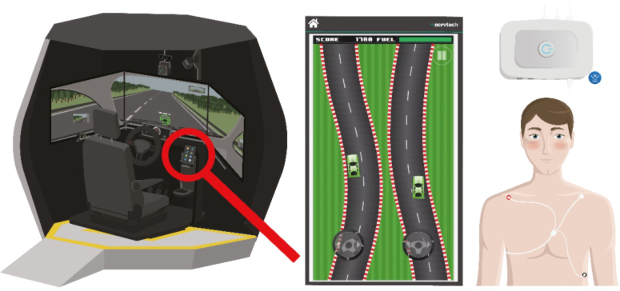
Instruments and Materials Driving Simulator and Performance Participants drove a semi-dynamic (four-degree-of-freedom motion platform, see Figure 1) driving simulator (Nervtech™, Ljubljana, Slovenia) recreating
a middle-sized electric automatic vehicle (equipped with autopilot and full self-driving capability features that amounts to SAE International Level 4 vehicle automation). To control the vehicle, participants used a real Skoda Octavia steering wheel (Škoda Auto a.s, Mladá Boleslav, Czech Republic), active force-feedback pedals (Sensodrive GmbH, Weßling, Germany) while seating on a real Ford-Max (Ford Motor Company, Dearborn, Míchigan, US) seat.
We employed SCANeR studio software (AVSimulation, Boulogne- Billancourt, France; version DT 2.5) to develop the virtual environment. The driving scenario was presented on three HD screens set into a panoramic arrangement to simulate the horizon of the virtual world (∼130
field of view). A 9-inch, dedicated screen, placed behind the steering wheel, dis- played an analogic speedometer. For further information on the features of the simulator, see Gianfranchi and Di Stasi, 2021.
Driving performance parameters (sample rate 125 Hz) were automatically extracted for each distraction period (in MD) via a customized MATLAB (Mathworks Inc., Natick, MA, USA) algorithm. Specifically, we extracted the mean and SD of the driving speed (km/h), the vehicle lateral position (meant as the SD of the lateral shift of the virtual vehicle from the middle of the rear axle of the vehicle towards the center of the lane). We also calculated the average time spent speeding (seconds). Following Spanish traffic regulations, we defined speeding as the amount of time driving at a speed 5% or more of the speed limits.
Figure 1: (Left) The driving simulator used for the study. (Center) The interface of the App “Old School Test Drive” (Adderit Games), used as one of the concurrent tasks (two- hand task condition). (Right) The BiosignalPlux Research Kit wearable ECG-solution and its electrodes recording configuration.
Concurrent NDRT We selected two on-line concurrent tasks that implied the interaction with a tablet installed in the simulator, using one-hand (i.e., keeping the tablet on its stand) or both hands (i.e., after removing the tablet from its stand). Dur- ing the one-hand task, participants answered to incoming SMS containing a series of two-digit arithmetical operations (additions without regroup- ing). The operations were randomly chosen from a predetermined set,
The Use of Cardiac-Based Metrics to Assess Secondary Task Engagement 371
which was the same for all the participants. For this task, as a perfor- mance index, we considered the number of arithmetic operations correctly answered. During the two-hand task, participants performed a game appli- cation (app) that required eye-thumb coordination (“Old School Test Drive” [Adderit Games], v1.2, available at https://play.google.com/store/apps/details ?id=com.adderit.oldschooltestdrive&hl=en_US&pli=1). This app simulated the bimanual visual-motor coordination task required by the Spanish Trans- portation authority for obtaining the driving license. The driver needs to coordinate and dissociate movement of each hand while interacting with a continuously moving stimulus. For this task, we considered the total mean score generated by the app as a performance index. To compare both indices, we performed a min-max normalization of the scores obtained. Thus, all scores obtained were transformed into percentages.
Finally, to assess the perceived task complexity associated to both NDRT, we used a single item (0-100 scale; with 0 meaning ‘not complex at all’ and 100 meaning ‘very complex’).
Cardiac Activity Recordings and Analysis We employed the BiosignalPlux Research Kit (PLUX Wireless Biosignals S.A., Lisbon, Portugal) to monitor participants’ cardiac activity (electrocardio- gram [ECG], see Figure 1). The system included a wearable hub with an 8-channel configuration (analogue ports) of 16-bit per channel resolution, using a Bluetooth data transmission technology for the synchronization with the simulator. A set of BiosignalPlux disposable, self-adhesive, pre-gelled, Ag/AgCl electrodes (24 mm diameter) was employed for ECG. The ECG was recorded with a single-lead local differential bipolar sensor (0.5-100 Hz bandwidth, ± 1.47 mV range, 400 Hz sampling rate) including a pos- itive, a negative, and a reference cable, each one ending with a dedicated electrode socket. The electrodes were placed in a chest Lead II configura- tion (Cacioppo et al., 2007) after having disinfected and gently cleaned the corresponding skin sites: one electrode on the depression below each of the shoulder blades (reference on the left side, positive on the right side) and one electrode (negative) on the anterior 5thintercostal space of the left side.
ECG signal was analyzed via customized MATLAB algorithms. The sig- nal was first down-sampled to 250 Hz and then filtered with a time-domain bandpass filter (1-100 Hz) and a notch filter (50 Hz; Chatterjee et al., 2020). The R peaks were automatically detected in the filtered signal using a 0.6 mV fixed detection threshold, with a 0.3 seconds searching range (Kwon et al., 2018). The inter-beat intervals (ibi) were calculated as the mean time differ- ence between two successive R peaks over each 5-minute distraction periods. Then, the heart rate (HR) and standard deviation of the R-R peaks interval (SDRR) were calculated as follows: HR = 60/mean (ibi) and SDRR = SD (ibi ×1,000).
Procedure The study was run under the guidelines of the University of Granada’s Institutional Review Board (IRB approval 1528/CEIH/2020). After sign- ing the consent form, participants filled in the SSS. Then, we provided
each participant with a cotton short-sleeve T-shirt to be worn during the entire experiment (see Diaz-Piedra et al., 2019). Afterwards, participants had a brief training session with the simulator and the tablet. Before the actual experimental session, we placed the ECG sensors (along with other psychophysiological sensors, not reported here) outside the simulator.
The experimental session started with a 5-minute familiarization phase with all the instruments and procedures once again, but with the participant alone in the simulator. Before starting the first driving scenario, participants had a 5-minute acclimation driving phase. Between the two driving scenar- ios, participants rested for five minutes. In both driving scenarios, the main participants’ task during MD was driving as if they were on a real highway (speed limit 130 km/h), keeping their hands on 10–10 position. The main task during AD was to supervise the system.
Data Analysis For the assessment of the NDRT effects on the ECG-based metrics and perceived task complexity level, we ran separate 2 × 2 repeated measures ANOVA with the Driving modality (MD vs. AD) and Task modality (one- hand vs. two-hand) as the independent within-participants variables. To analyze the driving performance (in MD), we ran separate dependent samples t-tests, one for each variable (average speeding time, driving speed [and its SD] and lateral shift position) with Task modality (one-hand vs. two-hand) as the independent within-participants variable. We used Holm-Bonferroni corrections for multiple comparisons.
RESULTS
During the driving simulation, we continuously recorded drivers’ ECG and their performance at the NDRT (with one/two hands) while the vehicle was set in AD or MD. After each NDRT, we also collected the perceived levels of task complexity (see Figure 2 and Table 1).
Table 1. Descriptive data (n = 32) for the main variables organized by driving modality (manual vs automated) and task modality (one-hand vs two-hand concurrent NDRT).
Table available in the original PDF paper.
Variables Manual driving Automated driving One hand Two hands One hand Two hands
The Use of Cardiac-Based Metrics to Assess Secondary Task Engagement 373
First, to ensure that the selected NDRT elicited an extra complexity to the driving task, we recorded and analyzed the driving performance while the vehicle was in MD. Indeed, while performing the NDRT with both hands (the most complex concurrent task), participants had less accurate control of the speed and lateral position of the vehicle, they drove slower with shorter periods of time speeding; all t-values31 > 2.72, all p-values < 0.05 (see Table 1). These results indicated the correct selection of the concurrent tasks.
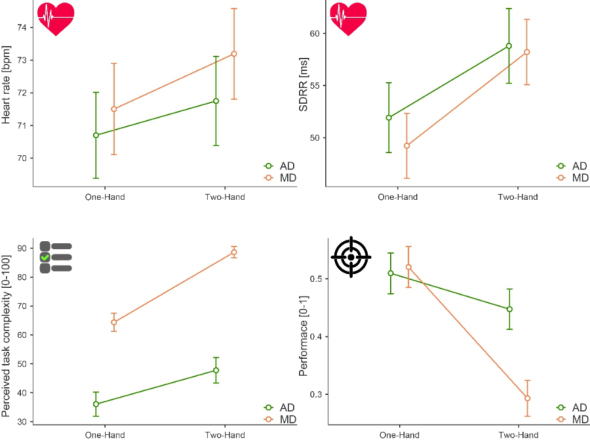
Perceived task load while engaging with NDRT was affected by Driv- ing modality, F1,31 = 90.02, p < 0.05, η2p = 0.74, and Task modality, F1,31 = 70.80, p < 0.05, η2p = 0.70, as well as by their interaction, F1,31 = 8.48, p < 0.05, η2p = 0.21. As expected, performing a concurrent task was judged more demanding during MD, especially for the two-hand task (all corrected p-values < 0.05).
Performance at NDRTs was affected by Driving modality, F1,31 = 6.61, p < 0.05, η2p = 0.18, Task modality, F1,31 = 13.05, p < 0.05, η2p = 0.30, as well as by the interaction between the two factors, F1,31 = 11.321, p < 0.05, η2p = 0.27. That is, NRDT performance drastically deteriorated when the concurrent task involved the two hands and the vehicle was set in MD (corrected p-values < 0.05).
Figure 2: Estimated marginal means (n = 32) for drivers’ heart rate and SDRR (top graphs), subjective ratings of complexity, and NDRT performance (bottom graphs) across the four experimental conditions. The orange line represents manual driving (MD) scenarios, while the green line represents automated driving (AD) scenarios. error bars represent the SD.
ECG-metrics were similarly influenced by the Driving Modality and Task Complexity. Heart rate was influenced by Driving Modality, F1,31 = 14.20, p < 0.05, η2p = 0.31, and Task Modality; F1,31 = 34.29, p < 0.05, η2p = 0.52.
SDRR was only significantly influenced by the Task Modality, F1,31 = 36.99, p < 0.05, η2p = 0.54. In both cases, the interactions between the two fac- tors were not significant, all F-values < 1.74, p-values > 0.05. That is, Task Modality similarly modulated both ECG-metrics, with the most complex task leading to higher heart rate and SDRR. Furthermore, AD was associated with a lower heart rate as a consequence of the reduced demands required by the driving task (covered by the automated system).
DISCUSSION
This experiment simulated conditions where drivers were induced to multi- task. The aim was to understand if concurrent tasks affected cardiac-based indices as well as performance and subjective indices while driving or super- vising the automated system. To do so, we designed two driving scenarios, which included both AD and MD modalities, while participants had to perform two types of concurrent tasks using a tablet, with one hand (i.e., answering to incoming SMS containing arithmetic operations) and two hands (i.e., using a dedicated app to perform a bimanual coordination test) besides driving/supervising. These concurrent tasks elicited different degrees of task load as participants’ driving performance showed: While driving engaging with a two-hand NDRT, driving style was less smooth (higher speed variation and less lateral control of the vehicle). However, in this experimental condi- tion (MD, two-hand NDRT), participants over speeded less –as they drove most of the time at a slower speed. Drivers’ behavioral self-regulation might explain these results. That is, when drivers perceive an increased presence of complexity and risk (i.e., multitasking while MD), they would self-regulate their behavior (reducing the driving speed) to adapt to the specific over- loading situation (Paire-Ficout et al., 2021). Indeed, in both AD and MD, participants would perceive as more demanding the two-hand NDRT. Fur- thermore, participants would have a better NDRT performance and perceive less task load during AD than during MD (e.g., Naujoks et al., 2016). ECG- related metrics mimicked the behavioral and subjective results, in line with classic results on ECG and task load manipulation (e.g., De Waard 1999). HR would be lower during AD than during MD. That is, participants would need to invest less effort when engaging in the NDRT and the driving task is automatized (see also Carsten et al., 2012). If we order the four experimental conditions by their degree of complexity, HR clearly increases as the over- all condition becomes more demanding (i.e., the task load increases).While these results confirm original (De Waard 1999) and more recent findings (see e.g., Alrefaie et al., 2019), it is important to acknowledge that physi- cal activity (i.e., motion artifacts) during MD and the two-hand concurrent task might have (in part) influenced cardiac-based metrics variations (e.g., Zontone et al. 2020). Finally, while Task modality had the same influence on SDRR and heart rate, Driving modality did not. That is, we observed a different sensitivity between these two metrics. SDRR is considered to be more accurate when calculated over 24-hour windows (Shaffer and Ginsberg 2017) than over 5-minute periods, such as the ones used in this study. Thus, it is possible that our methodological decision have led to a misrepresentative
The Use of Cardiac-Based Metrics to Assess Secondary Task Engagement 375
finding. Future studies should explore alternative time/ frequency-domain ECG-related metrics to assess secondary task engagement during automated and manual driving.
CONCLUSION
It is well known, that driving while engaging in NDRTs represents a potential hazard to road safety. However, the use of DMS (e.g., Morales et al., 2017) as well as the development of new driving modalities (partial/fully AD) can help to reduce the negative effects derived by driving when overloaded or distracted (e.g., Wilson et al., 2022). Here, we present findings that have the potential to improve DMS design and road safety by showing that accurate measurements of driver engagement can be provided without the need to use gaze/face/head camera detection. They can be key to assess future driver- vehicle interactions using for example, non-contact, more realistic, heart-rate radar-based sensor solutions embedded into the driver seat (e.g., Castro et al., 2019).
ACKNOWLEDGMENT
This study was funded by the European Union’s Horizon 2020 research and innovation programme under grant agreement No. 875597 - HADRIAN (Holistic Approach for Driver Role Integration and Automation Alloca- tion for European Mobility Needs) project. This document reflects only the author’s view, the European Climate, Infrastructure and Environment Exec- utive Agency (CINEA) is not responsible for any use that may be made of the information it contains.
Authors thank Dr. E. Gianfranchi and I. Blazquez for their contributions to the early version of the manuscript, data pre-processing, and/or help during data collection. We give special thanks to C. Calero, graphic designer, for her help with some of the illustrations and Dr. R. Fernandez-Mendez for her suggestions on the manuscript.
REFERENCES
Alrefaie, M. T., Summerskill, S. and Jackon, T. W., 2019. In a heart beat: Using driver’s physiological changes to determine the quality of a takeover in highly automated vehicles. Accident Analysis & Prevention, 131, pp. 180–190. Arakawa, T., 2021. A review of heartbeat detection systems for automotive applica-
tions. Sensors, 21(18), p. 6112. Cacioppo, J. T., Tassinary, L. G. and Berntson, G. eds., 2007. Handbook of psychophysiology. Cambridge university press. Carsten, O., Lai, F. C., Barnard, Y., Jamson, A. H. and Merat, N., 2012. Con-
trol task substitution in semiautomated driving: Does it matter what aspects are automated?. Human factors, 54(5), pp. 747–761. Castro, I. D., Mercuri, M., Patel, A., Puers, R., Van Hoof, C. and Torfs, T., 2019.
Physiological driver monitoring using capacitively coupled and radar sensors. Applied Sciences, 9(19), p. 3994.
Chatterjee, S., Thakur, R. S., Yadav, R. N., Gupta, L. and Raghuvanshi, D. K., 2020.
Review of noise removal techniques in ECG signals. IET Signal Processing, 14(9), pp. 569–590. de Waard, D., van der Hulst, M., Hoedemaeker, M. and Brookhuis, K. A., 1999.
Driver behavior in an emergency situation in the Automated Highway System. Transportation human factors, 1(1), pp. 67–82. Diaz-Piedra, C., Gomez-Milan, E. and Di Stasi, L. L., 2019. Nasal skin temperature reveals changes in arousal levels due to time on task: An experimental thermal infrared imaging study. Applied Ergonomics, 81, p. 102870. Gianfranchi, E. and Di Stasi, L. L., 2021. Results and Demonstrators of WP2 studies.
Final version as of 31.05.2021 of deliverable D2.3 of the HORIZON 2020 project HADRIAN. EC Grant agreement no: 875597, ViF: Virtual Vehicle Research GmbH, Graz, Austria. https://hadrianproject.eu/wp-content/uploads/2021/09/Vi deo-D2.3-Results-and-Demonstrators-of-WP2-Studies_f.mp4 Hayley, A. C., Shiferaw, B., Aitken, B., Vinckenbosch, F., Brown, T. L. and Downey, L. A., 2021. Driver monitoring systems (DMS): The future of impaired driving management?. Traffic Injury Prevention, 22(4), pp. 313–317. Hoddes, E., Zarcone, V., Smythe, H., Phillips, R. and Dement, W. C., 1973. Quan-
tification of sleepiness: a new approach. Psychophysiology, 10(4), pp. 431–436. Jorna, P. G., 1992. Spectral analysis of heart rate and psychological state: A review of its validity as a workload index. Biological Psychology, 34(2-3), pp. 237–257. Kauffmann, N., Fahrenkrog, F., Drees, L. and Raisch, F., 2022. Positive risk bal-
ance: a comprehensive framework to ensure vehicle safety. Ethics and Information Technology, 24(1), p. 15. Kwon, O., Jeong, J., Kim, H. B., Kwon, I. H., Park, S. Y., Kim, J. E. and Choi, Y., 2018.
Electrocardiogram sampling frequency range acceptable for heart rate variability analysis. Healthcare Informatics Research, 24(3), pp. 198–206. Liu, S., Koch, K., Zhou, Z., Maritsch, M., He, X., Fleisch, E. and Wortmann, F., 2021. Toward nonintrusive camera-based heart rate variability estimation in the car under naturalistic condition. IEEE Internet of Things Journal, 9(14), pp. 11699–11711. Ma, K., Zhang, Y., Ren, C., Chen, Y., Zhou, P. and Chen, Y., 2022. Effect of
time-delay feedback control on vehicle seat vibration reduction and suspension performance. Journal of Low Frequency Noise, Vibration and Active Control, 41(3), pp. 1214–1233. Manstetten, D., Beruscha, F., Bieg, H. J., Kobiela, F., Korthauer, A., Krautter, W. and Marberger, C., 2020, October. The evolution of driver monitoring systems: A shortened story on past, current and future approaches how cars acquire knowledge about the driver’s state. In 22nd International Conference on Human-Computer Interaction with Mobile Devices and Services (pp. 1–6). Morales, J. M., Díaz-Piedra, C., Rieiro, H., Roca-González, J., Romero, S., Catena,
A., Fuentes, L. J. and Di Stasi, L. L., 2017. Monitoring driver fatigue using a single-channel electroencephalographic device: A validation study by gaze-based, driving performance, and subjective data. Accident Analysis & Prevention, 109, pp. 62–69. Mulhall, M., Wilson, K., Yang, S., Kuo, J., Sletten, T., Anderson, C.,... & Lenné, M. G., 2023. European NCAP Driver State Monitoring Protocols: Prevalence of Distraction in Naturalistic Driving. Human Factors, Online first. https://doi.org/ 10.1177/00187208231194543 Naujoks, F., Purucker, C. and Neukum, A., 2016. Secondary task engagement
and vehicle automation–Comparing the effects of different automation levels in
The Use of Cardiac-Based Metrics to Assess Secondary Task Engagement 377
an on-road experiment. Transportation Research Part F: Traffic Psychology and Behaviour, 38, pp. 67–82. Paire-Ficout, L., Lafont, S., Hay, M., Coquillat, A., Fabrigoule, C. and Chavoix, C.,
2021. Relationships between cognitive and driving self-awareness in older drivers. The Journals of Gerontology: Series B, 76(6), pp. 1077–1085. Roscoe, A. H., 1992. Assessing pilot workload. Why measure heart rate, HRV and respiration?. Biological Psychology, 34(2-3), pp. 259–287. Shaffer, F. and Ginsberg, J. P., 2017. An overview of heart rate variability metrics and
norms. Frontiers in Public Health, p. 258. Sharma, S. S., Yadav, S., Joshi, A., Goyal, A. and Khatri, R., 2022. Application of metallic foam in vehicle structure: A review. Materials Today: Proceedings, 63, pp. 347–353. Teodorovicz, T., Kun, A. L., Sadun, R. and Shaer, O., 2022. Multitasking while
driving: A time use study of commuting knowledge workers to assess current and future uses. International Journal of Human-Computer Studies, 162, p. 102789. Tian, R., Ruan, K., Li, L., Le, J., Greenberg, J. and Barbat, S., 2019. Standardized evaluation of camera-based driver state monitoring systems. IEEE/CAA Journal of Automatica Sinica, 6(3), pp. 716–732. Tremoulet, P. D., Belwadi, A., Corr, B., Sarfare, S., Seacrist, T. and Tushak, S., 2021.
How do novel seat positions impact usability of child restraints?. Transportation Research Interdisciplinary Perspectives, 10, p. 100372. Wierwille, W. W. and Eggemeier, F. T., 1993. Recommendations for mental workload measurement in a test and evaluation environment. Human Factors, 35(2), pp. 263–281. Wilson, C., Gyi, D., Morris, A., Bateman, R. and Tanaka, H., 2022. Non-Driving
Related tasks and journey types for future autonomous vehicle owners. Trans- portation Research Part F: Traffic Psychology and Behaviour, 85, pp. 150–160. Zangi, N., Srour-Zreik, R., Ridel, D., Chassidim, H. and Borowsky, A., 2022.
Driver distraction and its effects on partially automated driving performance: A driving simulator study among young-experienced drivers. Accident Analysis & Prevention, 166, p. 106565. Zontone, P., Affanni, A., Bernardini, R., Del Linz, L., Piras, A. and Rinaldo, R.,
2020. Stress evaluation in simulated autonomous and manual driving through the analysis of skin potential response and electrocardiogram signals. Sensors, 20(9), p. 2494.
LISTED IN THE AHFE DIGITAL BOOKSTORE CATALOGUE
Explore the complete digital volume
Application of Emerging Technologies
Read this individual research paper free through the original publisher, or explore the full digital proceedings book.
ISBN 978-1-958651-91-9
Explore this ISBN in the AHFE Bookstore ↗Listed in the July 2026 bookstore catalogue; search by ISBN to confirm current availability · Digital book purchase optional