Nuria Brüggemann, Preis Sebastian, Arnd Engeln, Anne Pagenkopf (2024). How to support level-compliant driver behavior in automated driving with optimized User Experience?. In: Advances in Human Factors of Transportation. AHFE Open Access, vol. 148, pp. 172–180. https://doi.org/10.54941/ahfe1005207
The research project KARLI is funded by the German Federal Ministry for Economic Affairs and Climate Action. Ensuring level-compliant driver behaviour in different SAE levels of automation is necessary for safe driving in automated vehicles. User Experience is considered relevant for user acceptance of those automated systems. In a qualitative study, 40 innovative ideas for interaction in automated driving were reflected in terms of User Experience. This was done by twelve individuals out of four different user groups – young people, frequent drivers with automation experience, people with children and people aged 65 and older. They evaluated the 40 ideas integrated in different concepts of automated driving, which were presented in user narratives. The evaluation was conducted across six UX facets (according to Engeln & Engeln, 2015): task (incl. interaction), self-expression, learnability, convenience of use, joy of use and aesthetics. The results provide important design insights for the development of interaction concepts for automated vehicles. Based on these findings, the interaction concepts to support level compliant driver behaviour were further elaborated and will be re-evaluated in an upcoming virtual reality experiment.
This article is based on the collaborative project KARLI (Artificial Intelli- gence for Adaptive, Responsive and Level-Compliant Interaction in Future Vehicles), funded by the Federal Ministry for Economic Affairs and Cli- mate Action (BMWK) (Diederichs et al., 2022). The aim of our research is to promote level-compliant driver behaviour across SAE levels 0–4 (SAE International, 2021). Level-compliant driver behaviour refers to the driver adhering to the specific rules outlined by SAE for each automation level. Mis- use of automated systems can be caused by unintentional and/or intentional misuse. Unintentional misuse is when the system is used inappropriately and potentially unsafely without conscious intent, such as confusing dif- ferent automated systems (Strand et al., 2018). Intentional misuse involves knowingly using the system improperly and unsafely, including violating reg- ulations or using the system beyond its intended purpose (Creaser & Fitch, 2015).
How to Support Level-Compliant Driver Behaviour in Automated Driving 173
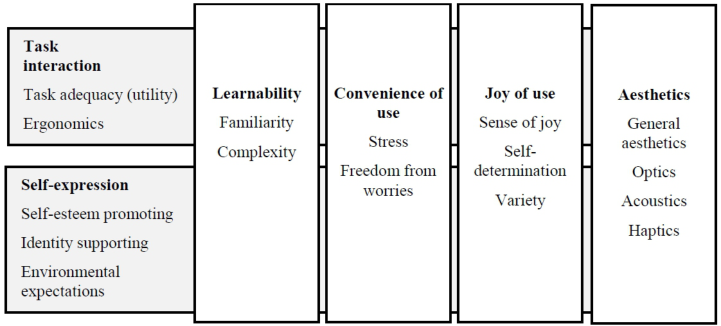
Ensuring the level-compliant driver behaviour of users at different SAE lev- els (Diederichs et al., 2022) is a necessary condition for safe behaviour with automated vehicles. The user experience (UX) is seen as a critical component for the acceptance of new interactive systems (Geis & Tesch, 2019). In the DIN standard “Process for the design of usable interactive systems”, UX is generally defined as: “person’s perceptions and responses resulting from the use and/or anticipated use of a product, system or service.” (DIN EN ISO 9241-210:2011-01, 2011). There are a variety of methods for measuring UX (Sarodnick & Brau, 2011). In predecessor projects in the context of auto- mated driving, the six UX facets according to Engeln and Engeln (2015) were successfully used in studies [Tango and Rumba]. This has proven helpful in systematically developing and evaluating offers because it includes explicitly reflected as well as subliminal influences on UX. The six UX facets include task (incl. interaction), self-expression, learnability, convenience of use, joy of use and aesthetics. The facets are understood as mutually influential. When developing concepts to promote level-compliant driver behaviour, the six UX facets (Engeln & Engeln, 2015) are used. According to empirical validation efforts, the six main facets are further divided into sub-facets (Engeln et al., 2020). Figure 1 depicts the current status of the model.
Figure 1: Facet model of UX (evolved based on Engeln, 2013; Engeln & Engeln, 2015; Engeln et al., 2020).
The six facets are briefly described below: Task including interaction: Does the product effectively help me accom- plish the task for which it was designed? Factors relevant to answering this question include task adequacy (utility) and ergonomic aspects of the product.
Self-expression: Does the product suit me, or would I rather prefer not to be associated with it? Self-expression is based on the product’s ability to promote self-esteem, support identity, and meet environmental expectations.
Learnability: Can I use the product intuitively, or how much effort will it take me to learn? Learnability is determined by a product’s familiarity and complexity.
Convenience of use: Does the product promote feelings of relaxation vs. stress? A product’s ease of use is defined by the degree to which it creates or avoids pressure and its impact on the level of worry during use.
Joy of use: Does the product influence the experience of fun vs. boredom? In this context, it is important whether the user experiences a sense of enjoy- ment while using the product, to what extent the user is self-determined, and whether the use of the product is varied vs. monotonous.
Aesthetics: Do I find the product attractive or unattractive? Aesthetics encompasses not only the general perception of aesthetics, but also the expe- rience of all the senses, acoustics, including optics, and haptics. The six facets are not seen as separate. Rather, the model emphasizes the mutual influence of the facets on each other.
Therefore, the question of this paper is how to support level-compliant driver behaviour in automated driving with an optimized user experience.
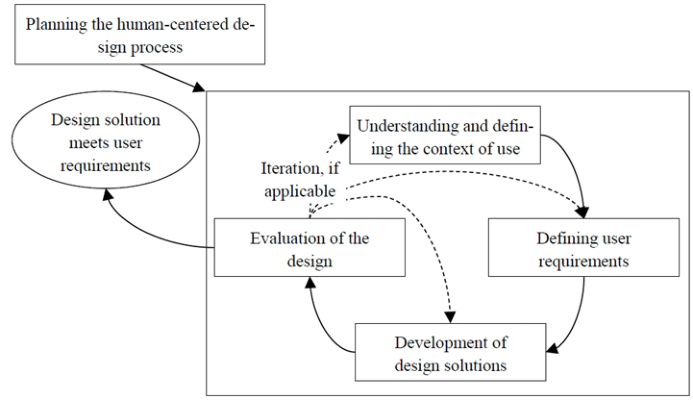
Design of User Narratives by Applying the User-Centred Development Process For the development of new concepts to support level-compliant driver behaviour, the authors apply the user-centred development process (DIN EN ISO 9241-210:2020-03, 2020, see Fig. 2) as explained below.
Figure 2: User-centred development process of DIN EN ISO 9241-210:2020-03 (adapted from Deutsches Institut für Normung e. V., 2020).
In Understanding and defining the context of use the requirements and needs for design of automated driving in the SAE levels were empirically investigated from the user’s perspective. The Stuttgart Media University (Hochschule der Medien; HdM) conducted a literature review and verified findings in a driving simulator study. In Defining user requirements Key learnings and opportunity areas such as system trust and individualization were identified. In Development of design solutions 40 ideas and prototypes
How to Support Level-Compliant Driver Behaviour in Automated Driving 175
for promoting level-compliant driver behavior were developed based on these opportunity areas in a Design Thinking workshop. They were specified in the form of simple low-fidelity prototypes, which are concrete representations of ideas or concepts using simple means to enhance their comprehensibility and ease of experience. In this study, the low-fidelity prototypes are taken the form of three user narratives. User narratives are a type of text-based scenario that describe innovative concepts in story form from the user’s per- spective. These user narratives depict a scenario where two colleagues, Lisa and Matthias, are traveling home from a conference in an automated vehi- cle ranging from SAE-level zero to level four. Lisa, who has never driven an automated car before, tests the vehicle at levels two to four. Matthias, who is an experienced user of automation, does not behave level compliant when he transitions from level three to two. Different interaction concepts are inte- grated into each user narrative on the basis of this story. All the concepts developed can be seen in the appendix.
METHOD
Procedure of the Interview Study The interviews for the evaluation of the concepts in the user narratives were conducted via Zoom by an interviewer and a note-taker. In each of the twelve interviews, one out of three different concepts were qualitatively evaluated regarding user experience, promotion of level-compliant driver behaviour and social implications of autonomous driving.
The first step of the interview was the thematic introduction to the SAE lev- els of automated driving. In the next step the participants read one of the user narratives. Then the interviewer asked for impressions of the user narrative (e.g., “What are your thoughts about the concept presented in the story and its functions?”). After that, the interviewer actively addressed specific inno- vation ideas included in the user narrative but not initiatively reflected by the participant (e.g., “How did you experience this? And why?”). Subsequently the participants were asked about their overall experience of the described automated vehicle. This reflection was structured theory related according to the six facets of User Experience (Engeln & Engeln, 2015). More precisely, the different facets were addressed by specific open questions (e.g., learn- ability: “What do you find more understandable about operating the vehicle described in the story, and what is less clear? And why?”). At last, reference was made to level-compliant driver behaviour, and participants were specif- ically asked how effective they thought the measures described in the story would be to promote level-compliant driver behaviour (“How do you assess the effectiveness of these measures in promoting safety-conscious behaviour by drivers?”).
The study was conducted from March 24 to June 26, 2023. The interviews had an average length of 74 minutes (range 60 to 100 minutes).
For the analysis, the protocols of the interviews were then analysed accord- ing to Mayring (2015) by summarizing user feedback on each idea. Irrelevant statements and duplicates were removed. For each user narrative, all general
statements on the user experience structured along the UX facets were col- lected and summarized. Statements regarding social implications were also collected separately and have been reported elsewhere (Brüggemann et al., 2023). Ideas that were considered relevant for further development were adapted based on user feedback and incorporated into the concepts under development.
Participants The interviews were conducted with N = 12 potential users, of which all had a valid driver’s license. Four different groups of participants were involved:
a. Three young individuals (18–25) with an interest in cars and technology b. Three heavy commuters (minimum 20,000 kilometres per year) with level 2 experience (level 2 means monitoring driver, the driver is responsible and supported by assistance or automation systems that take over the driving task under constant user supervision (Diederichs et al., 2022)) c. Three individuals aged 65 or older d. Three individuals with children and who are responsible for childcare In total, seven female and five male individuals participated in the study. The age range was from 20 to 70 years. For each user narrative, one person from each of the four demographic groups was interviewed. Table 1 depicts the user groups, the test subject number, age, gender, and employment status of the interviewed individuals. Parents in the fourth group were not asked about their employment status.
Table 1. Participants.
Table available in the original PDF paper.
Age in range and mean
User group
Test subject number
Gender in female and male
Employment status a. TS01-03 20 – 22 M = 21 F = 2 M = 1 student b. TS11-13 29 – 59 M = 41,33 F = 1 M = 2 employee c. TS21-23 70 M = 70 F = 1 M = 2 retried d. TS31-33 42 – 45 M = 44 F = 3 M = 0 parent
RESULTS
In total, the authors evaluated 40 innovative ideas from the user’s perspective and gave an overall estimation along the UX facets. Table 2 shows examples for one positive and one negative argument per UX facet, extracted from the interviews.
Table 2. Sample answers from the UX facets.
Table available in the original PDF paper.
UX Facet Exemplary user feedback positive Exemplary user feedback negative Task (including interaction) Unusable if there are too many warnings/announcements > currently too many (UN2, TS22) Useful because it relieves stress and saves time, especially when traveling long distances (time can be used for other activities when the vehicle is in motion) (UN1*, TS01**)
(Continued)
How to Support Level-Compliant Driver Behaviour in Automated Driving 177
Table 2. Continued UX Facet Exemplary user feedback positive Exemplary user feedback negative
Table available in the original PDF paper.
Self-expression The social circle would think positively about the system, as it makes a major contribution to safety and relaxed driving; would be well received (UN2, TS12)
Concern that passengers think that you are endangering them if such systems are not yet established and you are not attentive, e.g. by being on your cell phone > TS does not want to endanger anyone and wants to avoid resentment; would be afraid if someone felt unsafe as a result (UN1, TS11) Learnability Operation seems very easy to understand, especially because the system gives instructions and the driver gets an introduction > relief (UN1, TS01)
According to the TS, the system would not perform an emergency stop; it is more probable that the car would beep or ask whether everything is OK with the driver (UN2, TS32) Convenience of use
Relaxing effect if you can ride longer in level 4 > you arrive at your destination more rested; level 4 as the biggest incentive (UN3, TS13)
Too many changes between levels can cause stress and make it annoying “then I might as well drive myself if I often have to take over despite the automated system”, e.g. if I had to change every 10 minutes (UN3, TS03) Joy of use Fun feeling when the car takes over the driving and you can use the time to watch a movie or for other things (UN2, TS02) Not very aesthetic that the steering wheel and pedals are still there “doesn’t look nice” (UN1, TS01)
Boring if you have nothing to do > other activities not possible for TS due to tendency to develop motion sickness symptoms (UN3, TS33) Aesthetics Design choices (e.g. voice selection, background colour, font colour) are responsive and ensure user satisfaction (UN1, TS11) *= user narrative, **= test subjects
In the following, overall results along the UX facets are reported: Task (including interaction): The respondents found the automated driving systems described in the story extremely useful (n = 9). They perceived them as a way to relieve stress and save time, particularly on long journeys, as they can engage in other activities while driving (TS01, 11, 31, 03, 33, 23). The introduction to the levels (TS02) and the tutorial first use (TS11) were also considered helpful. Some test subjects perceived certain aspects of the automated driving system as unnecessary or less helpful. These include the avatar (TS02, 12), the trust calibration (TS11) and the classic intervention, which could decrease motivation (TS02).
Self-expression: The automated driving systems appear to have had a pos- itive effect on the self-expression of almost all test subjects (n = 10). The test subjects expressed positively that such a new system would fill them with pride and be positively received by those around them. Only one person (TS33) expressed that he would feel embarrassed to use the system in his social circle. Two participants found individual features unpleasant in front of the social circle, such as the avatar or the control handover (TS12, 11) Learnability: With regard to learnability, the autonomous vehicle pre- sented in the user narrative was described by many test subjects as easy to understand (n = 11). Questions arose about individual functions, such as the emergency stop (TS32, 23).
Convenience of use: In summary, the statements show that the respon- dents perceive such an automated vehicle as relaxing and relieving (n = 7). Especially during longer travels (TS21, 02), while travelling on vacation or (TS32) in traffic jams (TS02). Manual driving is perceived as exhausting (TS01, 02, 21). The opportunity to carry out other activities while driving, such as working, is rated positively (TS32).
Joy of use: The enjoyment of driving mainly comes from manual driving itself (TS02, 22, 03, 21), although the opportunity to do other things while driving is also perceived as fun (n = 7, TS21, 02, 32, 03, 23, 11, 31). E.g. watching a movie (TS02, 03, 23) or features such as seat massages (TS11, 31). The possibility to decide the level yourself or to keep the option to drive manually is therefore recommended by one test person (TS01).
Aesthetics: The test subjects had many suggestions for the hardware design of the vehicle, such as presenting information on the windshield (TS01), mas- sage rollers in the seat (TS31), sufficient storage space and a panoramic roof. In addition, they made suggestions for selection options in the design (e.g. voice selection, background colour, font colour) (TS11).
DISCUSSION
The interviews reveal that the automated driving system discussed received positive feedback from various user groups regarding user experience. Most test subjects had a positive experience in all six facets. In particular, the oppor- tunity was to drive automated on long journeys was highly praised, allowing the driver to focus on other tasks or relax. However, we also found varying opinions or rejections of certain ideas: to further enhance user experience, options such as manual driving, massage integration, or watching a movie should be considered.
From a methodological point of view, the low-fidelity evaluation helps to identify basic criteria for the success of supporting level-compliant driver behaviour in automated driving. Including the user experience in early devel- opment is useful for identifying initial reasons why users may reject or accept a product. The effort required to conceptualize, conduct and anal- yse qualitative interviews varies and can comprise of several person-months, but it remains far below the effort required to design and implement a simulation prototype that may be suboptimal according to the basic user criteria. However, in this study, there were given some relevant sugges- tions for further development. In contrast to that, evaluating aesthetics was difficult as there was no visualisation or acoustics given in the low- fidelity prototypes. The focus of this early evaluation was on functionality. In future low-fidelity evaluations, it may be beneficial to either include sen- sory hints (e.g. pictures, sounds) into the prototypes or to avoid asking about aesthetics.
Finally, the results are purely qualitative and require further quantitative validation in the subsequent development process, for example through a simulation environment based on the derived concept.
How to Support Level-Compliant Driver Behaviour in Automated Driving 179
APPENDIX
Developed interaction concepts and ideas from the user-centred development process. Number one to three describes the User Narratives, were the con- cepts and ideas integrated.
Learning phases Motivation Comprehensibility Individualization Comprehensibility and transparency
User Nar- rativ
User profile 1. Creation of an individual user profile
Enter user preferences yourself 1. Input by tapping or selectable as language 2. Output text or speech 3. Adjustable extent of communication
1 Visualization of the driving manoeuvres 1. Display of the route and the next manoeuvres 2. Schematic representation of the levels with icons showing what is currently allowed or required
Tutorial first use 1. Training drive prior to the first driving attempt 2. Explanation of the functions and the driver’s role 3. Levels are unlocked one after the other, after understanding confirmation from the driver
Trust calibration 1. The system communicates its own likelihood of making mistakes (“I recognize nine out of ten pedestrians”) 2. Vehicle shows what it can see/estimate 3. Feedback from the system in the event of driver misconduct (what is permitted/what misconduct was detected)
Enter user preferences yourself 1. Input by tapping or selectable as language 2. Output text or speech 3.Adjustable extent of communication
Integrated learning system 1. Explanation of the levels during use 2. On & off as required 3. With increasing experience decrease of information
Gamification 1. Individual gamification concept for every type of driver 2. Adjustable personality of the game or subtle mechanisms for gamification. 3. Reward for LCB with gamification
MRM 1. The system decides (output, input, extent of communication)
Feedback Loop user system 1. User feedback at the end of the ride. Feedback for successful & unsuccessful use
Avatar 1. Is created automatically 2. Can be configured 3. World and language customizable 4. Shape can be changed by photo 5. AI automatically recognizes the user 6. Communication with the user is conducted through an avatar 3 Feedback concept of the system 1. Driver can ask questions to the system 2. Transition above level 0 at level down. Not when shifting up.
Quick tips 1. Short tips are displayed 2. Remind the driver of higher levels with reference to possible activities (you wanted to read/phone/)
Classical intervention 1. Reprimand for non-level- compliant driver behaviour 2. Persistent inattentiveness despite request leads to an emergency stop
REFERENCES
Brüggemann, N., Preis, S., Pagenkopf, A. & Engeln, A. (2023). Empirical analysis of social implications during the development of automated driving. AHFE Interna- tional Conference Hawaii Edition, Honolulu, Hawaii (Poster Presentation). Creaser, J. I., Fitch, G. M. (2015) “Human Factors Considerations for the Design of
Level 2 and Level 3 Automated Vehicles”, in: Road Vehicle Automation 2, Meyer, Gereon, & Beiker, Sven (Ed.) pp. 81–89. Springer International Publishing.
Deutsches Institut für Normung e. V. (2020). “DIN EN ISO 9241-210:2020-03, Ergonomie der Mensch-System-Interaktion - Teil 210: Menschzentrierte Gestal- tung interaktiver Systeme (ISO 9241-210:2019)”, Deutsche Fassung EN ISO 9241-210:2019: Beuth, Berlin. Diederichs, F. Wannemacher, C. Faller, F. Mikolajewski, M. Martin, M. Voit, M.
Widlroither, H. Schmidt, E. Engelhardt, D. Rittger, L. Hashemi, V. Sahakyan, M. Romanelli, M. Kiefer, B. Fäßler, V. Rößler, T. Großerüschkamp, M. Kurbos, A. Bottesch, M. Immoor, P. Engeln, A. Fleischmann, M. Schweiker, M. Pagenkopf, A. Mathis, L-A. and Piechnik, D. (2022). “Artificial intelligence for adaptive, responsive, and level-compliant interaction in the vehicle of the future (KARLI)”, CONFERENCE 2022, International Conference on Human-Computer Interac- tion pp. 164–171. Springer International Publishing, Cham. DIN EN ISO 9241-210:2011-01 (2011). Ergonomie der Mensch-System-Interaktion Teil 210: Prozess zur Gestaltung gebrauchstauglicher interaktiver Systeme. Berlin: Beuth Verlag. Engeln, A. (2013). User Experience als Ansatz zur Gestaltung marktattrak- tiver Produkte. In T. Maier (Ed.), Human Machine Interaction Design: - Gezielt wahrnehmen—Sicher erkennen—Attraktiv gestalten pp. 75–83. Univer- sität Stuttgart: IKTD. Engeln, A., and Engeln, C. (2015). “Customer Experience und kundenzentri-
erte Angebotsentwicklung. Was gehört dazu?” in: Brand Experience: An jedem Touchpoint auf den Punkt begeistern, Andreas, Baetzgen (Ed.). pp. 253–273. Schäffer-Poeschel. Engeln, A. Pagenkopf, A. Palm, S. Stimm, D. and Wörgerbauer, E. (2020). TANGO
- Technologie für automatisiertes Fahren nutzergerecht optimiert. Technische Informationsbibliothek (final report). Geis, t. and Tesch, G.(2019). Basiswissen. Usability und User Experience. Heidelberg: dpunkt.verlag. Mayring, P. (2015). Qualitative Inhaltsanalyse. Grundlagen und Techniken. Wein-
heim: Beltz. SAE International (2021). Taxonomy and definitions for terms related to driving automation systems for on-road motor vehicles. SAE Mobilus. https://www.sae. org/standards/content/j3016_202104/preview/ Sarodnick, F. and Brau, H. (2011). Methoden der Usability Evaluation. Bern: Verlag
Hans Huber. Strand, N. Stave, C. and Ihlström, J. (2018). A case-study on drivers’ mental model of partial driving automation (Project HATric). 25th ITS World Congress, Copenhagen, Denmark.
LISTED IN THE AHFE DIGITAL BOOKSTORE CATALOGUE
Explore the complete digital volume
Advances in Human Factors of Transportation
Read this individual research paper free through the original publisher, or explore the full digital proceedings book.
ISBN 978-1-964867-24-3
Explore this ISBN in the AHFE Bookstore ↗Listed in the July 2026 bookstore catalogue; search by ISBN to confirm current availability · Digital book purchase optional