Sandra Sueli Vieira Mallin (2022). Mental Fog and Ergonomics: Approaches and Interactions. In: Human Factors in Aging and Special Needs. AHFE Open Access, vol. 38, pp. 197–205. https://doi.org/10.54941/ahfe1001681
The work initially presents a conceptual approach on Mental Fog, Menopause, Cognition and Work and makes a correlation between their necessary interactions. From this point of view, it is demonstrated the little emphasis that has been given to the subject when addressing the health of working women in menopause in the field of Ergonomics. Many women report forgetfulness events at this time of life that hinder their quality of life and their work performance. Sometimes this forgetfulness has been associated with neurological diseases such as Alzheimer's and in times of a pandemic the mental fog has been reported as a residual effect of Covid-19, but few doctors consider the association of these events with the so-called "mental fog" typical of the drop in estrogen in the female body during menopause. The research, of exploratory nature, sought to analyze through a bibliometric study in renowned databases, approaches or lack of them in scientific articles that consider mental fog as an important factor to be addressed in the scope of Ergonomics. Seven articles from a total of 38 retrieved documents were analyzed. The results point to a significant gap in the proposed theme.
With more and more women over 50 years old staying active longer in the world of work, the changes resulting from the climacteric and menopause and their impacts must be known and widely disseminated in order to better welcome these workers who are not only aging, but also are giving a new biopsychosocial meaning for their roles (Lomônaco et al., 2015). According to the Global Consensus on Menopause in the Workplace, in 2020 there were 657 million women aged between 45 and 59 years worldwide, and 47% of them were menopausal workers (Rees et al., 2021). Numerous women in this climacteric period report forgetfulness events that hinder their quality of life and their work performance. Sometimes this forgetfulness has been associated with neurological diseases such as Alzheimer’s and, in times of a pandemic, mental fog has been reported as a residual effect of Covid-19, but few doctors consider the association of these forgetfulness events with the so-called “brain fog” or mental fog, typical of the drop in estrogen in the female body during menopause (Plitt, 2021). The lack of information about “mental fog” shows how it has been put in the background when analy- zing menopausal symptoms; in how there is greater emphasis on symptoms
considered more serious, such as depression or osteoporosis, and how it has not been properly addressed in the promotion of quality of life in the work of climacteric women. A cross-sectional study conducted by health professi- onals in 2014 in the city of Uberlândia, state of Minas Gerais, Brazil, with 30 women who were in the climacteric period, between 50 and 67 years old, revealed that 60% of the interviewees presented as symptomatology the “forgetfulness” and 20% presented “mental confusion” among other mani- festations, in a mild or moderate way (Lomônaco et al., 2015); 3.3% of them judged that forgetfulness was a difficult symptom to bear. The data demonstrate the subjectivity in the perception of cognitive deficit, how it affects women’s lives and how each one perceives and reacts to this phase in different ways.
CLIMACTERIC, MENOPAUSE AND MEMORY According to the Health Sciences/DeCS/MeSH Descriptors of the Latin American and Caribbean Health Sciences Information Center - BIREME, menopause is defined as the period in which the last menstruation occurs, corresponding from 6 to 12 months after its permanent termination in a woman above 45 years (DeCS, 2022). The International Menopause Society (IMS) clarifies the difference between climacteric and menopause by esta- blishing for such that the climacteric corresponds to the transition phase between the reproductive period and the non-reproductive of the woman, a state that incorporates the phases of pre-, peri and postmenopausal (IMS, 2022). Menopause, a term coined by the French physician Charles-Pierre- Louis de Gardanne in 1821, corresponds to the period resulting from the loss of follicular ovarian activity and occurs after 12 consecutive months of amenorrhea or last menstruation being that there is no biological mar- ker for this event (IMS, 2022). In menopause there is a decline of estradiol, main circulating estrogen in the body in the reproductive age of the woman (Henderson, 2008). The estrogen modulates in the body many systems among them the immune system, metabolism and neuronal functions (Kuhl, 2005). There are estrogen receptors distributed throughout the brain, neurons and glia that produce effects throughout your bioenergetic system (Rettberg, Yao and Brinton, 2013) and changes in this brain system compromise some cogni- tive functions, among them memory (Medeiros, 2019; Weber et al., 2014; Henderson, 2008). The term memory refers to the numerous brain functions that have in common the ability to recreate stimuli through the “synchro- nic firing of the neurons involved in the original situation” (Carter, 2012). Some studies indicate that the mitochondrial function of cells that is to sup- ply about 90% of the body’s energy, is impaired by the fall of estrogen and this energy drop causes a decline in cognition (Lejri; Grimm and Eckert, 2018; Schroeder et al., 2020). With the fall in the performance of memory in the climacteric there are difficulties of concentration, lapses, problems in attention and decision making, episodes that interfere in the quality of life of the woman. Since there is no nerve activity without learning and memory (Izquierdo, 1989), when the latter is damaged, many women are con- fronted with their individual history and the constraints of aging processes,
Mental Fog and Ergonomics: Approaches and Interactions 199
both in private life and in professional life. Knowing the interference of the fall of estrogen in women’s memory helps in understanding the relationship of their own aging versus their work activities which leads to encouraging the regulation of deficits through the use of established skills (Laville and Volkoff, 2007), because the postmenopausal brain adapts to the fall of estro- gen not being the cognitive deficit a definitive situation, but that it needs to be diagnosed correctly (Greendale, 2021) and that can last months or years. To better establish an understanding and correlation between these events, it is necessary to know a little more the concept “brain fog” or “mental fog.”
MENTAL FOG As a symptom, the cognitive decline called “mental fog” or “brain fog” is defined as the feeling of having slow reasoning, sometimes appearing to be wrapped in a mist that prevents concentration and the ability to think clearly occurring difficulties with memory (Pooya et al., 2021). First used in 1853, the phenomenon known today as mental fog, was described by the British physician Edward John Tilt (1870), author of the first book on menopause written in the English language called “The change of life in health and dis- ease: a practical treatise on the nervous and other incidental affections to women at the decline of life”. Tilt associated episodes of forgetfulness of the menopause phase with the term “pseudo-narcotism” (Tilt, 1870; Mattern, 2019). The Mental fog has numerous causes, including hormonal imbala- nce and is currently recognized as a residual effect in patients affected by Covid-19 (Budson, 2021).
COGNITION AND WORK Associated with learning, the term cognition refers to the description and explanation of mental processes (Antipoff and Soares, 2021). The verbal and executive cognitive functions as well as the speed of information processing are the most affected in the menopause period (Melo et al., 2017) and 60% of women have cognitive difficulties in this period (Greendale et al., 2011). Labor losses are evident with decreased productivity and increased stress cau- sing a huge impact on women’s lives (Brinton et al., 2015). A robust report presented by the UK in 2017 and conducted by researchers at the Univer- sity of Leicester studied the effects of menopause on female workers in that country by presenting data indicating that many women associate discom- fort at work at this stage of their lives with stress and do not correlate with menopause most of the time. Data also point out that the most recurrent disorders for many women in the workplace are decision-making, concen- tration and memory showing that for every 10 women in the menopause phase, 6 of them report a negative impact of these factors on their work and reinforce that physical aspects and their facilities can worsen or improve sym- ptoms of the menopause phase depending on the approach of the managers (Brenis et al., 2017).
200 Vieira Mallin
WHAT DOES ERGONOMICS SAY?
Although Ergonomics addresses topics such as aging and work, work and gender, workload and stress among others, there is a gap regarding menopause, mental fog and cognitive impairments of this phase and its relati- onships with work. Some authors associate aging with a decline in functions, but closely linked to the relationships between experience and skills. They also state that in the context of ageing, many companies do not have a concrete action plan to address the issue of ageing in advance (Laville and Volkoff, 2007). In the female case the topic is even more complex in view of the ignorance of managers and workers about what happens in the meno- pause phase (Jack et al., 2015) besides gender discrimination and ageism (WHO, 2021) that many women experience with serious consequences for their health. At the same time bringing together a collection of knowledge about human functioning and action practices (Daniellou, 2004), Ergono- mics needs to give a more concrete answer on how to look at women in the climacteric phase in the labor field. There is much talk about macro ergo- nomics, work organization, environmental conditions in women’s work, but very little is observed on the topic of climacteric, menopause and mental fog in the framework of work ergonomics, fact that is characterized as parado- xical given that besides advocating work with comfort, safety, health and well-being to all workers, it is also interested in human cognition and its pro- cesses, decision-making, attention and memory in work situations, precisely the factors that are most involved in women’s problems with mental fog in menopause. In order to corroborate this hypothesis, an exploratory resea- rch was carried out that sought to analyze through bibliometric study in the conceptual databases of Ergonomics, approaches or absence of them in the scientific articles that consider the mental fog in menopause as an important factor to be treated in the context of Ergonomics.
METHODOLOGY
The systematic review of literature was carried out considering renowned titles of the area of interest. The following publications were selected for the study: Applied Ergonomics, Ergonomics, International Journal of Industrial Ergonomics, International Journal of Occupational Safety and Ergonomics, Proceedings of the Human Factors and Ergonomics Society Annual Meeting and AHFE Conference Books, using the following descriptors: brain fog, mental fog, menopause, cognition in menopause, human factors in ageing, human factors and menopause. As inclusion criteria were accepted all retri- eved articles with the exact descriptors, without time limit, accepted in all languages of the source publications. The methodology followed the pro- tocol Preferred Reporting Items for Systematic Reviews and Meta-Analyses (PRISMA) seeking to provide greater accuracy and transparency to research. The data were collected in November 2021.
Results
For a total of 38 recovered articles, the descriptor who presented the highest number of incidences was “menopause”. With it were recovered 30 articles
Mental Fog and Ergonomics: Approaches and Interactions 201
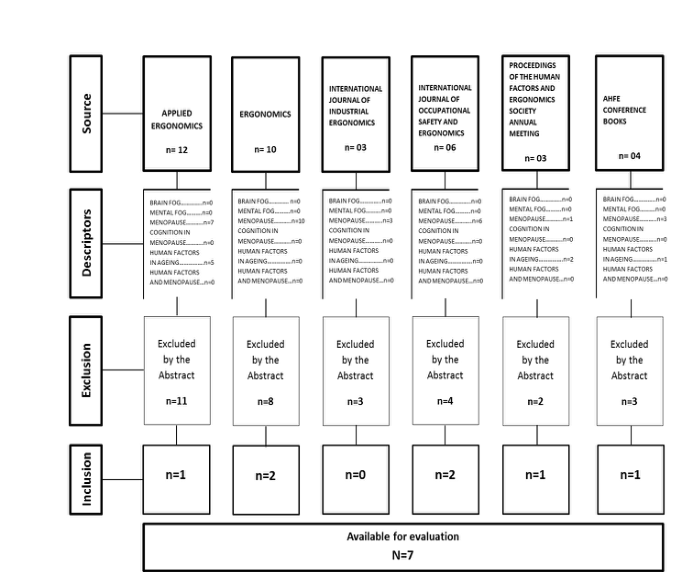
being 07 in the publication Applied Ergonomics; 10 in the publication Ergo- nomics; 03 in the International Journal of Industrial Ergonomics; 06 in the International Journal of Occupational Safety and Ergonomics; 01 in the publication Proceedings of the Human Factors and Ergonomics Society Annual Meeting; 03 in AHFE Conference Books. Through the descriptor “human factors in ageing” were recovered 08 articles being 05 in the publi- cation Applied Ergonomics, 02 in the publication Proceedings of the Human Factors and Ergonomics Society Annual Meeting and 01 in the publication AHFE Conference Books. For the other descriptors no article has been retri- eved (see Figure 1). After reading the abstracts of the articles found, 31 were excluded for not presenting direct relation to the proposed search theme. At the end 7 articles were analyzed (see Table 1).
Figure 1: Selection process of articles (Author, 2021)
DISCUSSION
Examining the findings in the literature on Ergonomics through the syste- matic review presented it was possible to find that although 7 articles were identified, few of them contained information relevant to the topic of meno- pause and none of them addressed the issue of mental fog in this period of female life and how it affects cognition and performance in labor activities. A demographic view of ageing from an analysis of developed countries already pointed in 1993 to the necessary change of look on women’s work with more and more women over 50 years taking up jobs (Coleman, 1993) enjoying
202 Vieira Mallin
Table 1. Selected articles (Author, 2021).
Table available in the original PDF paper.
SELECTED ARTICLES Descriptor Author Title Date Source
1993 Applied Ergonomics
Human Factors in Ageing
Coleman, R. A Demographic Overview of the Ageing of First World
1999 Ergonomics
Menopause Birch, K. M and Reilly, T.
Manual Handling Performance: the Effects of Menstrual Cycle Phase
1984 Ergonomics
Menopause Mackay, C. J. and Bishop, C. M.
Occupational Health of Women at Work: Some Human-Factors Considerations
2021 International Journal Of Occupational Safety and Ergonomics
Menopause Raczkiewicz, D., Bojar, I. and Humeniuk, E.
Work Ability, Functional Exercise Capacity and Prevalence of Obesity in Perimenopausal and Postmenopausal Women with Non-Manual Employment
Menopause Racziewicz, D., et al.
2019 International Journal Of Occupational Safety and Ergonomics
Work Conditions in Agriculture as Risk Factors of Spinal Pain in Postmenopausal Women Vercruyssen, M.
Age-Related Slowing of Behavior
Human Factors in Ageing
1991 Proceedings of the Human Factors and Ergonomics Society Annual Meeting
Montagna, G. et al.
Human Factors in Ageing Consumers
2018 AHFE Conference Books
Human Factors in Ageing
well-being but also exposed to labour tensions (Mackay and Bishop, 1984). From the point of view of menstruation it was demonstrating that female physiological responses in physical performance as load handling are related to hormonal fluctuations (Birch and Reilly, 1999). In the peri and postme- nopausal periods, there is an important growth of obesity interfering in the ability to perform physical exercises and work tasks, negatively affecting the quality of life of women (Raczkiewicz, Bojar and Humeniuk, 2021). This obesity can lead to back pain with health risks, such as in women working in agriculture (Racziewicz et al., 2019). It is important to emphasize that with the advancement of the age human behavior will slow down and this factor must be considered, because it interferes in the attention and motor perfor- mance (Vercruyssen, 1991). People are aging and composing an increasing group with very particular needs that require special attention in addition to
Mental Fog and Ergonomics: Approaches and Interactions 203
remaining much longer in active life in the world of work (Montagna et al., 2018). All these issues indicated in the articles constitute a picture of the needs and specificities of the population above 50 years old to which the menopause and brain fog are also added. It is up to Ergonomics professionals to take a closer look at these shortcomings by drawing new boundaries to help combat the stigmas of the woman that work and that at the same time grows old.
CONCLUSION
From the articles analyzed it is possible to conclude that there is not until the present date, works in the area of Ergonomics, in the universe of the publica- tions studied, that address the menopause and the mental fog proper to this phase of the life of the woman and its relationship with the quality of life at work. Some authors treat the subject of menopause very punctually. The same is true of the theme of human factors related to age. The bibliometric study revealed a gap that deserves future research in order to contribute to the con- struction of a robust collection of knowledge that favors the clarification not only of working women, but also managers and co-workers creating an orga- nizational culture on the subject, for there is already a “global consensus” of recommendations on the issue of menopause in the working environment and ergonomics researchers cannot fail to give an answer by helping to com- bat stigmas, discrimination and ageism preparing to this enormous demand, because it is necessary to understand the theme to resignify it.
ACKNOWLEDGMENT
The author would like to thank Professor Eduardo Cassiano Mallin (son) for the support and guidance in the discussions on physiology as well as to Mrs. Eni Medeiros Vieira (mother) who from the height of her 96 years old teaches how to live and age with excellence.
REFERENCES
Birch, K. M. and Reilly, T. (1999). Manual handling performance: the effects of menstrual cycle phase. Ergonomics. [online], 42(10), pp. 1317–1332. Available from:https://www.tandfonline.com/doi/citedby/10.1080/001401399184974 Brenis, J. et al. (2017). The effects of menopause transition on women’s econo-
mic participation in the UK. Department for Education [online], Available from: https://www.gov.uk/government/publications/menopause Brinton, R. D. et al. (2015). Perimenopause as a neurological transition state. Nat Rev Endocrinol. 2015, 11, pp. 393–405. Budson, A.E. (2021). What is COVID-19 brain fog and how can you clear it? Harvard
Health. [online], March, 8. Available from: https://www.health.harvard.edu/blog/ what-is-covid-19-brain-fog-and-ho. Carter, Rita et al., (2012). The human brain book. Rio de Janeiro, Agir. Coleman, R. (1993). A demographic overview of the ageing of first world. Applied Ergonomics.[online], Feb. 24(1), pp. 5–8. Available from: https://www.sciencedir ect.com/science/article/abs/pii/000368709390152Y Daniellou, Françoise. (2004). Ergonomics in search of its principles: epistemological
debates. São Paulo, Edgard Blücher.
204 Vieira Mallin
Greendale, G. A, Derby C. A, Maki, P. M. (2011). Perimenopause cognition. [online] Obstet Gynecol Clin North Am. 2011, 38, pp. 519–535. 2011 Available from: https://www.ncbi.nlm.nih.gov/pmc/articles/PMC3185244 Greendale, G. A. et al. (2021). Longitudinal assessment of physical activity and
cognitive outcomes among women at midlife. Jama Network Open. 2021; 4(3), pp. 213–227. Health Sciences Descriptors: DeCS [Internet]. (2017). São Paulo (SP): BIREME / PAHO / WHO. Available from http://decs.bvsalud.org/I/homepagei.htm Henderson, V. W. (2008). Cognitive changes after menopause: influence of estrogen.
Clin Obstet Gynecol. 51(3), pp. 618–626. International Menopause Society. IMS. [Internet]. (January, 2022). Menopause terminology. Available from: https://www.imsociety.org Jack, G. et al., (2015). Menopause in the workplace: what employers should be doing.
Maturitas, 2015 (85), pp. 88–95. Available from: https://pubmed.ncbi.nlm.nih.go v/26857886/ Izquierdo, I. (1989). Memories. Advanced Studies. 3(6), pp. 89–112. Available from: https://www.revistas.usp.br/eav/article/view/8522 Kuhl, H. (2005.) Pharmacology of estrogens and progestogens: influence of different
routes of administration. Climacteric, 8:sup1, 3–63. Laville, A. and Volkoff, S., (2007) Ageing and work. In: Falzon, P. (ed), Ergonomics, São Paulo, Editora Blucher, pp. 112–123. Lejri, I., Grimm, A. and Eckert, A. (2018). Mitochondria, estrogen and female
brain aging. Front. Ageing Neurosci. April, (10)124, pp. 01-12. Available from: https://www.ncbi.nlm.nih.gov/pmc/articles/PMC5934418/ Lomônaco, C., Tomaz, R. A. F. and Ramos, M. T. O. (2015). The impact of menopause in the relationships and social roles established on the Family and at work. Reprod. Clim. 2015, 30(2), pp. 58–66. Available from: http://www.sbrh.org.br Mackay, C.J. and Bishop, C. M. (1984). Occupational health of women at work:
some human-factors considerations. Ergonomics. [online], 27(5), pp. 489–498. Available from: https://www.doi.org/10.1080/00140138408963517 Maki, P. M. and Henderson, V. W. (2016). Cognition and the menopause transition”, Menopause, 23(7), pp. 803–805, July 2016. Mattern, S. P. (2021). A time of change: a history of our understanding of
the menopause. BBC World Histories Magazine, issue 21. Available from: http://www.historyextra.com/period Medeiros, M. F. (2019.) Memory loss in menopause due to suppression of the estrogens neuroprotective effect: a bibliographical study. Estácio Saúde 2019, 8(2), pp. 57–64. Melo, C. S. B. et al. (2017). Cognitive decline and perimenopause: systematic review.
Reprod. Clim. 2017, 32(2), pp. 132–137. Montagna, G. et al. (2018). Human factors in ageing consumers. AHFE Conference Books. Advances in Human Factors and Ergonomics in Healthcare and Medical Devices.[online]. 23 June, pp. 319–326. Page, M. J. et al. (2021). The PRISMA 2020 statement: an updated guideline for
reporting systematic reviews. British Medical Journal 2021; 372: n71. Plitt, L. (June 11, 2021). Which is the mental fog, one of the lesser known symptoms of menopause. The BBC World News/Brazil. Website: http://www.bbc.com/port uguese/geral-57416388 Pooya, A. A. A. et al. (2021). Long Covid syndrome associated brain fog. J. Med.
Virol. 2021, pp. 1–6.
Mental Fog and Ergonomics: Approaches and Interactions 205
Raczkiewicz, D, Bojar, I and Humeniuk, E. (2021). Work ability, functional exercise capacity and prevalence of obesity in perimenopausal and postmenopau- sal women with non-manual employment. International Journal of Occupa- tional Safety and Ergonomics. [online], 27(4), pp. 970–978. Available from: https://doi.org/10.1080/10803548.2019.1676565 Raczkiewicz, D. et al. (2019). Work conditions in agriculture as risk factors
of spinal pain in postmenopausal women. International Journal of Occupa- tional Safety and Ergonomics. [online], 25(2), pp. 250–256. Available from: https://doi.org/10.1080/10803548.2017.1364903 Rees, M. et al. (2021). Global consensus recommendations on menopause in the workplace: A European Menopause and Andropause Society (EMAS) position statement. Maturitas 2021, 151, pp. 55–62. Rettberg, J. R., Yao, J. and Brinton, R. D. (2014). Estrogen: a master regulation of bio-
energetics systems in the brain and body. Front Neuroendocrinol. 2014 January, 35(1), pp. 8–30. Schroeder, R. A. et al. (2020). Bioenergetic markers and cognition in peri- and postmenopausal women. Menopause. 27(12). Tilt, E. J. (1870). The change of life in health disease: a practical treatise on the
nervous and other affections incidental to women at the decline of life. Chapter VII. Diseases of the Brain, London, J. Churchill & Sons, pp. 159–215. Available from: https://wellcomecollection.org/works/nuavzmee Vercruyssen, M. (1991). Age-related slowing of behavior. Proceedings of the Human Factors and Ergonomics Society Annual Meeting. [online], September, 1, Available from: https://journals.sagepub.com/doi/pdf/10.1177/154193129103500307 Weber, M. T., Maki, P. M. and McDermott, M. P. (2014) Cognition and mood in
perimenopause: a systematic review and meta-analysis. Journal Steroid Biochem Mol Biol. 2014 July, 0: 90–98. World Health Organization (WHO), (2021). Global Report on Ageism. Geneva: WHO. Available from: https://www.who.int/teams/social-determinants-of- health/demographic-change-and-healthy-ageing/combatting-ageism/global- report-on-ageism
LISTED IN THE AHFE DIGITAL BOOKSTORE CATALOGUE
Explore the complete digital volume
Human Factors in Aging and Special Needs
Read this individual research paper free through the original publisher, or explore the full digital proceedings book.
ISBN 978-1-958651-14-8
Explore this ISBN in the AHFE Bookstore ↗Listed in the July 2026 bookstore catalogue; search by ISBN to confirm current availability · Digital book purchase optional