Ilona Kačerová, Marek Bures, Jana Kleinová, Filip Rybnikár, Pavel Vránek (2022). Evaluation of local muscular load on the forearm in industry. In: Human Factors in Aging and Special Needs. AHFE Open Access, vol. 38, pp. 56–63. https://doi.org/10.54941/ahfe1001664
The paper is focused on influence of the upper limb position on the forearm iEMG activity. The paper describes the methodology of measurement and assessment of local muscle load in production workers with a detailed focus on the influence of the position of the upper limbs and the loads handled, because ergonomics affects not only the productivity of workers, but also their health. The paper contains the results of measurements on a group of 180 research participants aged 20-65 years. To understand the links between these activities, it was necessary to implement experimental measurements in laboratory conditions where probands performed controlled movements with different weights. The experimental results were then statistically evaluated and verified to determine the specific conclusions of the paper. It is a continuation of research that has already been described in the paper "Influence of the upper limb position on the forearm EMG activity – Preliminary Results".
In today’s era of extensive robotization, it may seem that the role of humans in production is becoming irrelevant, but the opposite is true, because humans will never disappear from the work process completely, but will occupy diffe- rent jobs than before. Today, there are many laws, standards and regulations that protect workers against overwork, whether it is chemical, biological or physical. There are also standards and regulations that set limits on the physi- cal strain that workers should be subjected to during a work shift; if the limits are not met, workers may develop occu-pational diseases. It is the overload of workers and the possible development of oc-cupational disease that is a major problem today. ( ˇCech, 1978) Both mental and physical aspects affect a person’s workload. Both affect the worker in a certain way. The worker may not be efficient enough due to psychologi-cal or physical stress, scrap- fulness increases, etc. However, psychological stress is difficult to measure and define, much more difficult to eliminate, but it is completely linked to psychological stress and has a significant impact on workers. These two aspe- cts cannot be separated, but only one is measurable - physical strain. Similar definitions are used by some other authors, for example, Mikuláštík (2015), who refers to workload as synonymous with stress, while indicating that wor- kload can be understood as the demands that are placed on the worker and the way in which the worker handles them and how these demands affect
Evaluation of Local Muscular Load on the Forearm in Industry 57
the worker’s psyche. It is im-portant to note that the concept of stress is not understood in a clinical sense in this case, although in more extreme working conditions, for example, the workload must be understood as a situation of imbalance and the consequences may also be cumu-lative for the worker and thus have a negative effect on the worker’s organism. It is the sum of the requirements and external conditions in a given work sys-tem that affect the physical and mental state of a person. Each activity is a signifi-cant load on the human organism. If the degree of strain exceeds a value that inter-feres with a person’s level of well-being at work, it is overload. Workload inclu- des both mental and physical stress, which can be objectively measured in defined units. (Bureš, 2013) Depending on the magnitude (level) of the wor- kload, fatigue will always set in. For a short period of time, fatigue can be overcome by willpower, but sufficient rest and regular breaks from work are needed to eliminate it. (Slamková, 2010) Physical stress causes many health complications, the most common occupational disease until 2021 was carpal tunnel syndrome, which was caused either by unilateral load of the upper limbs or from working with vibrating tools. (Bureš, 2020) Since this is the most common disease in industrial workers, the work focuses on physical stress, especially on the evaluation of forearm muscle stress. Physical load is the work performed by the muscles. It is influenced by the range of muscle groups and their activities as well as energy ex-penditure. It can be divided into static work, which is characterised by the fact that the muscles are con- tracted and remain in this position for a long time. The muscles are therefore not sufficiently supplied with blood and oxygen and are overloaded. In terms of time, it is a static load if the muscle is contracted for more than 3 seconds. And dynamic work, which in turn is characterized by alternating involve- ment of muscle groups and thus tension in these groups. (Kaˇcerová, 2019) Dynamic load is less burdensome than static load. After static load is over, the muscles need time to recover. The de-gree of load is of course depen- dent on the strength capabilities of the person, as well as gender, age and the ability of muscle groups to recover. (Slamková, 2010) Research shows that women’s physical strength is about one-third less than that of men. Men have the highest strength around 25 years of age, then there is a gradual decline of 2.5% in strength over a five-year period to 45 years, then the de-cline is much faster, around 5% over a five-year period. (Grime, 2018) The measurements can be performed by integrated electromyography (IEMG) or by strain gauge and computa-tional methods. EMG is nowadays the most accurate method available for measuring local muscle strain, and it is also the method legally permitted for the assessment of physical strain in the workplace. Electrom- yography is an examination method that allows us to assess the state of the human nervous and musculoskeletal system. The aim of integrated electrom- yography is to record the electrical activity of a selected muscle, which is induced by the change in the electrical potential resulting from mus-cle acti- vation. The activity is recorded from nerves or muscles. Muscle activity is induced either by stimulation of the proband or by the will of the subject. (Ticháˇcek, 2008) The study was conducted in the Czech Republic; there- fore, all limits refer to national legis-lation. The experiments were conducted to determine local muscle loading in industri-al workers. Local muscle load
is the load of small muscle groups when performing work with the limbs. The muscle forces exerted, the number of movements of the musculoskele- tal structures under consideration and the working positions in relation to the extent of the static and dynamic components of the work are determi- ned and assessed. In the Czech Republic, the EMG Holter from GETA is the only device approved by legislation for measuring local muscle strain. After the examination, it is evaluated whether the work is static or dynam-ic. The static component is defined as a load without movement during muscle con- traction lasting 3 seconds or more or as a load associated with movement of muscle structures without rest periods. Predominance of static work means that static tasks are performed in an average eight-hour shift for more than 4 hours. Evaluation of the monthly average Fmax of the work forces for the extensors and flexors of the left and right hand according to NV 68/2010 Coll. The permissible values in % Fmax for men and women when working with a predominantly dynamic component for a monthly average 8-hour shift are 30%. The permissible values in % Fmax for men and women at work with a predominantly static component for an 8-hour shift aver-aged over the whole month are 10%. For the assessment of local muscle strain, it is necessary to assess several criteria in relation to each other, in particular excessive-ness, unilateralness and long-termness.
Longevity can be considered as a period of impairment that excludes an injury mechanism. The criteria of unilateral and exces-sive are always con- sidered in relation to each other and tell us about the ratio of the forces exerted to their time course in terms of load on the same anatomical stru- ctures. (Mukhopadhyay, 2007) The main goal of the study is to analyse the connections between position of the upper limbs and the loads handled. The research was conducted primarily to define in advance inappropriate working positions that could cause future damage to the upper limbs.
METHODOLOGY
Subjects A male group of were selected to perform the measurement. The group was in the age range 20 to 38 years (average age 26, 4, average height 180 cm, average weight 78 Kg, average BMI 24, 1). There were 51 men all comple- tely healthy without any movement disorder, health problems or after hand surgery. The vast majority was university students or administrative wor- kers who have sedentary job and spend most of theirs time working with the computer. Men had a different physiological body structure and a different physique. All of those men were right-handed.
Process of the Measurement When measuring and assessing local muscle strain, a detailed analysis of the working conditions (job description, time factors of work, rest, work mode, etc.), an assess-ment of the time factors of work (time snapshot of the working day), a description and assessment of the workplace (focusing on the hand- ling plane and movement space, reach distances, tools, implements, etc.), and
Evaluation of Local Muscular Load on the Forearm in Industry 59
Table 1. Differences by flexion 0° – 40°.
Table available in the original PDF paper.
Flexion Average Fmax [%] Standard Average Standard 0° – 40° flexors deviation Fmax [%] deviation flexors extensors extensors 0Kg 1, 958 1,12 1,551 1,234 2Kg 9,129 3,930 5,035 1,934 4Kg 11,048 4,813 7,249 2,271 6 Kg 16,525 5,456 13,139 4,743 8 Kg 21,1525 5,383 16,965 5,755 10 Kg 26,8623 6,720 21,791 8,114
a description and assessment of the working positions (biomechanical analy- sis of the occurrence of conditionally acceptable and unacceptable working positions, assessment of the suitability of the basic choice of working posi- tion) must be carried out. The measurements can be per-formed by means of integrated electromyography (IEMG), or by strain gauge and computa- tional methods. EMG is nowadays the most accurate method available for measuring local muscle load, during the measurement electrophysiological biopoten-tials are sensed from the examined muscle groups of the hands and forearms (elec-trodes are glued to the flexors and extensors). The EMG Hol- ter device is used for the measurements, the data are then processed using special software. The measurement process was identical to the preliminary study which was already conducted (Bureš, 2020) respecting the conditions (Firrell, 1996) and (Mathiowetz, 1985). The measurements were performed using the EMG Holter from GETA. In the evaluation, the average maximum forces of the given tasks were compared according to legislation.
RESULTS
The results of the measurements are the relative values of the exerted muscle forces - % Fmax (MVC). The results were varied depending on the physi- cal condition of the volunteers. Volunteers who are accustomed to using the muscles of their hands and forearms (for example by work out in fitness cen- tre) have had better results than volunteers who have more passive lifestyle. Results of measurements were also af-fected by the place where the electrodes are stacked, amount of hairs on forearm, fat under the skin etc. The wor- king positions were measured according to the methodo-logical instruction and then evaluated by statistical evaluation. A total of 51 meas-urements were evaluated. Since in industry activities are mainly performed with the dominant upper limb, only the right hand was evaluated.
Comparison of arm Flexion The following tables contain average Fmax and standard deviations for arm flexion.
Extensors demonstrate greater muscle load than flexors, this is mainly due to the fact that all movements were performed overhand. In the event that
Table 2. Differences by flexion 0° – 60°.
Table available in the original PDF paper.
Flexion Average Fmax [%] Standard Average Standard 0° – 40° flexors deviation Fmax [%] deviation flexors extensors extensors 0Kg 2,756 3,154 1,955 2,345 2Kg 10,892 4,368 6,663 3,590 4Kg 13,522 4,378 10.689 4,724 6 Kg 17,639 4,899 13,896 5,028 8 Kg 26,713 6,666 22,508 8,813 10 Kg 28,836 9,764 22,069 8.835
Table 3. Differences by flexion 0° – 80°.
Table available in the original PDF paper.
Flexion Average Fmax [%] Standard Average Standard 0° – 40° flexors deviation Fmax [%] deviation flexors extensors extensors 0Kg 2,905 3,258 2,058 2,445 2Kg 12,102 4,274 8,214 3,158 4Kg 15,921 5,845 12,799 5,105 6 Kg 23,011 4,109 10,710 8,853 8 Kg 30,157 8,295 22,464 8,101 10 Kg 35,337 10,819 25,756 10,462
the movements were performed in an underhanded manner, it is hypothesized that the flexors would ex-hibit greater muscular load than the extensors.
Due to the different physical constitu-tion, it can be seen that the stan- dard deviation increases with increasing mass, caus-ing more variability in the results. Flexors have lower values than extensors. The mean averagce %Fmax (MVC) values for both arms increase gradually. The biggest differe- nce is between 0 and 2 kg, as can be seen in the graph below, the difference is more pronounced in the extensor muscle group due to the load on the upper limbs.Due to the legislative limits (30% Fmax - MVC), the muscle load is close to the limit in the case of shoulder flexion with a 10 kg weight in all tested working positions. The limit is exceeded in the case of the 0 - 80° posi- tion and already in the case of handling an 8 kg load, see the results in the graph below.
Comparison of arm Abduction The following tables contain average Fmax and standard deviations for arm abduction.
In the case of abduction, greater muscle strength is also observed in the extensors of the upper limbs, the difference between extensors and flexors is on average around 6% Fmax. The greatest increase in muscle strength is between 0 and 2 kg. The muscle load limit is exceeded in the case of mani- pulation with 10 kg weights up to 60° and up to 80°, also in the case of manipulation with 8 kg weights up to 80°. In the case of handling an 8 kg
Evaluation of Local Muscular Load on the Forearm in Industry 61
Table 4. Differences by abduction 0° - 40°.
Table available in the original PDF paper.
Flexion Average Fmax [%] Standard Average Standard 0° – 40° flexors deviation Fmax [%] deviation flexors extensors extensors 0Kg 2,025 2,028 1,304 1,571 2Kg 11,018 4,376 7,561 2,829 4Kg 16,458 5,013 9,926 4,041 6 Kg 22,039 5,668 15,244 6,230 8 Kg 25,140 6,894 18,259 7,208 10 Kg 27,306 7,486 21,039 7,809
Table 5. Differences by abduction 0° – 60°.
Table available in the original PDF paper.
Flexion Average Fmax [%] Standard Average Standard 0° – 40° flexors deviation Fmax [%] deviation flexors extensors extensors 0Kg 2,259 1,491 1,906 1,602 2Kg 13,678 4,716 8,892 4,499 4Kg 18,584 5,727 11,655 5,246 6 Kg 23,768 6,324 16,411 6,933 8 Kg 28,529 7,046 21,669 8,678 10 Kg 31,312 7,425 23,739 9,089
Table 6. Differences by abduction 0° – 80°.
Table available in the original PDF paper.
Flexion Average Fmax [%] Standard Average Standard 0° – 40° flexors deviation Fmax [%] deviation flexors extensors extensors 0Kg 2,899 3,339 1,877 2,794 2Kg 15,198 4,417 8,262 3,453 4Kg 21,032 6,978 13,754 6,436 6 Kg 26,201 8,203 16,537 6,561 8 Kg 32,493 11,016 23,814 10,127 10 Kg 38,355 13,189 26,501 11,686
weight up to 60°, the limit is approached. The muscle load of handling loads up to 80° is shown in the graph below.
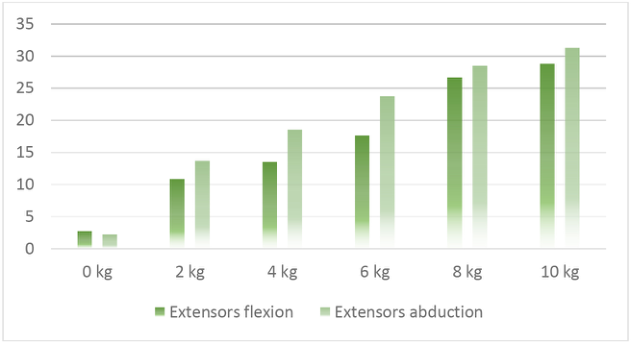
Comparison of arm Flexion and Abduction The muscle load in the case of shoulder abduction is higher than in the case of shoulder flexion in every considered case. There is a greater difference in the extensor muscle group with an average difference of about 3, 5% Fmax (MVC), in the case of the flexor muscle group the average differe- nce is about 1, 2% Fmax (MVC). The difference was observed between all measured positions. The difference between extensor muscle loads for fle- xion and abduction for all manipulated loads can be seen in the graph below. The biggest difference in the case of manipulation up to 40° was recorded
Figure 1: Comparison of flexion/abduction 60°.
in the case of manipulation with a 4 kg weight, while in other positions the biggest difference was recorded with a 6 kg weight. The biggest difference was observed in movement up to 60° and when handling a 6kg load, as you can see in the graph below.
Abduction is an unnatural movement for humans and workers in terms of physiology, and this is one of the reasons that the muscle load on the forearm is higher.
CONCLUSION
On the basis of the conducted research it was found that flexion of the upper limb is less demanding than abduction of the upper limb in terms of muscle load of the forearm (extensors, flexors). The given outcome was obtained by measuring it using integrated electromyography and then evaluating it according to the average muscle force during the given movement. Due to the link to industrial production, only the dominant upper limb was evalua- ted in the research; the submissive upper limb is minimally used for unilateral load handling. 51 respondents participated in the research. The respondents were selected by random sampling method to ensure variability and reliabi- lity of the outcomes. Based on the outputs, it can be confirmed that there is an association between job position and weight of load handled. The paper is focused on specific changes in EMG results which emerge with the shoul- der angle. Those results helped for evaluation of the measuring methodology and brought important knowledge on which areas to pay more attention. The research is continuing. More groups will be measured as well as female population. In the final phase our research will bring new information and more detailed outputs on interconnections between shoulder angle, lifting weights and % Fmax (MVC). With these results in mind, it is possible to eli- minate inappropriate working positions that could cause workers to suffer an occupational dissease or illness in advance.
Evaluation of Local Muscular Load on the Forearm in Industry 63
ACKNOWLEDGMENT
This article was created with the support of the internal grant of the Univer- sity of West Bohemia, number SGS-2021-028 - Developmental and training tools for the interaction of man and the cyber-physical production system.
REFERENCES
ˇCech Vladimír, Organisation and management of work and work collectives in a company. University of Mechanical and Electrical Engineering in Pilsen, 1978. Bureš Marek, Workplace design and optimization. 1st ed. 1st edition: SmartMotion
s.r.o., 2013. ISBN: 978-80-87539-32-3 BUREŠ, M., GORNER, T., KA ˇCEROVÁ, I., KÁBA, M., Influence of the Upper Limb Position on the Forearm EMG Activity – Preliminary Results, Advances in Physical ergonomics and Human Factors (2020), 34–43 Government Regulation n. 361/2007 Coll., https://www.zakonyprolidi.cz/cs/2007-
361 GRIME, A., DAINES, S., PRINGLE, L., HEANG, L. A RIBEIRO, D.C. The Within- Day Reliability of Scapular and Shoulder EMG Measurements in Asymptomatic Individuals during Shoulder Abduction. In: New Zealand Journal of Physio- therapy, volume 46. [online]. 2018, 67–72. ISSN 03037193. Availible: DOI: 10.15619/NZJP/46.2.02 J. C. Firrell and G. M. Crain, “Which setting of the dynamometer provides maximal
grip strength?,” J. Hand Surg., vol. 21, no. 3, pp. 397–401, 1996. KA ˇCEROVÁ, I., KÁBA, M. Use of biomechanical systems for muscle load assessment.
Industrial Engineering 2019: International Student Scientific Conference, 65–72 Mathiowetz V, Kashman N, Volland G, Weber K, Dowe M, Rogers S: Grip and pinch strength: normative data for adults. Arch Phys Med Rehabil 66:69-72, 1985. Mikuláštík, M, Managerial Psychology. 3rd revised edition. Prague GRADA. 2015.
ISBN: 978-80-247-4221-2 Mukhopadhyay, P., O’Sullivan, L.W., Gallwey, T. J., 2007 a. Estimating upper limb discomfort level due to intermittent isometric pronation torque with various com- binations of elbow angles, forearm rotation angles, force and frequency with upper arm at 90°abduction. Int. J. Ind. Ergon. 37, 313–25. Slamková, E., Dulina, ˇL., Tabaková, M., Ergonomics in Industry, GEORG, Žilina,
2010, 261 s., ISBN 978-80-89401-09-3 TICHÁ ˇCEK, Aleš. Biological feedback in therapy [online]. Brno 2008 [accessed 2018-08-23]. Available from: http://www.ambulatorium.cz/pdf/im f-diplomka.pdf
LISTED IN THE AHFE DIGITAL BOOKSTORE CATALOGUE
Explore the complete digital volume
Human Factors in Aging and Special Needs
Read this individual research paper free through the original publisher, or explore the full digital proceedings book.
ISBN 978-1-958651-14-8
Explore this ISBN in the AHFE Bookstore ↗Listed in the July 2026 bookstore catalogue; search by ISBN to confirm current availability · Digital book purchase optional