Zehong Wei, Lan Zhao, Yuanyuan Ren, Ran Yang, Xuelian Zheng, Zhimao Hu (2022). Driver Intention identification based on Vehicle Driving State and Driving Behavior Interaction. In: Human Factors in Transportation. AHFE Open Access, vol. 60, pp. 348–358. https://doi.org/10.54941/ahfe1002466
An intention identification method is proposed in this paper, which is based on vehicle running state and driving behavior interaction. The driving simulator experiment is designed to obtain vehicle driving time series data of lane keeping and lane changing. Based on the stage division of lane changing process, the lane changing intention stage can be obtained. It is found that the length of lane changing intention stage approximately obeys the normal distribution, and the length of left lane changing intention stage is greater than that of right lane changing. When exploring the influencing factors on the length of lane changing intention stage, it is found that the length of intention stage is approximately linearly correlated with the average speed of vehicles. Finally, based on the vehicle running state and intention stage, a continuous hidden Markov model based on Gaussian probability density function is established, which can effectively identify the driver's lane changing intention with high recognition accuracy and great real-time performance. The average accuracy of the model is 90%, the advanced time of left and right lane changing intention is 1.5s and 1.4s.
With the development of sensing technology and computing power, ADAS is gradually applied to improve driving safety. Through the method of driver intention recognition, ADAS can understand the driver’s intention and action, and then provide better auxiliary and cooperative control strategies (Xing et al., 2020). In the past few years, there have been more and more researches on driving intention recognition. As one of the mainstream methods, machine learning is used by many researchers. In the study of lane change intention identification, the determination of the lane change intention stage has an important influence on the identification effect of the model.
For example, the length of the intention stage should be paid much more attention. For intention stages with long duration, information of other
stages will be mixed up; and for intention stages with quite short duration, necessary information might be lost. In addition, due to the diverse driving styles and the dynamic surrounding environment, the lane changing process is mixed with strong randomness and uncertainty. Therefore, the length of the intention stage and its start- and end-point has quite difference between lane-changing samples. Most of the existing intention stage determination methods are based on video observation, data statistical analysis and experi- mental comparison. They used a fixed time window length to extract the lane change intention stage (Yuan et al., 2013; Ma et al., 2014; Peng et al., 2013). This method cannot take the influence of driving styles on the lane-changing process into account, so that it cannot obtain the accurate lane-changing intention stage in each lane-changing sample. Feng Jie defined the intention stage as the time difference between the driver’s first attention to the rearview mirror and the steering wheel angle. At the same time, the intention stages of impulsive, ordinary and cautious drivers are obtained as 2s, 3s, and 5s, respectively (Feng, 2018). According to the visual characteristics, Doshi et al selected the intention stage as 2s and 3s respectively for recognition and com- parison, and found that the recognition accuracy of 2s is higher than that of 3s (Doshi and Trivedi, 2009). Therefore, a reasonable selection of the intent stage is quite important to improve the intention recognition accuracy. In the research of lane change intention identification, this paper focuses on analy- zing the lane change intention stage in different lane change samples, and explores the factors that affect the length of the lane change intention stage, which provides a theoretical basis for the determination of the intention stage in the intention identification research.
This paper intends to screen out the lane-changing intention representation parameters with high importance and low correlation. A clustering method is used to determine the location and length of the lane-changing intention stage. Then the influencing factors are analyzed. Gaussian probability density function is used to describe the relationship between the hidden state and the observed variables, and GMM-CHMM model is established to identify lane changing intention on the highway.
EXPERIMENT DESIGN AND DATA ACQUISITION Experiment Design
The test uses the RADS type 8-DOF panoramic driving simulation system developed by Research Institute of Highway Ministry of Transport(RIOH)to collect driving data. The driving simulation system is mainly composed of 6 DOF, Yaw-Table, Vibration, X-Table, cabin, multi-channel projection system, sound system, power system and other auxiliary systems. UC-win/Road sof- tware is used for 3D road modeling and traffic simulation, Carsim is used to v simulate vehicle dynamics. In addition, the system can connect with eye tracking system and polycardiac physiological acquisition system to realize the acquisition of multi-dimensional parameters.
The test scenario covers urban road sections and elevated expressway secti- ons. The whole journey is 10.35 kilometers, including 11 curved sections. The minimum turning radius is 100 m and the maximum turning radius is 300
Table 1. Participants information.
Table available in the original PDF paper.
Ages/year Driving experience/year range 28~50 range 0~12 average 29.79 average 7.57 Standard deviation 2.694 standard deviation 3.275
m. There are two types of roads, two-way two-lane and two-way four-lane, and the width of the elevated expressway is 3.25m (Zhong et al., 2006). This research is mainly aimed at identifying the driver’s lane-changing intention in high-speed sections. So only the data of the elevated sections in the test route are selected. During the experiment, the test drivers drive freely according to their personal driving habits, and change lanes freely according to the preset condition.
17 drivers are selected for the test, including 6 female drivers and 11 male drivers. The selected drivers are all healthy. The basic information of the subjects is shown in Table 1. Before the start of the test, all the drivers are fully familiar with the driving simulation platform, and each driver is required to complete the entire test at a speed of 80km/h to 120km/h.
Data Acquisition The driving simulation system can simultaneously collect vehicle driving state parameters, traffic flow environment parameters, driver eye movement beh- avior and mental and physical conditions. The driving simulation system can output 123 different dynamic parameters with a sampling frequency of 60Hz, among which there are 22 parameters related to the study, as shown in Table 2. Among these 22 parameters, there are 16 parameters related to vehicle driving state, and 6 parameters related to vehicle position. During the driving simulation experiment, abnormal or missing data were generated due to the driver’s operation error or the equipment itself. Finally, 14 drivers were used for research. The data processing method is the sliding average algorithm to filter the data.
INTENTION FEATURES EXTRACTION AND INTENTION STAGE ANALYSIS Intention recognition is essentially the process of matching the observation sequence of the vehicle based on the multi-intention classifier trained by the machine learning classification algorithm. Among them, the acquisition of intention representation features and the determination of the intention stage are the premise of constructing an intention recognition model.
Intention Features Extraction In this paper, the extraction method of lane-changing intent parameters in Ren et al. (2021) is used to extract intent features. The principles for selecting intent features are as follows:
Parameters are easy to get.
Driver Intention Identification Based 351
Table 2. Initial parameters.
Table available in the original PDF paper.
No. Parameters Explanation 1 Str Steering wheel angle, degree. Left turn is negative. 2 Lf The distance between the vehicle and the lane centerline, m. When vehicle is on the right of the lane centerline, the value is positive. 3 Rf The distance between the vehicle and the road centerline, m. 4 Ap Accelerator pedal depth, ranges 0~1. 5 Bp Brake pedal depth, ranges 0~1. 6 Yaw Vehicle yaw angle, rad. 7 Pitch Vehicle pitch angle, rad. 8 Roll Vehicle roll angle, rad. 9 Rbd The distance from the vehicle to the rightmost side of the driving direction lanes, m 10 Lbd The distance from the vehicle to the leftmost side of the driving direction lanes, m 11 Rpm Revolutions per minute, n/s 12 V Vehicle driving speed, m/s 13 Vx Vehicle longitudinal velocity, m/s 14 Vy Vehicle lateral velocity, m/s 15 Ax Vehicle longitudinal acceleration, m/s2
16 Ay Vehicle lateral acceleration, m/s2 17 Dx the midpoint vehicle front axle along the x-axis, m 18 Dy the midpoint vehicle front axle along the y-axis, m 19 Ryaw Yaw rate, rad/s 20 Rroll Roll angular, rad/s 21 Ayaw Yaw acceleration, rad/s2
22 Aroll Roll acceleration, rad/s2
It is helpful to distinguish lane changing intention and lane keeping behavior, and there are obvious differences under different intentions;
The cross-correlation between the selected features is low so as to reduce the complexity of model training.
Based on the original parameters in Table 2, the time series features are discretized by the way of constructing statistical sub-features of the original parameters. In this paper, the information gain rate is used to characterize the importance of intention features in classification, so as to obtain intention features with high importance. Secondly, based on the Pearson correlation coefficient, correlation analysis is performed on the intention features with high importance. Under the condition that the significance level P values are all less than 0.05, the features with correlation coefficient values greater than 0.5 are excluded. The remaining features are the steering wheel angle, yaw acceleration and lane departure, respectively. These are features with high importance and low cross-correlation. Finally, the steering wheel angle, yaw angle acceleration, and lane deviation are used as the characteristics of lane
Figure 1: Three types of driving behaviors.
change intention, and the observation layer input parameters are provided for the training of the following intention recognition model.
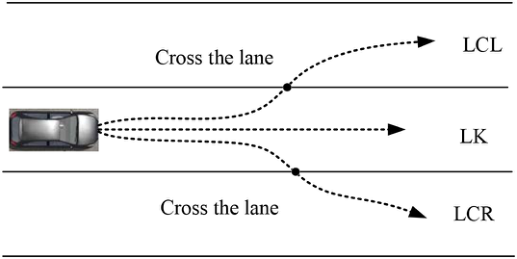
Intention Stage Analysis A lane change is the process of a vehicle traveling from one lane to ano- ther to keep going straight again. As shown in Figure 1. The lane-changing intention stage refers to the time interval from when the driver generates a lane-changing intention to when the driver performs a lane-changing beha- vior. As part of the whole lane change process, the lane change intention stage has two attributes: position and length. Due to the complexity of traffic sce- nes and the diversity of drivers’ driving styles, the lane-changing intention stages of different lane-changing processes are not the same. The common method of intercepting the lane-changing intention stage based on a fixed time window often ignores the diversity of driving styles, and regards all lane-changing samples as the same lane-changing pattern. In response to this problem, Ren Yuanyuan et al. proposed a clustering-based intention stage determination method. The k-means unsupervised clustering method was used to determine the starting and ending points of the lane-changing inten- tion stage based on the time-series change law of steering wheel angle and lane deviation (Ren et al., 2021). Then, the lane change intention phase is intercepted from the complete lane change process.
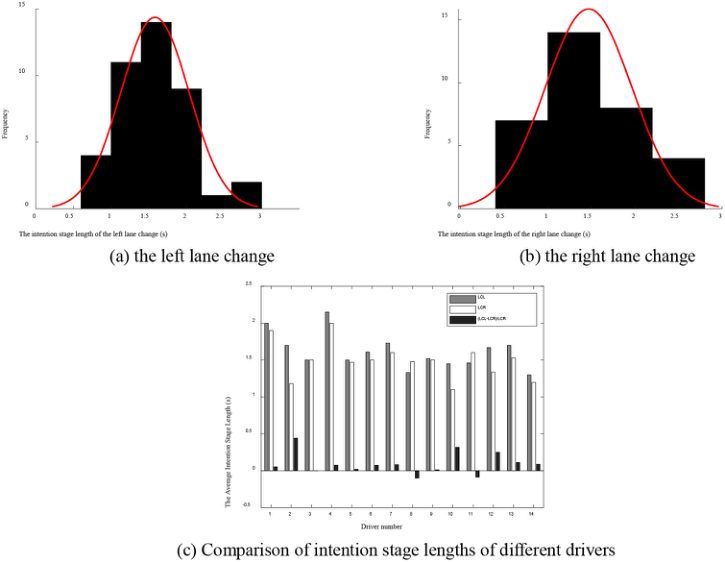
The data of 112 lane-changing training samples of 14 drivers is used to determine the intention stage of each lane-changing sample according to the above-mentioned determination method of lane-changing intention stage. Then we counted the intention stage length of all lane change samples and the average intention stage length of each driver’s left and right lane changes. The results are shown in Figure 2 and Table 3.
Statistical analysis is performed on the lane change intention stage of all samples. The average and standard deviation of the intention stage length are shown in Table 3.
It can be seen from Figure 2(a)-(b) that the length of the left lane-changing intention stage is longer than that of the right lane-changing. Curve fitting is performed, and it is found that the lengths of the left and right lane changes intention stage approximately obey the normal distribution. The length of
Driver Intention Identification Based 353
Figure 2: Statistics of lane change intention stage length.Table 3. Statistics of intention stage length.
Table available in the original PDF paper.
The left lane change intention
The right lane change intention Average Standard deviation
Average Standard deviation The intention stage length 1.6 0.46 1.47 0.50
the left lane-changing intention stage obeys a normal distribution with an average of 1.6 s and a standard deviation of 0.46 s. The length of the right lane-changing intention stage obeys a normal distribution with an average of 1.47 s and a standard deviation of 0.5 s. Figure 2(c) is a comparison of the average lengths of the left and right lane- changing intention stage of 14 drivers. The height of the column on the left is the average length of the driver’s left lane change intention stage. The height of the column on the middle is the average length of the driver’s right lane change intention stage. The height of the column on the right is the difference between the time of the left lane change intention phase and the right lane change intention phase time and the percentage of the latter. It can be seen that the average length of the left lane change intention stage is longer than the average length of the right lane change intention stage. After calculation, the former is 9.52% longer than the latter.
Figure 3: Relationship of the intention stage length and average velocity.
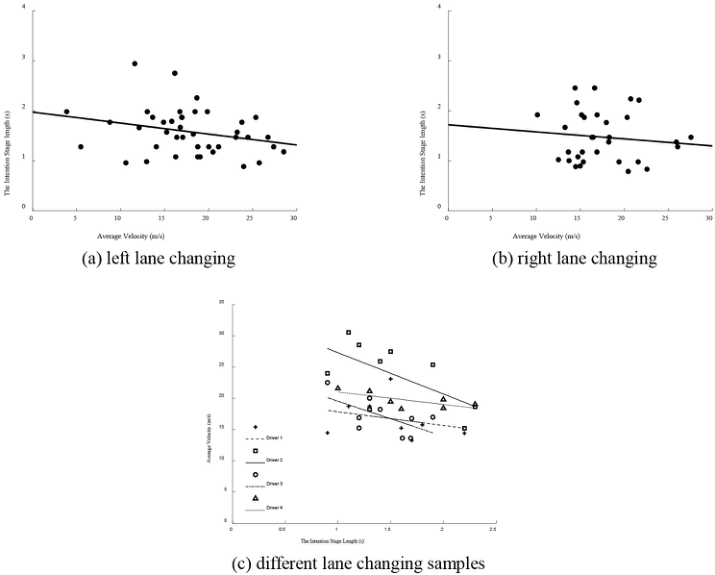
Influencing Factors on Intention Stage Through the analysis of the characteristics of the length of the lane-changing intention stage in the previous section, it can be found that the driver’s left lane-change intention stage takes longer time than that of the right lane- change. To explore the reasons, this section analyzes the influencing factors on the lane-changing intention stage. The relation between vehicle average velocity and the length of intention stage are shown in Figure 3.
(1) Lane-changing direction. It can be seen from Figure 2 that driver’s left lane-changing intention stage takes longer than that of the right lane- changing. In general, the left lane is the fast lane, and the right lane is the slow lane. While the lane-changing behaviors studied in this paper are all free and arbitrary lane-changing, the left lane change behavior can be considered as the vehicle changing lanes to the fast lane in order to reach the desired speed. During this process, the driver needs to acce- lerate in advance, and at the same time judges the feasibility of changing lanes and ensures the safety conditions after the vehicle changes lanes to the fast lane. In addition, the driver will take a longer observation time before changing lanes to the left. These factors together lead to a longer length of the left lane change intention phase than that of the right lane change. Conversely, a right lane change is a change from fast lane to slow lane. The driver does not need to accelerate in advance. The speed
Driver Intention Identification Based 355
of the vehicle is relatively slow. The driver’s observation time is short. These factors together lead to a shorter length of the right lane change intention phase than that of the left lane change. (2) Vehicle average velocity. Figure 3(a) and Figure 3(b) show the relation- ship between the average velocity and the length of lane change intention stage. The Figure 3(c) shows the relationship between the length of the lane-changing intention phase of a single driver and the average velocity. Only four samples are listed here. It can be seen from Figure 3(a)-(b) that the length of the intention stage decreases approximately linearly when the average velocity increases. When the velocity is low, the distribution of the length of the intention stage is more scattered, the value is high and the span is large. When the velocity increases, the distribution of the length of the intention stage is more concentrated, the value is low and the span is small. This shows that the lane-changing intention stage of high velocity vehicles is shorter than that of low velocity vehicles.
THE INTENTION IDENTIFICATION MODEL Model Design
The lane changing behavior has a strong temporal sequence property. The current state only depends on the previous one. Therefore, the model cho- oses a left-right chain Hidden Markov structure. Steering wheel angle, yaw acceleration and lane offset are used as the intention representation varia- bles to train the left lane change intention identification model (LCL), the right lane change intention identification model (LCR), and the lane keeping identification model (LK).
A complete CHMM (Continuous Hidden Markov Model) model can be represented by a 7-tuple, λc = {N, M, π, A, Cjm, µjm, 6jm}. Among them π, and A take random values under the condition that the left-right chain is satisfied. The parameters Cjm, µjm, 6jm of the Gaussian probability density function are assigned initial values by the K-means clustering method. N and M are defined as follows:
In the lane-changing intention identification model, the lane-changing behavior is divided into two stages: the formation stage of the lane- changing intention and the implementation stage of the lane-changing intention. So, the number of states N is equal to 2.
M represents the number of Gaussian probability density functions. The time series can be obtained by fitting M Gaussian probability density functions. According to the Gaussian density function fitting analysis of the time series samples, the M values of the three models are 2, 3, and 2, respectively.
Model Training The optimal parameter group λc = {N, M, π, A, Cjm, µjm, 6jm} can be obtained by separately training the three recognition models based on their respective training database data.
Table 4. Sample numbers for each identification model.
LCL LCR LK number of validation samples 21 17 23 number of accurate predictions 19 15 21 accuracy 90.5% 88.2% 91.3%
The training sample set is a three-dimensional time series consisting of steering wheel angle (Str), Lane offset (Lf) and yaw acceleration (Ayaw).
O(t) = {str(t); Lf(t); Ayaw(t)} (1) The number of training, validation and real-time testing samples for each intention identification model is shown in Table 4.
Based on the HMM toolbox to write a script program, the 3-fold cross sampling method is used to train the model. Some parameters of the trained model are shown in Table 5.
MODEL EVALUATION Identification Accuracy
The recognition accuracy of the verification samples is shown in Table 6.
Driver Intention Identification Based 357
Figure 4: Schematic diagram of lane change intention identification.Figure 5: The advanced time of lane change intention identification.
The Real-Time Performance In actual driving, the driver’s intention is a continuously changing process. In addition to the prediction accuracy, the real-time nature of the prediction is also an important factor affecting the practical application of the identifica- tion model. In this paper, the sliding window method is used to evaluate the real-time performance of the intention identification model.
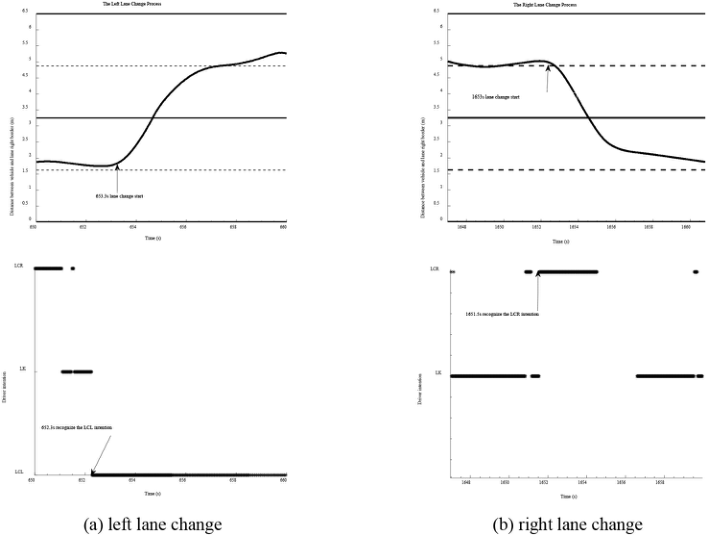
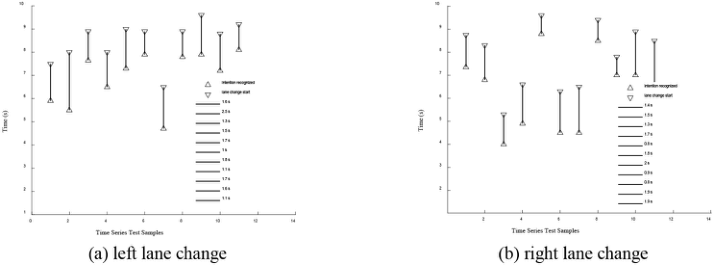
11 left and right lane change are selected as the real-time testing samples. Figure 4 shows the results of using the sliding window method to identify lane-changing intention for a single test sample. The lane change start point in the trajectory graph is the end point of the intention stage obtained by K-means clustering.
The identification results of the 11 test samples are shown in Figure 5. The inverted triangle indicates the start time of the lane change. The positive tri- angle corresponds to the moment when the intention is correctly identified. The length of the line between the two points is the time advance of intention recognition. The length of the line between the two points is the time advance of intention recognition. The average advanced time of left lane change inten- tion recognition is 1.5s, and the average advanced time of right lane change intention recognition is 1.4 s.
CONCLUSION
The paper proposed an intention recognition method based on vehicle dri- ving state and driver behavior interaction. First, the left and right lane change and lane keeping samples are obtained by the driving simulator. Second, given the consideration that the lane changing process is greatly affected by the driving style, analysis on the lane changing intention stage is carried out and influencing factors on intention stage length is obtained. Finally, a Gauss-Hidden Markov Model for lane-changing intention identification is established. The evaluation results show that the model has high intention recognition accuracy and long prediction time advance. The average offline recognition accuracy is higher than 90%, and the driver’s lane-changing intention can be judged 1.5 s before the start of the left lane change and 1.4 s before the start of the right lane change.
REFERENCES
Doshi A. and Trivedi M. M. (2009) On the Roles of Eye Gaze and Head Dynamics in Predicting Driver’s Intent to Change Lanes[J]. IEEE Transactions on Intelligent Transportation Systems, 10(3):453–462. Feng J. (2018) Research on Driving Characteristics of Lane-changing Vehicle Based
on Driver Behavior[D]. Wuhan University of Technology. Ma Y., Fu R., Guo Y.-S., et al. (2014) Multi-Parameter Prediction of Driver’s Lane Change Behavior Based on Real-World Driving Tests[J]. Journal of Chang’an University (Natural science), 34(005):101–108. Peng J.-S., Fu R., Guo Y.-S., et al. (2013) Lane Change Intent Identification Based
on Driver’s Visual Characteristics[J]. Journal of Wuhan University of Technology, 35(3):73–79. Ren Y. et al., (2021) “Lane Change Intention Parameter Selection and Intention Stage Determination on the Highway,” Journal of Hunan University (Natural Sciences)., vol. 48, pp. 10–20, doi: 10.16339/j.cnki.hdxbzkb.2021.02.002. Xing Y., Chen L.V., Cao D.-P. (2020) An Ensemble Deep Learning Approach for Dri-
ver Lane Change Intention Inference[J]. Transportation Research Part C Emerging Technologies. Yuan W., Fu R., Guo Y.-S., et al. (2013) Driver’s Lane Changing Intention Identification Based on Visual Characteristics[J]. China Journal of Highway and Transport, (04):136–142. Zhong L.-D., Rong J., Sun X.-D. (2006) Discussion of Lane Width of Elevated
Read this individual research paper free through the original publisher, or explore the full digital proceedings book.
ISBN 978-1-958651-36-0
Explore this ISBN in the AHFE Bookstore ↗Listed in the July 2026 bookstore catalogue; search by ISBN to confirm current availability · Digital book purchase optional